

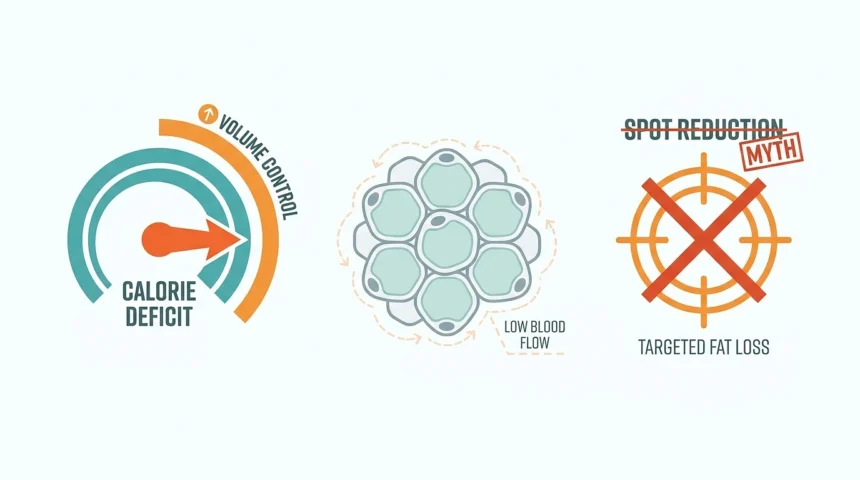
Upper body fat, the kind that settles across the lower belly, the flanks, and the chest, usually clears last because those pockets are governed by receptor chemistry, blood supply, and hormones your calorie deficit never touches directly. A deficit sets how much fat you lose. It gets no vote on the order that fat leaves. That gap between what a deficit controls and what it can’t explains almost every frustrating plateau where the scale keeps dropping but the mirror seems stuck on the same soft midsection.
Fat Leaves The Whole Body, Never One Patch At A Time
The first thing worth accepting is that you cannot aim fat loss. When you are in a deficit, your body pulls from a shared reserve spread across every fat cell you own, and it draws that reserve down unevenly. What looks like “the belly won’t move” is really the belly emptying more slowly than your face, arms, and legs.
The research on this is unusually clean. A 2021 review of 13 trials with more than 1,100 participants found that training a specific body part did not reduce the fat sitting on top of it. People who did hundreds of crunches lost no more abdominal fat than people who trained other muscles entirely. The definition you eventually see over a worked muscle comes from the muscle growing underneath, not from fat vacating that zone on command.
Some Fat Cells Are Built To Resist
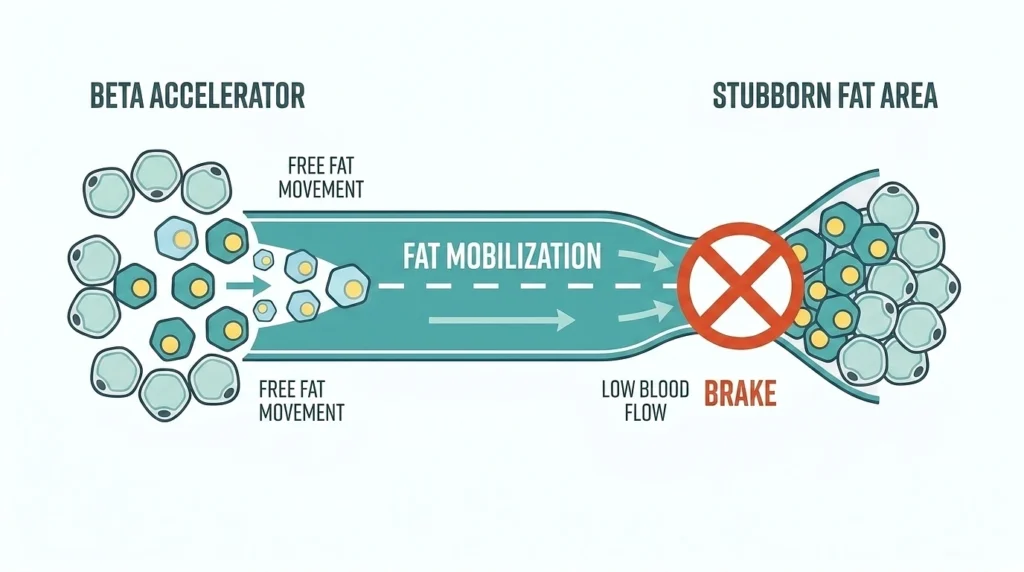
Every fat cell carries tiny switches called adrenergic receptors, and two of them decide how easily that cell gives up its contents.
- Beta receptors speed fat release and widen blood flow to the area. Think of them as the accelerator.
- Alpha-2 receptors slow fat release and choke blood flow. They are the brake.
Stubborn depots carry a high ratio of alpha-2 brakes to beta accelerators. When your body sends out the hormones that should unlock a fat cell, these regions barely respond. Microdialysis studies that measure fat release inside living human tissue show alpha-2 activity actively suppressing lipid mobilization and local blood flow in exactly the depots people complain about most.
Blood flow is the second strike. Even on the occasions a stubborn cell does release its fat, that fat has to be carried away in the bloodstream to get burned elsewhere. Poorly perfused tissue, like the lower belly and love handles, moves that traffic slowly. Research measuring fat release during exercise in subcutaneous tissue confirms these regions sit at a circulatory disadvantage. Low release plus low transport is why the last inch feels welded on.
Hormones Draw The Map Of Where Fat Parks And Where It Leaves
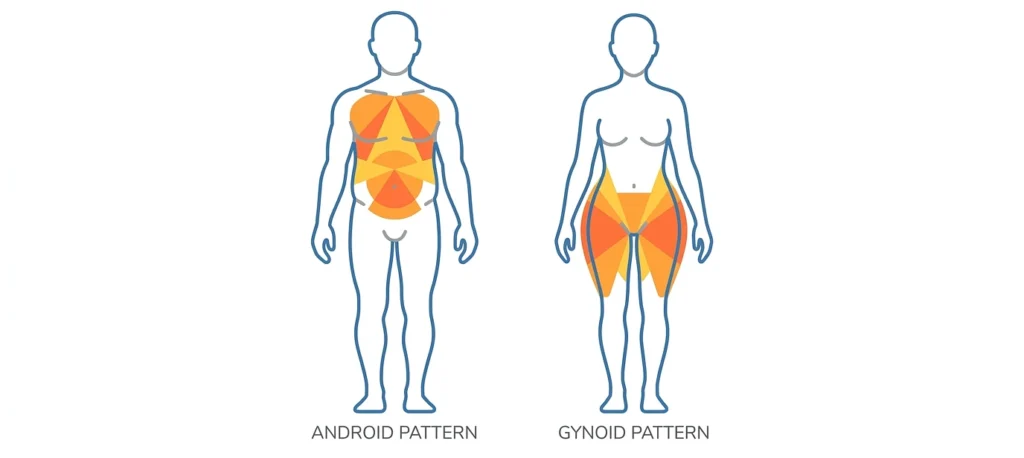
Testosterone tends to push fat toward the abdomen and trunk, the pattern often called android storage. Estrogen tends to route fat toward the hips, thighs, and buttocks, the gynoid pattern. Data from a national sample of more than 6,600 adults tracked these links directly: in men, higher testosterone lined up with lower fat mass and a lower trunk-to-hip fat ratio, while estradiol trended the opposite way.
This is why “upper body goes last” rings truer for many men than for many women. A large share of men watch their limbs and face lean out while the lower belly and flanks hold on until the very end. Many women find the reverse, with hips and thighs as the final holdout, though the lower belly is a common stubborn zone across the board. The pattern is not fixed for life either. As estrogen falls with age, women’s fat storage drifts toward the android, upper-body pattern, which shifts where the stubborn fat lands. The receptor chemistry underneath is identical. Hormones just decide which region draws the short straw.
What Your Deficit Controls, And What It Doesn’t
Your calorie deficit does control one thing that matters enormously: the total amount of body fat you lose over weeks and months. Energy balance is the engine. Without a genuine deficit, none of the fat leaves, stubborn or not.
Your deficit does not control the sequence fat leaves in, the receptor density of any given region, the blood supply to that tissue, or the hormonal blueprint deciding where fat clings hardest. No macro split, meal timing, or clever exercise reorders that queue. The deficit is a volume dial, not a targeting system.
Once that lands, stubborn upper body fat stops feeling like a personal failure and starts looking like what it is: the last withdrawal from an account your body was always going to empty in its own order.
The Deficit That Quietly Stops Being A Deficit
When people lose weight, total daily energy burn falls by roughly 15 percent after about a 10 percent loss in body weight, and close to 40 percent of that drop goes beyond what the smaller body alone would predict. The body becomes genuinely more efficient. Part of this shows up as fidgeting less, taking fewer spontaneous steps, and moving with less unconscious energy across the day. That slack can erase a carefully planned deficit before you ever register it on a tracking app.
This adaptation is stubborn in its own right. Follow-up work on people years past major weight loss found their suppressed metabolism persisted long after the diet ended, and studies on low-energy diets link stronger metabolic adaptation to slower fat loss. The cruel timing is that this efficiency peaks right when you are leanest, which is precisely when only the stubborn upper body fat is left. The plateau and the last inch tend to arrive together.
What Actually Shifts The Fat That Clings
Getting leaner overall is still the only lever that empties a stubborn depot, so the work is protecting a real deficit long enough for your body to reach into those alpha-2-heavy, low-flow regions. That means checking whether your intake has crept up or your steps have quietly dropped, since adaptation hides in both. It means keeping protein high and training with resistance, which preserves the muscle and metabolic rate that keep your maintenance calories from collapsing under you. Periodic breaks at maintenance can ease the metabolic slowdown that makes late-stage fat loss grind to a halt. Sleep and stress belong on the list too, because elevated cortisol nudges fat toward the abdomen and works against you in the exact zone you want to clear.
What will not help is any product or exercise sold on the promise of melting fat from one spot. The same University of Sydney reviewers who dismantled spot reduction also examined more than 120 trials of weight-loss supplements and found none delivered a meaningful reduction. The fat that goes last responds to patience and a protected deficit, and to almost nothing else. Understanding why it resists is what makes staying the course feel less like failure and more like waiting out a process that was always going to end this way.