

Key Takeaways
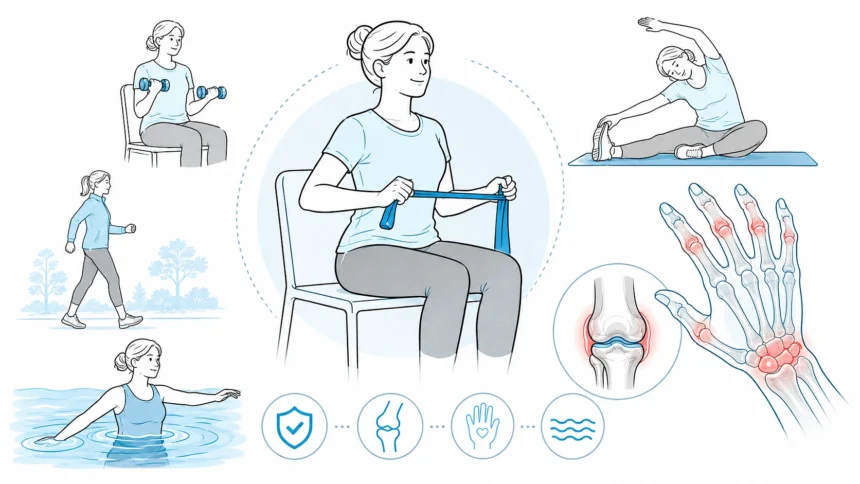
- Exercise doesn’t damage RA joints. Research on people with stable RA shows aerobic exercise is safe and improves aerobic capacity, and resistance training is recommended alongside it.
- A flare changes the rules completely. Overusing an actively inflamed joint can aggravate the arthritis and increase joint damage.
- Read the joint, not the calendar. One swollen knee doesn’t ground your whole body.
- Grip is where the hidden damage happens. Load through a knuckle joint during grip reaches several times the force you apply, and RA-thinned cartilage handles that badly.
- Half an hour is your test. Aching after exercise is fine if it settles inside thirty minutes. Longer means halve the session, not quit it.
- Hands decline fast. Women with RA average only 40% of normal power and pinch grip within six months of diagnosis, even on early DMARD treatment.
- Water cuts the load to a quarter. Neck-deep immersion leaves you bearing about 25% of your body weight.
- Housework doesn’t count. Tiring is not the same as therapeutic.
Why Every RA Exercise List Falls Short
Search rheumatoid arthritis exercises and the same seven things come back. Wrist bends. Finger curls. Shoulder rolls. Ankle circles. Something about walking.
None of it is wrong. All of it skips the part that decides everything, which is what your joints are doing right now. Exercise is Medicine puts it plainly: symptoms vary from day to day, and sudden increases called flares are common and can last days or months.
A fixed list can’t handle that. Osteoarthritis is mechanical wear, so its advice can stay constant. RA is autoimmune. The joint lining inflames, the capsule thickens and swells during flares, and the disease breaks down cartilage and bone as it progresses. Loading a joint mid-flare is a different act from loading it in remission, even when the movement looks the same from outside.
What follows isn’t seven exercises. It’s the logic for choosing which ones belong in today.
First, Read The Joint
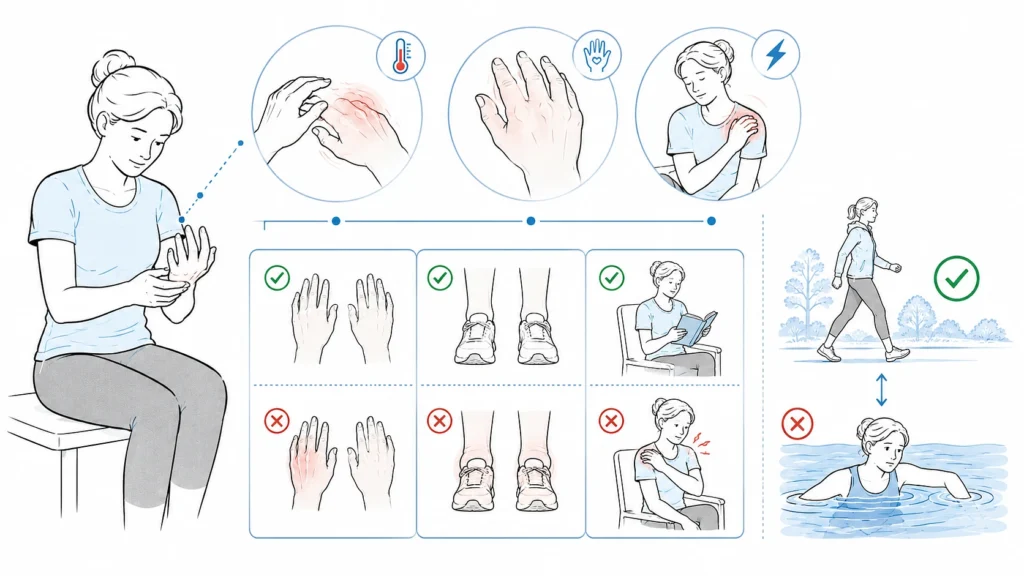
Check each joint you plan to load. You’re looking for three signs:
- Warmth. Touch it, compare it to the other side.
- Swelling. Visible puffiness, or rings and shoes fitting differently.
- Pain at rest. Not pain when you move. Pain when you’re doing nothing.
All three together means an acute inflammatory state. Clinical guidance defines a flare by warmth, swelling and elevated acute-phase reactants, and during one, passive rest and splinting take priority over active exercise.
None of the three means that joint is ready for strengthening work.Assess joint by joint, never as a whole-body verdict. RheumInfo spells out the substitution: if hands, wrists or shoulders hurt, walk rather than swim. Swap the activity instead of cancelling it.
Exercising Through A Flare
People get this backwards. A flare doesn’t mean stop moving. It means move differently.
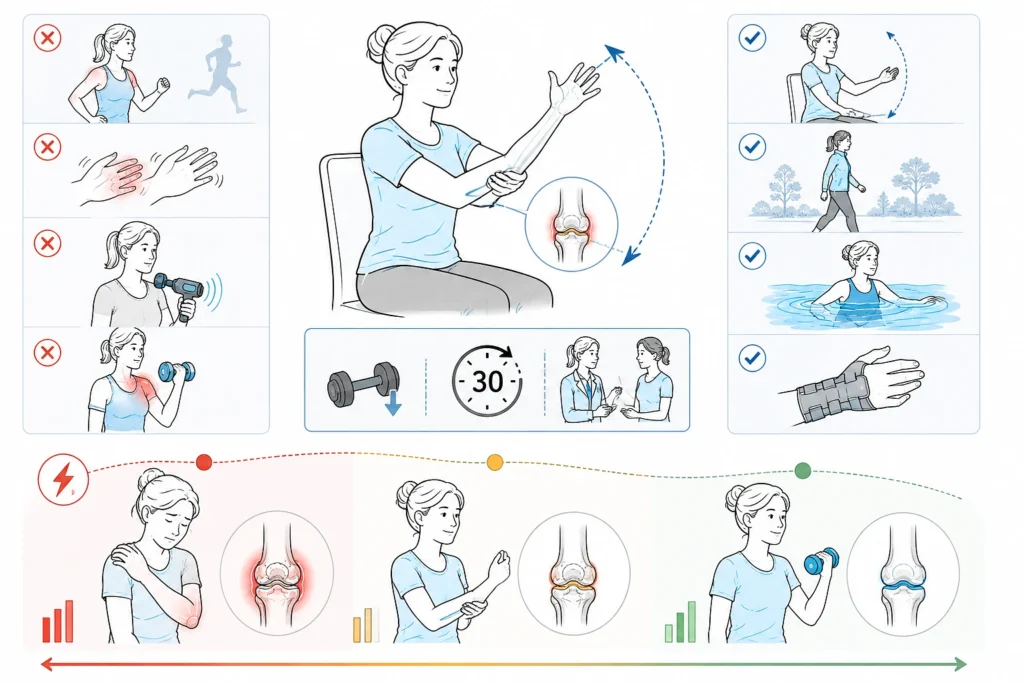
The dose is specific. Rheumatology physiotherapy guidance says that acutely flared joints need rest, and that you take them through their full range just once a day. Once. No repetitions, no resistance, no session. A single controlled pass so the joint doesn’t stiffen into a permanently smaller arc.
That one movement matters more than it sounds. Immobility during a flare is exactly how range of motion gets lost for good.
What stops
- Vigorous exercise during acute flares or inflammation, swapped for gentle stretching.
- Rapid or repetitive movement of affected joints.
- Anything percussive.
- Strengthening work through the inflamed joint.
What continues
- Daily active range of motion, working up to pain but not into it.
- Everything for the joints that aren’t flaring.
- Water-based work.
- Splints or braces on the affected joint.
If a strengthening exercise hurts, drop the weight or the reps. If the pain sticks around after that, pull the exercise out of your programme and raise it with your physiotherapist.
Mayo Clinic recommends asking your own team what to do during flares specifically, since the answer might be range-of-motion work only, or moving into water.
Flares aren’t one flat state
A flare has three stages, and your programme should follow the arc rather than sitting still through it.
As things settle, expect to come back below your pre-flare level. Trying to pick up where you left off is the single most reliable way to trigger the next flare.
Hands Need Their Own Rules
Hand joints in RA are a different problem from knees and hips. The reason is leverage.
In a healthy metacarpophalangeal joint, grip load reaches multiples of the applied force because of lever-arm geometry. Squeeze with ten units of force and the joint sees considerably more. RA makes that worse: synovial inflammation reduces cartilage thickness and ligament integrity, so identical forces become disproportionately damaging.
The numbers on decline are hard to ignore. Physiopedia’s review of the evidence reports that 60% of RA patients lose functional ability within five years of diagnosis, half struggle with household tasks within two years, and women deteriorate faster than men. The grip figure is the one that should change behaviour: women average only 40% of normal power and pinch grip six months after diagnosis, even when DMARDs started early.
Protection isn’t rest
Here’s where people get confused. Joint protection means maintaining functional ability by adapting how you work and move, sometimes with splints or pacing. Changing those habits reduces pain, inflammation and stress on the joint during daily activity, and may preserve joint structures long term.
Climb the joint ladder. Instead of fingers, use the wrist. Instead of the wrist, the elbow. Instead of the elbow, the shoulder. Lifting a bag off a counter means bending your knees, hugging it with both arms, and straightening up with elbows bent.
Loosen your grip. Use a relaxed hold and enlarge handles where you can. Open jars by putting your palm flat on the lid and turning your arm at the shoulder, using body weight, with a damp cloth underneath to stop the jar sliding. Hold a knife or mixing spoon like a dagger, handle parallel to your knuckles, which converts cutting from sawing into pulling. Don’t carry bags or buckets by the handle. Hold nothing tighter than the task requires, and release a tight grasp often when you can’t avoid one.
Keep weight off your knuckles. Loading the backs of your fingers happens more than you’d think: pushing up from a chair with a closed fist, resting your chin on the backs of your fingers. Use palms with fingers straight instead.
Guard the thumb. It’s needed for 40% of hand activities, so keep pressure off the tip and pad. Open milk containers with the heels of your hands.
Respect pain without fearing it. Fear of pain produces inactivity, which costs you motion and strength. Ignoring pain produces bad movement patterns, which increases pain. Stop before you reach discomfort, and treat anything causing pain more than an hour after you stop as too much.
Fix your keyboard. Wrist extension beyond 15 degrees during typing measurably raises carpal tunnel pressure and MCP joint load. Keyboard tray height and split-keyboard designs address it directly.
One thing about splints: time out of the brace matters too, so you keep full range of motion.
The Stairs Rule
Small, specific, immediately useful if knees or hips are involved.
Lead with the good limb going up. Lead with the affected limb going down. This lowers peak joint reaction force and gets taught as standard in rheumatology rehabilitation.
Up with the good, down with the bad. You’ll use it a dozen times a day.
Timing Beats Effort
Stiffness peaks after overnight rest, which makes early morning both the worst window for demanding activity and the one people most often pick.
Warm up before demanding tasks. A structured 10 to 15 minutes of gentle range-of-motion work before morning activity is clinically documented to reduce injury risk.
Build around your own pattern. Exercise when your pain is lowest and when your medication is working best. Exercise is uncomfortable for roughly 85% of people with RA, so choosing the good window isn’t avoidance.
Daily tasks follow the same logic. Plan work for when you’re at your best. Break jobs into little and often. Mix heavy with light. Rest before you’re tired rather than after.
How To Tell You Pushed Too Hard
The clearest rule in RA rehabilitation, worth memorising word for word:
Exercise should not be painful. You may ache a little afterwards, but it should settle in less than half an hour. If it takes longer, you have overdone it. Cut the exercises by half, but don’t stop altogether.
That last clause is doing the heavy lifting. The correct response to overdoing it is reduction, not abandonment. All-or-nothing thinking, where a bad session leads to two weeks off and then an ambitious comeback, is the engine driving the flare-and-deconditioning cycle.
Mayo Clinic says the same in broader terms: pain that worsens or persists after exercise means you're pushing too hard, and the answer is shorter or less frequent sessions.Building the Real Programme
Range of motion, every day
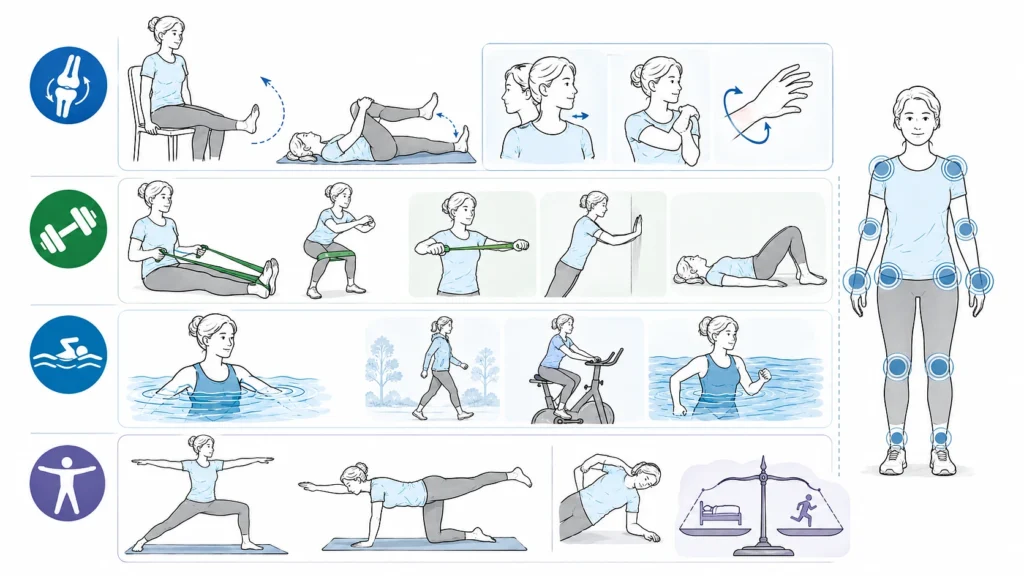
The foundation everything else sits on. Take affected joints through as full a range as pain allows. Loss of range and strength leads directly to loss of function, which is why this comes before anything else.
Strengthening, two or three times a week
Resistance exercise is recommended for RA, with stretching and warm-up treated as essential rather than optional. The case for it is straightforward: people with RA already have reduced muscle strength and joint function.
Resistance bands and bodyweight work beat free weights early on, because bands don’t demand sustained grip in the same way. For hands, work with a therapist instead of improvising. The leverage problem makes wrong choices costly.
Aerobic work, built slowly
Aerobic exercise is safe in stable RA and improves aerobic capacity. Start with three 10-minute sessions and set goals by time rather than intensity or distance.
Water deserves special mention. Exercising in water reduces joint stress while improving cardiovascular fitness, and going in to neck depth means bearing about a quarter of your body weight. For anyone with significant knee, hip or ankle involvement it’s the most forgiving option available.
The exception holds: if hands, wrists or shoulders are the problem, swimming loads exactly the wrong joints.
The whole body, not just the sore parts
Johns Hopkins makes this point directly. Exercise should target the entire body, not only the arthritic joints. It’s easy to build a programme entirely around problem areas and end up deconditioned everywhere else.
Their framing of the balance is worth keeping. Rest matters, particularly during flares, but inactivity brings muscle weakness, joint stiffness, reduced range of motion, fatigue and general deconditioning. Current recommendations sit between the two rather than at either end.
What Quietly Wrecks Most Programmes
Housework, however tiring, does not count as exercise.
Pedantic-sounding, and true. RA fatigue is real, and after a day of household tasks the sense of having done enough physical work is honest. But the movement patterns are wrong, the loading is often exactly what joint protection tries to prevent, and none of it builds capacity.
The companion trap is catch-up thinking. Rehabilitation guidance names the exact thought: it doesn’t matter if I skip today, I’ll do twice as much tomorrow. Doubling a session is how flares start. Low-level consistency beats bursts every time.
Questions Worth Bringing to Your Next Appointment
General advice takes you so far. These get you a plan built for your disease:
- What exactly should I do during a flare? Range of motion only, water, something else?
- Which strengthening exercises suit me when joints are inflamed?
- Should I be splinting during activity, and which joints?
- How do I distinguish normal post-exercise ache from a warning sign?
Occupational therapy and physical therapy deliver most formal joint protection instruction, so ask for that referral by name rather than waiting for it to come up.
One finding worth knowing before you go: handing patients an information booklet doesn’t work on its own. Behavioural approaches are significantly more effective at getting joint protection actually used, and they work for early and established RA alike. Ask for the programme, not the pamphlet.