

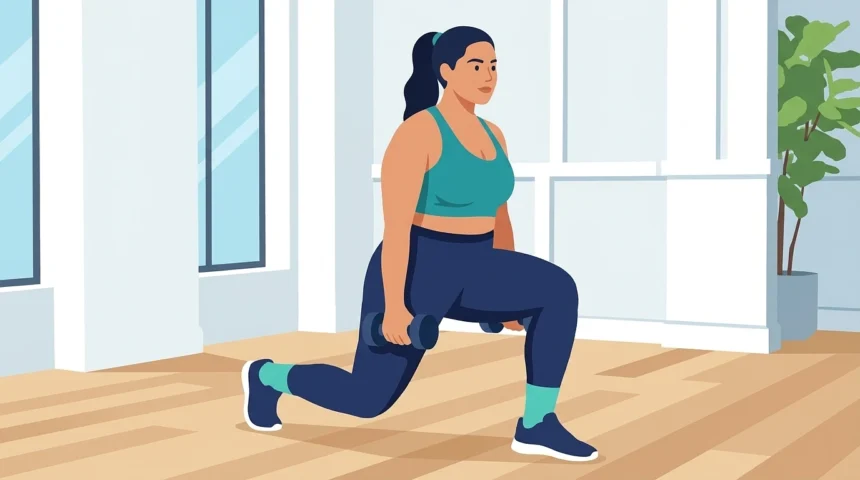
Lung cancer changes what limits your training, usually shifting the ceiling from your muscles to your breathing. The fix is not doing less of what you did before, it is swapping to movements that deliver the same benefit at a lower ventilation cost. Incline walking instead of running, higher reps instead of heavy lifts, water walking instead of laps, short bouts instead of long sessions. Clear any of it with your oncology team first, because blood counts, surgical sites, and bone involvement all change what is safe.
Most exercise advice written for lung cancer starts from zero. It assumes you arrive as a blank slate, ready to be told that walking is good and that chair yoga exists.
Work Out What Actually Changed
Lung cancer is not the constraint. It is the reason for the constraint, which is a different question, and the swaps only make sense once you know which one you are working around.
- Breathlessness during exertion means ventilation demand outruns supply. You stop before your legs do. The limiter has moved. It used to be muscular or cardiac, now it is respiratory, and training that ignores the move keeps you hitting the same wall in the same place.
- Reduced capacity after surgery is a different situation. A lobectomy removes tissue permanently. Function recovers, the remaining lung compensates, conditioning improves, but the ceiling is genuinely lower than it was. That is adaptation, not a detour.
- Treatment fatigue behaves like nothing else. It does not respond to rest the way ordinary tiredness does, and it swings across a cycle, so what you managed on day four tells you very little about day twelve.
- Deconditioning from weeks of doing less sits on top of all of it. This one is the most reversible, and it is usually a larger share of the problem than people expect by the time they go looking for advice.
Most people have some mix of the four. One tends to dominate, though, and the dominant one decides whether you are building a bridge back or building something new.
| Skip or modify | Safer alternative | Why the swap works |
|---|---|---|
| Heavy lifting at near-maximal effort | Lighter load, higher reps, continuous breathing | Removes the breath-hold against a closed glottis while keeping muscle under enough tension to hold strength and lean mass |
| High-intensity cardio such as running or intense aerobics | Interval walking, incline walking, gentle stationary cycling | Shifts cardiovascular load onto the legs rather than the lungs, so you reach a useful heart rate at a lower breathing rate |
| Continuous long sessions | Short bouts accumulated across the day | Lets you build real volume at a sustainable intensity, and lets you add or drop bouts as fatigue shifts |
| Lap swimming, particularly freestyle | Water walking and vertical resistance work | Keeps the joint support and resistance of immersion without a stroke rhythm dictating when you breathe |
| Rigid or strenuous yoga flows | Chair yoga, tai chi, qigong | Opens the chest and improves posture at a pace that lets breathing stay under your control |
| Crunches and sit-ups | Gentle trunk work without breath-holding, alongside separate diaphragmatic breathing practice | Trunk strength and breathing efficiency are two different goals, and neither one substitutes for the other |
Running Becomes Incline Walking

Running buys cardiovascular load with ventilation. That trade is fine when breathing is free. When it is not, you cap out on air before accumulating any real aerobic work, and you finish the session having pushed hard and trained very little.
Incline walking splits the two apart. Walking uphill loads the cardiovascular system through resistance rather than speed, so you reach a useful heart rate at a much lower breathing rate. The legs take on the work the lungs were doing.
- Set the treadmill grade high and the speed low.
- Let the incline determine the effort, not the pace.
- Outdoors, find a hill and walk it slowly.
- Watch for the pull to speed up, because speeding up is running again and it undoes the point.
Heavy Lifting Becomes Higher-Rep, Lower-Load Work
A heavy low-rep set involves holding your breath against a closed glottis. The Valsalva manoeuvre is what makes a heavy squat possible, and it is exactly what you want to avoid with compromised respiratory function or a healing surgical site.
Drop the load, raise the reps, and breathe throughout. Exhale on the effort, inhale on the return. Treat a broken rhythm as the signal that the weight is still too high rather than something to push through.
The right load is the one where breathing stays continuous and controlled, which is a different question for every reader. Someone six weeks post-surgery and someone mid-chemo who lifted regularly beforehand will land in very different places, and a fixed number in a table would mislead both of them.
This matters more than it reads on the page. Muscle mass during cancer treatment is not a cosmetic concern. It is tied to treatment tolerance and functional independence and how well the whole process goes. People who stop lifting entirely because they cannot lift the way they used to give up something that is genuinely difficult to recover afterwards.
Swimming Becomes Water Walking
Swimming is an odd case, because the water helps and the stroke does not. Immersion is kind to the joints and the hydrostatic pressure is often comfortable. Freestyle, though, imposes a fixed breathing pattern, and rhythmic breath restriction is a strange thing to add when breathing is already the limiting factor.
Water walking and vertical resistance work keep the immersion and lose the pattern:
- Breathe whenever you want, with no stroke rhythm dictating it.
- Water still provides resistance through the full range.
- Joints stay supported, which matters if you are also deconditioned.
- The aerobic base you were swimming for is still available.
One caution unrelated to lungs. Pool access needs specific clearance during active treatment, particularly around central lines, surgical sites, and neutropenic periods. Ask about it directly rather than assuming a pool is neutral.
Breathing Work Sits Alongside Training, Not Inside It
Diaphragmatic breathing appears on nearly every list of exercises for lung cancer care, usually filed as a substitute for something else. It is not a substitute. It is its own practice, aimed at breathing efficiency and at the sensation of breathlessness rather than at strength or aerobic capacity.
That distinction is worth keeping straight, because it changes when you do it. Breathing work does not replace your trunk training and it does not replace your cardio. It runs in parallel, often on days when nothing else is available, and it addresses a symptom the other work does not touch.If crunches are off the table because of a surgical site or because breath-holding is a problem, the replacement for crunches is gentler trunk work with continuous breathing. The breathing practice is a separate line item.
Long Sessions Become Accumulated Intervals
Break the volume into short bouts with rest between them. Six short efforts scattered across a day can add up to more real training than one attempt at a long session that dies at the eight-minute mark because you ran out of air. During treatment this also handles the fatigue swings, since bouts can be added or dropped as the day allows, which a single long session cannot do.
What The Third Column Is For
The column that carries this whole approach is the one nobody writes. Not what you lost, not what you are doing instead, but what the substitute preserves.
Running to walking is obvious enough that it is not advice. Running to incline walking because incline shifts the load from ventilation to muscular resistance and keeps the cardiovascular stimulus under a respiratory ceiling is a different kind of statement. It tells you why, which means it also tells you when the swap stops being right and what to change when your situation changes.
That reasoning is what lets you build your own swaps instead of waiting for someone else’s list. Once you understand the goal is aerobic load without ventilation cost, you can hold a rowing machine or a cycle ergometer or a flight of stairs up against that standard and judge for yourself.
Temporary Or Permanent
Whether the swap is permanent changes how you should feel about it, and almost nobody gets told which situation they are in.
Treatment fatigue lifts. What you build during it is a bridge, and bridges are meant to be temporary. You will swap back.
Surgical loss is not that. The remaining tissue compensates and conditioning improves a great deal, but the tissue is not returning. Treating it as a detour leaves you waiting on a return that is not scheduled, holding rather than training. The numbers are different now. They are attached to the same body and they respond to work in the same way, and the argument with the old numbers is the part worth dropping first