

Ask anyone what Parkinson’s looks like and they’ll describe a tremor. A hand that shakes when it’s resting. A shuffle. A face that stops doing the small things faces do. That picture isn’t wrong, but it’s a late picture. By the time the tremor shows, the disease has been running for years.
Parkinson’s is a progressive neurological condition. It starts when dopamine-producing cells in a small midbrain region called the substantia nigra begin dying off. Dopamine is what lets the brain fine-tune movement, so as those cells disappear, motor control frays. The circuits running between cortex, basal ganglia and thalamus stop coordinating properly.
The four classic motor signs:
- Resting tremor, usually starting on one side, often in a hand or fingers.
- Rigidity, muscles that stay tight and resist being moved.
- Bradykinesia, movement that gets slow and small (handwriting shrinks, steps shorten).
- Postural instability, balance that fails, usually later in the disease.
Then there’s everything else. The non-motor symptoms get less attention and matter enormously, partly because several of them arrive long before anyone says the word Parkinson’s out loud. Loss of smell. Constipation. Depression and anxiety. Blood pressure that drops on standing. Cognitive changes.
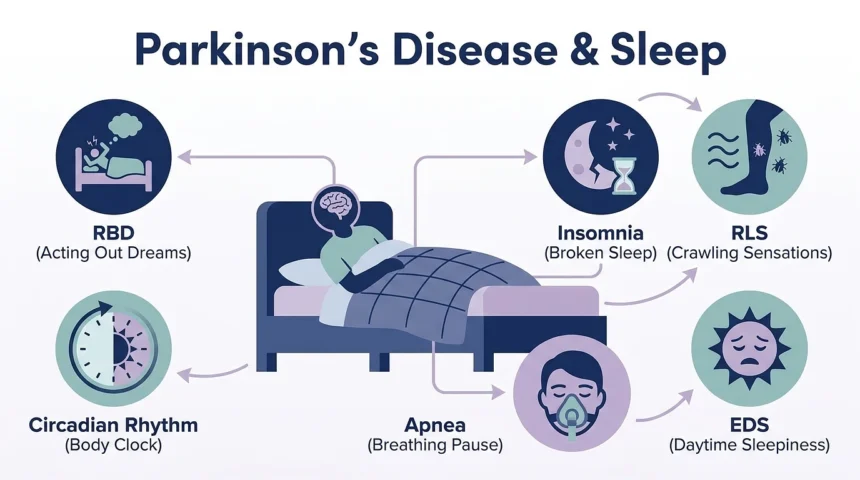
And sleep. Sleep is where this disease tips its hand earliest and holds on longest. According to the Parkinson’s Foundation, sleep challenges affect more than 75% of people with Parkinson’s, and sleep tends to be lighter and more easily broken.
The Six Sleep Disorders, Side By Side:
| Disorder | What it looks like | What drives it |
|---|---|---|
| REM sleep behavior disorder | Acting out dreams: shouting, punching, leaping from bed | Brainstem damage to the REM paralysis switch |
| Insomnia (maintenance type) | Waking repeatedly, rarely trouble falling asleep | Levodopa wearing off, rigidity, bladder, mood |
| Restless legs syndrome | Crawling urge to move the legs at rest, worse in the evening | Dopamine pathways, often low iron |
| Excessive daytime sleepiness | Fighting to stay awake despite enough hours in bed | Loss of wake-promoting neurons, dopamine agonists |
| Obstructive sleep apnea | Snoring, gasping, morning headache, unrefreshing sleep | Airway collapse, usually blamed on Parkinson’s instead |
| Circadian rhythm disruption | Sleep and wake times drifting, weak day-night contrast | Flattened melatonin cycle, too little daylight |
Most patients have more than one. A study of 162 people in the early stages of Parkinson's set out to determine exactly how these disorders combine and interact, because in practice they rarely show up alone.REM Sleep Behavior Disorder: The Symptom That Comes First
What’s actually happening
During REM sleep, when dreaming happens, the only part of the body that normally moves is the eyes. The brain shuts down large-body movement as a protective measure, and that shutdown is generated by a small cluster of neurons in the brainstem.
Parkinson’s damages that cluster early. The Parkinson’s Foundation describes neurodegenerative diseases including Parkinson’s as being linked to the failure of that on-off switch. When it fails, dreams get acted out.
What it looks like in a bedroom
Not subtle. People with RBD may shout, hit or kick their bed partner, or grind their teeth. In moderate to severe cases they may get out of bed and attack the person beside them. Bed partners report being punched, bitten and kicked while the dreamer has no awareness of any of it happening.
Frequency varies wildly, from once a month to several times a night.
Why the timing matters so much
The Parkinson’s Foundation reports that about half of people with Parkinson’s have RBD, and that in most cases it precedes the diagnosis by five to 10 years.
That gap is why researchers watch this so closely. As therapies that might slow Parkinson’s progression develop, there may be a window for preventative intervention in people who have RBD but haven’t yet developed a neurodegenerative disease.
There are cognitive stakes too. RBD appears to be a risk factor for more severe cognitive decline, and a systematic review found that sleep disorders in Parkinson’s were associated with impaired executive function, reduced attention and weaker verbal memory, and could predict the risk of developing dementia.
What it doesn’t mean
Not everyone who thrashes in their sleep is on this path. Sleep apnea and antidepressant use can both produce the same behavior. The version carrying prognostic weight gets confirmed on a polysomnogram, in a lab, where the absence of REM muscle atonia is measured rather than guessed at.
Insomnia in Parkinson’s Runs Backwards From What You’d Expect
Insomnia is the most commonly reported sleep complaint here, and the Parkinson’s Foundation defines it broadly: ongoing trouble falling or staying asleep, or not feeling rested afterward, counts as insomnia regardless of cause.
But ask someone with Parkinson’s about their sleep and they’ll rarely say they can’t fall asleep. Most drop off quickly. Some drop off too quickly. The problem is staying asleep, and the causes stack on top of each other rather than competing. The Foundation is direct about this: these challenges usually have more than one cause, and sleep problems in Parkinson’s are often complex.
Motor symptoms don’t take the night off
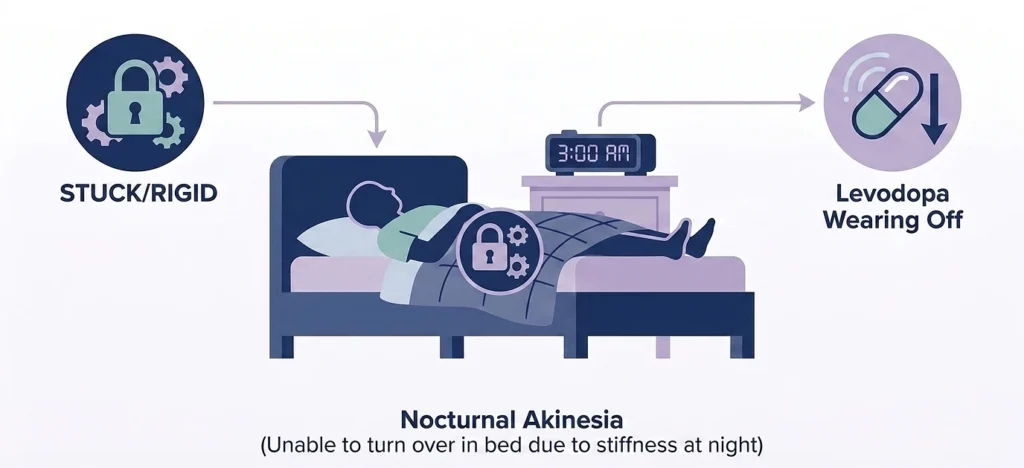
Levodopa has a short half-life. An evening dose fades over a few hours, and somewhere in the small hours rigidity comes back. Turning over in bed, a coordinated sequence most of us never think about, becomes a real physical struggle. People wake up stuck, unable to reposition, unable to reach the bedside table.
Medications or their timing can affect alertness or lead to symptoms returning overnight. This is called nocturnal akinesia and it’s one of the most fixable items on the whole list.
The bladder gets involved
Nocturia is extremely common, and it isn’t about drinking too much water before bed. Bladder urges at night may be related to overactive bladder, lighter sleep, daytime low blood pressure, or a combination.
Each trip means fighting rigidity to get out of bed, then walking on unsteady legs in the dark. A substantial share of nighttime falls happen exactly here.
Mood restructures sleep directly
Depression changes sleep architecture on its own: early morning waking, less slow-wave sleep, shifted REM timing. The connection runs strongly enough that, as the Sleep Foundation notes, doctors often look for mental health disorders in people with Parkinson’s who have sleep problems.
Parasomnias beyond RBD
Later stages and higher medication doses bring other things. Parkinson’s is associated with non-REM parasomnias including confusional arousals, sleep terrors, sleep-related hallucinations and sleepwalking. One questionnaire study found 39% of patients with RBD had coexisting symptoms of other parasomnias, including nightmares in 17.2% and hallucinations in 15.3%.
Vivid dreams and nocturnal hallucinations are a recognised effect of dopaminergic therapy, and a common reason people start dreading bedtime.One thing worth raising with a clinician: cognitive behavioural therapy for insomnia has proven effective in healthy lifestyle adults, though more research is still needed on its effects specifically in Parkinson’s patients. It gets skipped because insomnia here is treated as inevitable rather than as a condition with its own evidence base.
Restless Legs And The Iron Test Nobody Orders
RLS shows up more often in Parkinson’s than in the general population, which tracks given that dopamine sits underneath both.
The sensation is hard to describe and patients struggle to. A crawling, pulling, electric discomfort deep in the legs that appears at rest, gets worse through the evening, and eases only with movement. Strong urges to move the legs at night can make it difficult to get comfortable or fall back asleep, and can delay sleep onset for hours.
The relationship isn’t as tidy as it sounds. The Parkinson’s Foundation is careful here: not everyone with Parkinson’s experiences RLS, and most people who have RLS will never develop Parkinson’s.
Periodic limb movements of sleep are a related but separate problem. Repetitive leg jerks during sleep that the sleeper is usually unaware of. The partner notices. What the patient experiences is unrefreshing sleep and daytime tiredness with no obvious cause.
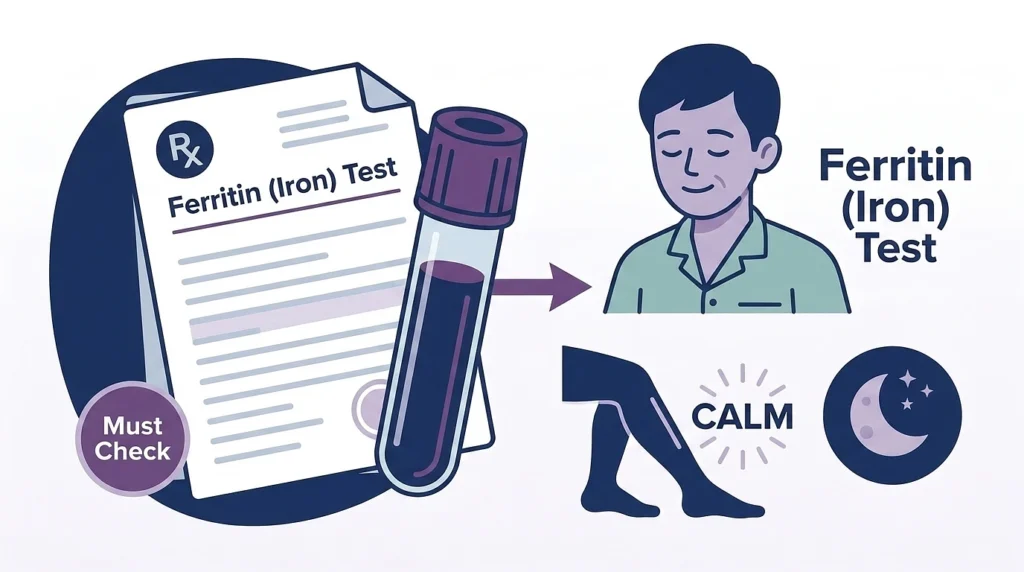
Get ferritin checked before anything else. Low iron stores worsen RLS substantially and correcting them can resolve the symptom outright. It’s a cheap blood test that gets skipped as a matter of routine.
Daytime Sleepiness Isn’t Always About Last Night
Excessive daytime sleepiness affects up to 50% of Parkinson’s patients and has a large impact on quality of life for patients and caregivers alike, in some cases more than the motor symptoms do.
The obvious explanation is that they slept badly, so they’re tired. Sometimes true. Often not.
The mechanism is neurological, not debt
Parkinson’s damages the brain’s wake-promoting systems directly. Two post-mortem studies found that patients with late-stage Parkinson’s have lost 38 to 45% of the hypothalamic neurons producing hypocretin (also called orexin), the neuropeptides that stabilise wakefulness.
That’s the same cell population destroyed in narcolepsy, though the scale is very different. Narcolepsy involves a 90 to 95% loss. Whether the partial loss in Parkinson’s is sufficient to cause the sleepiness on its own remains debated, but the mechanism is real and it isn’t a sleep-debt mechanism.
The practical consequence is sharp. A study of sleepiness and sudden sleep onset concluded that no evidence to date shows increasing sleep quantity or quality improves excessive daytime sleepiness or sudden-onset episodes in Parkinson’s. You can put in nine hours and still be losing the fight at two in the afternoon.
Medication makes it worse
Drug-induced sleepiness is its own problem, since many dopamine agonists used to treat Parkinson’s carry it as an adverse effect.
It’s widely recognised that dopamine agonists can precipitate these somewhat narcoleptic events, sometimes called sleep attacks. Interestingly, total dopaminergic drug dose rather than the specific agonist may be the better predictor of daytime sleepiness.
These episodes have caused car accidents. Regulators require the warning on the label. If sleepiness worsened after a medication change, the medication is the first thing to examine, not the last.
Fatigue and sleepiness are not the same symptom
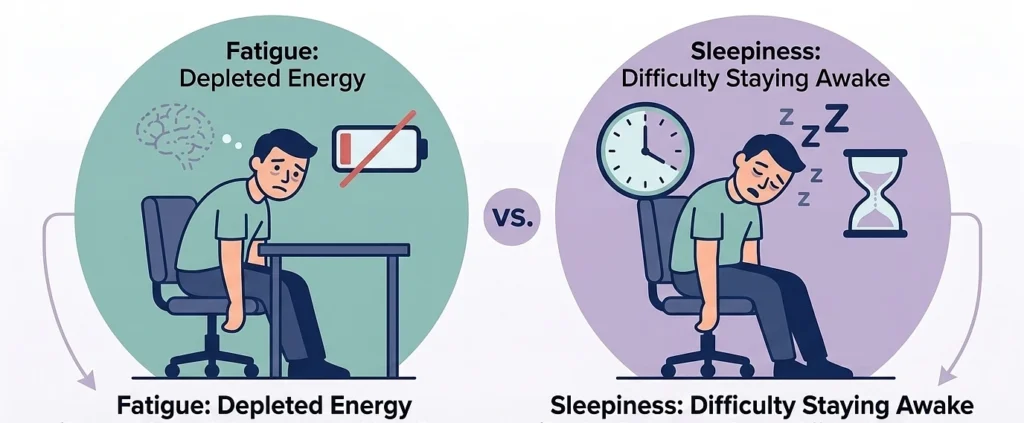
Worth holding onto. Fatigue is depleted energy that persists whether or not you feel sleepy. Sleepiness is difficulty staying awake. Plenty of patients have both. They have different causes and different treatments, and treating one does nothing for the other. Describing them as a single complaint wastes appointments.
Sleep Apnea Keeps Getting Blamed On Parkinson’s
Sleep apnea is a breathing problem that becomes more common with age and disturbs restful sleep. People with obstructive sleep apnea suffer repeated lapses in breathing that disrupt sleep quality, usually with snoring and gasping.
The difficulty is diagnostic, not clinical. Look at the symptom list:
- Snoring and witnessed pauses in breathing.
- Morning headaches.
- Unrefreshing sleep.
- Daytime sleepiness.
Every one of those overlaps with something Parkinson’s produces on its own. So the apnea gets absorbed into the primary diagnosis and never investigated. People spend years being told their exhaustion is neurological when a meaningful share of it is a treatable airway problem.
If snoring or breathing pauses are part of the picture, push for the sleep study specifically.
The Circadian Clock Flattens Out
Melatonin sits at the centre of it. Melatonin is the principal hormone secreted by the pineal gland, it substantially modulates the circadian clock and mood state, and it’s considered a safe treatment for sleep disturbances such as RBD in Parkinson’s.
Lifestyle compounds the biology. Reduced mobility means less time outdoors. Less time outdoors means less bright light reaching the retina. Less light means a weaker circadian signal. Daytime napping fills the gap, and the whole thing reinforces itself.
What comes out the other end is sleep scattered across 24 hours instead of consolidating at night. Different problem from insomnia, even though it looks similar from outside.
What Actually Helps
Sleep advice for Parkinson’s usually arrives as generic hygiene tips that ignore the disease. Some things are more specific and more useful.
The Parkinson’s Foundation’s guidance on sleep starts in the right place talk to your provider about sleep issues, fatigue or daytime sleepiness, and expect a careful review of every medication to determine whether an adjustment or addition might improve things.
Medication timing
- Long-acting levodopa at bedtime. Long-acting levodopa, or an additional dose, is sometimes prescribed for bedtime use to carry motor control further into the night.
- COMT inhibitors. These act on an enzyme affecting how well levodopa works, and can prolong its benefit.
- Move the activating drugs earlier. Selegiline and rasagiline tend to be stimulating and usually get shifted to earlier in the day. Amantadine is stimulating for some people. Anticholinergics affect sleep architecture.
Some of the worst insomnia in Parkinson’s is caused by treatment and fixed by moving a dose four hours earlier. None of this is a self-adjustment; it’s a conversation with a movement disorder specialist.
Making the bedroom safe for RBD
Practical rather than medical help:
- Mattress on the floor, or bed rails
- Padding around hard corners and the bedside table
- Clearing the nightstand of anything breakable
- Moving weapons and sharp objects out of the room entirely
- Partners sleeping separately, in some cases, for their own safety
Clonazepam and melatonin are the standard pharmacological options.
Small things with real returns
Satin sheets. Sounds trivial, isn’t. Less friction makes turning in bed genuinely easier for someone with rigidity. Costs almost nothing and works immediately.
Morning light. Consistent bright light exposure early in the day targets the circadian flattening directly, and it’s one of the few levers acting on both nighttime sleep and daytime alertness.
A ferritin test for anyone with leg symptoms. Cheap, skipped constantly, occasionally transformative.
An apnea screen before assuming Parkinson’s explains the exhaustion.
Key Takeaways
- Sleep disruption in Parkinson’s is six separate disorders, not one problem. RBD, insomnia, restless legs, daytime sleepiness, sleep apnea and circadian disruption each need identifying individually, because each has its own treatment.
- Sleep challenges affect more than 75% of people with Parkinson’s.
- REM sleep behavior disorder affects roughly half of patients and usually precedes diagnosis by five to 10 years. Acting out dreams warrants a sleep study.
- Insomnia here is a maintenance problem, not an onset problem. Falling asleep is usually easy. Staying asleep is where levodopa wearing off, nocturia, rigidity and depression all converge.
- Daytime sleepiness affects up to half of patients and is frequently neurological rather than sleep debt. No evidence currently shows that sleeping more improves it.
- Dopamine agonists can trigger sudden-onset sleep episodes, including while driving, with total dopaminergic dose the likely driver. New or worsening sleepiness should trigger a medication review.
- Sleep apnea is common and routinely missed, because its symptoms are indistinguishable from Parkinson’s symptoms without a sleep study.
- Check ferritin if restless legs are involved. Low iron worsens RLS and correcting it can resolve the symptom.
- Fatigue and sleepiness are different symptoms with different causes and treatments. Describe them separately.
- Several fixes cost almost nothing: satin sheets, morning light, a bedroom set up for safety, and activating medications shifted earlier in the day.