

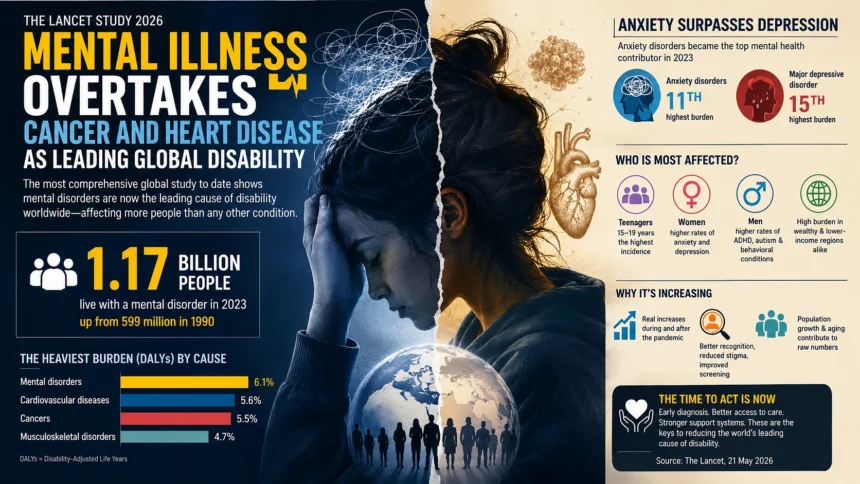
For most of modern medicine, the diseases we feared most were the ones that killed quickly. Heart attacks. Tumors. The conditions that show up on a death certificate. A study published in The Lancet on 21 May 2026 quietly rearranged that hierarchy, and the finding deserves more attention than the news cycle gave it.
Mental illness is now the single biggest reason people on Earth live in a state of disability. Not heart disease. Not cancer. Mental disorders.
The number that anchors the whole study is 1.17 billion. That is roughly one in seven people alive in 2023 carrying a diagnosable mental health condition, a figure that has nearly doubled since 1990. The research came out of the Institute for Health Metrics and Evaluation at the University of Washington, working with the University of Queensland and the Queensland Centre for Mental Health Research, using data from the Global Burden of Disease Study 2023.
What The Study Actually Measured
The word doing the heavy lifting here is disability, and it is easy to misread. The study is not claiming mental illness now kills more people than cancer. It is measuring something different and arguably more honest about how illness affects a life: years lived with disability, the time people spend functioning below full health because of a condition.
By that measure, mental disorders climbed to the top of the list. They account for 6.1 percent of the total global burden of disease, edging past cardiovascular disease, cancer, and musculoskeletal conditions in non-fatal impact.
A few figures worth sitting with:
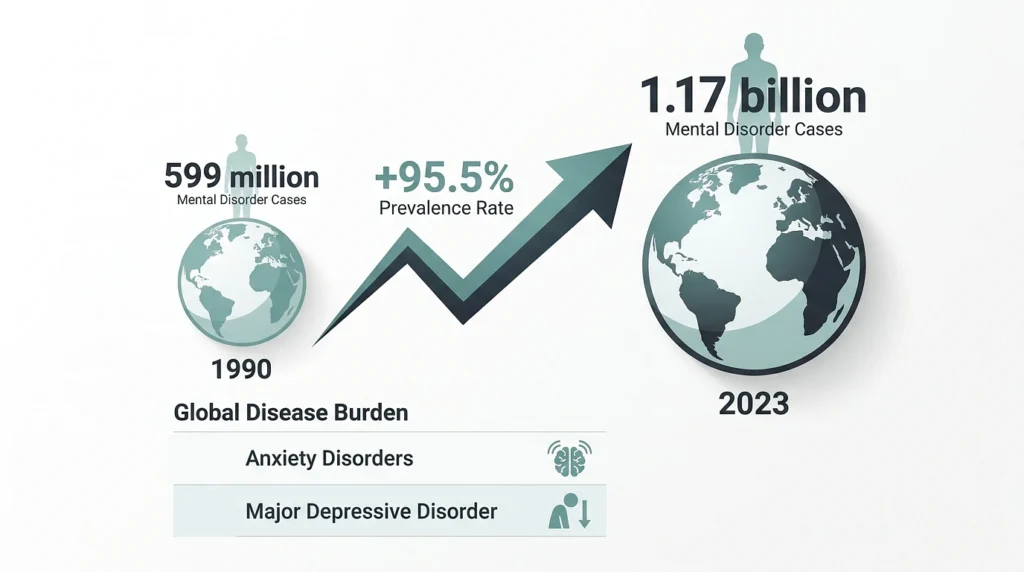
- 1.17 billion people had a mental disorder in 2023, up from 599 million in 1990.
- The age-standardized prevalence rate rose by 95.5 percent across that period, so this is not just a story about more people being born.
- The analysis covered 12 mental disorders across 204 countries and territories, 21 regions, and 25 age groups, which makes it the most detailed snapshot of global mental health assembled to date.
- Among more than 300 ranked diseases and injuries, anxiety disorders landed 11th and major depressive disorder 15th in total burden.
Lead author Dr. Damian Santomauro said he was honestly shocked at the magnitude of the increase. The research team wrote that the trends suggest the world is moving into a more troubling phase of mental health decline, not a plateau.
The Quiet Plot Twist: Anxiety Passed Depressiona
Depression has been the assumed heavyweight of mental illness for decades. That changed in this dataset. Anxiety disorders overtook depression in disease burden for the first time in 2023.
That shift matters for anyone planning care or writing about the topic. Anxiety behaves differently from depression. It often resolves on its own, it tends to start younger, and it responds to a different mix of treatment and prevention. A health system built around treating depression as the default condition is now slightly out of step with where the burden actually sits.
The third-largest contributor was a grouping the researchers call residual personality disorders, the cases that do not fall neatly into the better-known categories. Depression and anxiety still dominate, but the texture underneath the headline is more varied than most coverage admitted.
Who Is Carrying The Heaviest Load
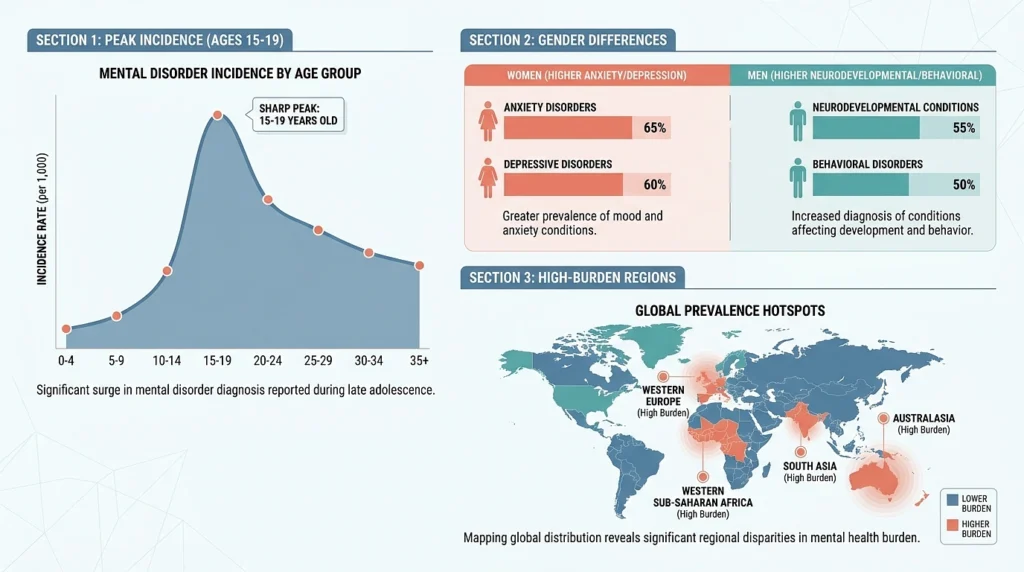
The burden is not spread evenly, and the patterns are specific enough to be useful rather than abstract.
Teenagers, especially ages 15 to 19:
The highest incidence of mental disorders showed up among people aged 15 to 19. That is the window where many lifelong conditions first take hold, which is exactly why the authors pushed hard on early prevention. Catching anxiety or depression at 16 changes a trajectory in a way that catching it at 40 cannot.
A gender split that runs in both directions:
Women recorded higher rates of anxiety and depression. Men showed higher rates of neurodevelopmental and behavioral conditions such as ADHD and autism spectrum disorders. The popular image of mental illness as a women’s issue collapses once you separate the conditions. It is more accurate to say men and women tend to struggle with different categories.
Geography that defies the easy assumptions:
Some of the highest burden rates appeared in wealthy regions, including Australasia and Western Europe, with the Netherlands, Portugal, and Australia standing out. Sharp increases also hit Western sub-Saharan Africa and parts of South Asia. Money and access clearly do not immunize a population. If anything, higher-income countries may simply count their cases more thoroughly.
Why The Numbers Nearly Doubled In Three Decades
The honest answer is both, and the study does not pretend otherwise.
- Real increases are part of it. Depression rose during the pandemic and never settled back to where it was before. Anxiety spiked and stayed elevated through 2023.
- Better recognition plays a role too. Reduced stigma and improved screening mean conditions that went unrecorded in 1990 now show up in the data.
- Population growth and aging account for a chunk of the raw total, which is precisely why the researchers also reported age-standardized rates that strip those factors out. The rate still climbed, so growth alone does not explain it away.
Paul Bolton, a senior scientist at Johns Hopkins who was not involved in the work, made a point worth repeating. Underreporting is a known weakness in mental health data, so nobody should treat these figures as exact. He also called them about as close to the real picture as we are likely to get. Both things can be true at once.
What This Changes Outside The Clinic
A condition that disables rather than kills creates a different kind of pressure on a society, and it compounds slowly.
Mental disorders pull people out of the workforce, strain the families and caregivers who absorb the daily reality of the illness, and place steady, long-term demands on health systems that were mostly designed around acute physical disease. A heart attack is a crisis with a clear protocol. Twenty years of recurring depression is a slow drain on a person’s income, relationships, sleep, and physical health, and it rarely produces a single dramatic moment that forces a system to respond.
That is the uncomfortable core of the finding. The leading source of human disability is largely invisible on any chart that tracks deaths, which is part of why it went underfunded for so long.
How To Read A Study Like This Without Spiraling
Big numbers can frighten people into bad conclusions, so a little perspective helps.
This is a measurement of burden, not a prophecy. The same data that shows the problem growing also shows where prevention works, where early treatment changes outcomes, and which age groups deserve the most attention. A 16-year-old with treated anxiety is not a statistic about decline. They are the reason early-intervention programs exist.
The practical takeaways are unglamorous and effective:
- Early diagnosis consistently changes long-term outcomes, which is why the focus on adolescents is more than a talking point.
- Treatment access remains the bottleneck in most of the world, not awareness.
- Everyday supports such as regular exercise, sleep, stress management, and a stable social network are not a cure, but they meaningfully shift how a person functions while living with a condition.
The 2026 Lancet study did not announce a new disease. It corrected the record on an old one we kept underestimating. Mental illness has been shaping lives at this scale for years. We are only now measuring it clearly enough to admit it.