

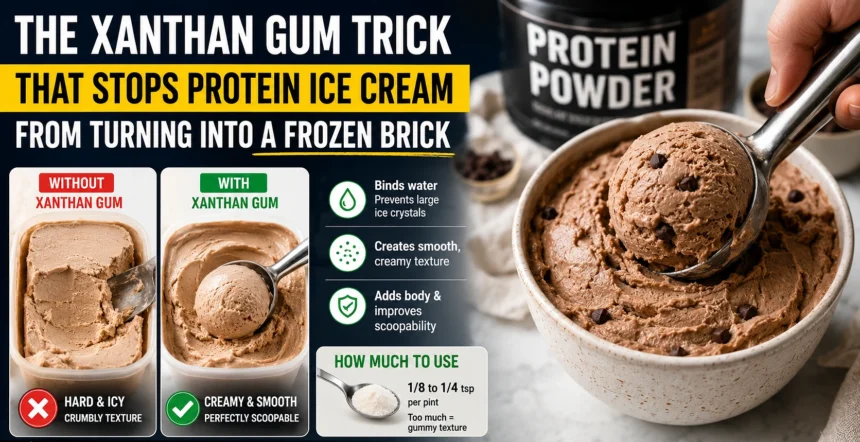
You did everything right. Scooped the protein powder, blended the milk, froze the pint overnight like the recipe said. Then you pulled it out, dug a spoon in, and the spoon basically bounced. What you made was not ice cream. It was a protein-flavored brick with the structural integrity of a hockey puck.
If that sounds familiar, the fix is almost insultingly small. A pinch of xanthan gum, less than you’d think, turns that frozen block into something soft and scoopable. The catch is understanding why the brick happens at all, because once you get that, the whole thing stops feeling like luck.
Why Protein Ice Cream Freezes Like Concrete
Regular ice cream stays soft for two reasons most people never think about: fat and sugar. Both of them get in the way of water freezing into one solid mass. Fat coats things and breaks up the structure. Sugar lowers the temperature at which the mix freezes and keeps the ice crystals small. Take a normal pint of Ben & Jerry’s out of the freezer and you can scoop it because it is loaded with both.
Now look at what you put in your protein pint. Skim or plant milk. A scoop of protein powder. Maybe a zero-calorie sweetener that does nothing for texture. You stripped out the fat and the sugar, which is the entire point nutritionally, but those were also the two things keeping the dessert soft. So the water in your base does exactly what water does when nothing is stopping it. It freezes hard, in big crystals, into a block.
This is the part that trips people up. The iciness is not a mistake in your technique. It is the predictable result of a low-fat, low-sugar, high-water mix doing what physics tells it to.
What Xanthan Gum Actually Does In There
Xanthan gum is a stabilizer and thickener, the same kind of behind-the-scenes ingredient that shows up in salad dressings and gluten-free bread. In a frozen dessert it does one job that matters above all others: it grabs the water and holds onto it.
When water is locked up in a thicker, more viscous base, it cannot rush together into those big jagged ice crystals. It helps the ingredients bind together more effectively, which cuts down the formation of large ice crystals during freezing, and that matters a lot in high-protein recipes because they naturally freeze harder than traditional ice cream. Smaller crystals read on your tongue as smooth. Big crystals read as icy. That is most of the difference between a creamy spoonful and a frostbitten one.
It also adds body. A thin protein base freezes thin and shatters into crumbs. A slightly thicker one holds together and scoops like soft serve.
How Much To Use, And Why Almost Everyone Overshoots
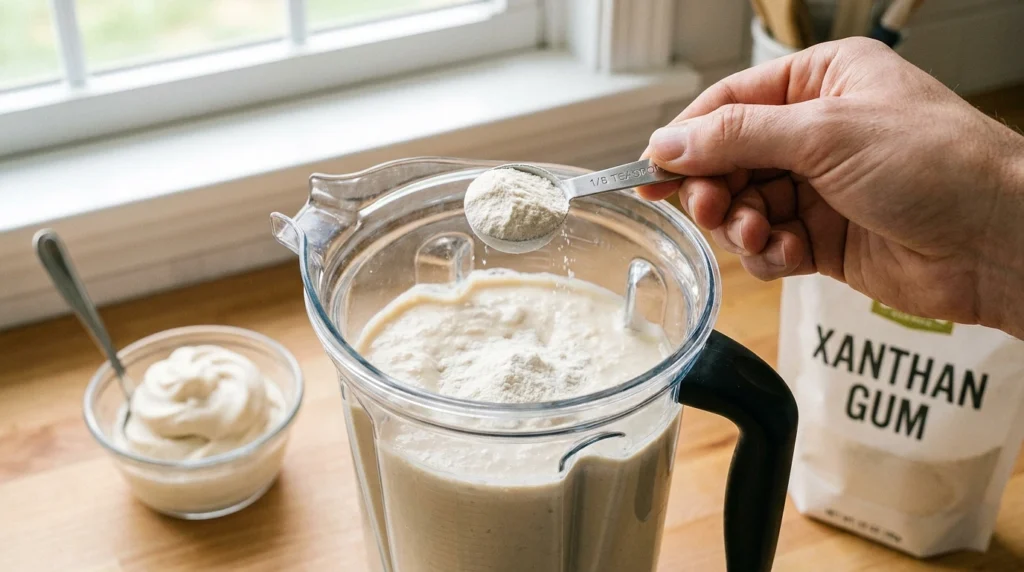
Here is where good intentions ruin perfectly good pints. A tiny amount does the whole job. The single most common beginner error is dumping in too much, and the punishment is swift. Use a quarter teaspoon of xanthan gum and no more, because too much takes your ice cream from creamy to weirdly gummy fast, and you are making dessert, not slime.
For a standard pint, your range is small:
- Start at 1/8 teaspoon. For a lot of bases this is genuinely all you need. An eighth of a teaspoon of xanthan or guar gum is enough to push the texture toward soft serve.
- Go up to 1/4 teaspoon if the first try still freezes too firm. Add it in stages rather than all at once, since the thickening keeps developing as it hydrates.
If you like measuring by weight loss instead, the pros think in percentages of the total mix. Roughly 0.06 percent of the total weight gives light stabilization without changing the mouthfeel much, while around 0.12 percent gives a firmer, fuller body closer to store-bought ice cream. For a normal pint that still lands you somewhere between an eighth and a quarter teaspoon, so the spoon math holds up fine.
Guar Gum, The Quieter Cousin:
Some people swear by guar gum over xanthan, especially in cold applications, and the food-science crowd often leans that way. In side-by-side testing, a combination of guar and xanthan together tends to produce the best texture, with guar reducing ice crystals and xanthan giving the scoopable firmness. The honest downside is that guar can be harder to find on a normal grocery run, which is why xanthan ends up being most people’s default. Either one works. Both together work a little better.
The Pudding-Mix Shortcut:
No gum in the house and not willing to wait for a delivery? Sugar-free instant pudding mix already has stabilizers built into it. A tablespoon of sugar-free instant pudding mix carries emulsifiers like xanthan gum inside it and improves the texture of light or low-fat Creami bases. One thing to remember: pudding mix is sweetened, so dial back whatever sweetener you were already adding or your pint will come out cloying.
The Trick Alone Will Not Rescue A Bad Base
This is the part most blog posts skip, and it is the part that actually separates a decent pint from a great one. Xanthan gum is a fixer, not a miracle. If your base has nothing creamy in it to begin with, no amount of gum will fake real richness.
A few levers matter as much as the gum itself:
- Bring back a little fat. Skim milk and water freeze icy almost no matter what. Swapping in whole milk, a higher-fat protein milk, a spoon of Greek yogurt, or even cottage cheese changes the whole game. Plant milks alone often turn icy, and mixing them with whole milk or a higher-protein milk brings back creaminess.
- Pick your protein powder on purpose. Most people reach for whey, but casein gives a noticeably thicker, creamier result, and a half-whey half-casein blend splits the difference well. Plant proteins can come out a touch grainier.
- Blend it properly. Clumps of dry protein powder turn into hard specks after freezing. A handheld frother or stick blender pays for itself here.
Putting It To Work, Start To Finish
Assuming a Ninja Creami or similar setup, the gum is one step in a short routine, and the routine is where everything either comes together or falls apart.
Mix your base until it is fully smooth, gum included, then freeze it for a full 24 hours. Spinning it after only a couple of hours leaves you with something loose and milkshake-like rather than ice cream. Patience is not optional on this one.
When you are ready, do not go straight from freezer to machine. Let the pint sit out for a few minutes, then run the bottom of the container under warm water for around a minute to loosen the block, and start on the Lite Ice Cream setting since it handles lower-fat, high-protein bases more gently. If it comes out crumbly, hit Respin. That second pass fixes more sins than people expect.
None of this is complicated. It is just a sequence, and the gum is the one ingredient that quietly makes the rest of the sequence forgiving. Get the pinch right, keep a little fat in the mix, give it the full freeze, and the brick stops showing up. You end up with the thing you were actually trying to make, which is a high-protein dessert that tastes like a treat instead of a punishment.