


Glasses slide down for about four reasons and only one of them involves the nose. Which is why so many people spend years squeezing their nose pads, getting a week of relief, and going back to pushing the frame up their face forty times a day.
The Temple Bend Is Usually The Culprit
Look at the arm of your glasses. It runs straight back from the hinge, then bends downward to curve behind your ear. That bend has a position along the arm, and where it lands relative to where your ear actually joins your head decides how the whole frame sits.
Two failure modes, opposite causes:
- Bend too far back, past your ear attachment, and there’s nothing anchoring the frame. It slides down your nose.
- Bend too far forward, in front of the ear attachment, and the temple tips ride up and off the ear across the day. Frame tilts, one side lifts.
An optician doesn’t guess at this. They look at where the bend sits, move it forward or back along the temple, and the complaint stops. Which is also why walking in and saying “the bend feels like it’s sitting behind my ear instead of on it” gets a faster result than saying the glasses are annoying.
The other three reasons, briefly a loose hinge screw, nose pads set too wide, and a frame front that’s gone out of alignment so one lens sits lower than the other. That last one you can spot yourself by putting the glasses face down on a table. Both temple tips should touch. If one hovers, the front is twisted.
A Sliding Frame Is a Prescription Problem, Not a Comfort Problem

Every lens has an optical center, one point where light passes through without being bent off course. It gets ground into position to sit directly in front of your pupil, and your pupillary distance measurement exists for exactly that purpose.
Move your eye off that point and the lens starts producing unwanted prismatic effect, bending light in a direction your prescription never accounted for. The clinical guidance lists the results plainly: blurred vision, eye strain, discomfort, headaches. The nastier version is vertical misalignment, where one eye looks through a spot higher than the other and your eye muscles spend the day fighting to stack the two images.
A frame sitting half a centimeter low does precisely that. Mild prescription, small effect. Strong prescription, or progressives where the corridor between distance and reading is narrow and deliberately placed, and it becomes the difference between glasses that work and glasses that produce a headache by four in the afternoon.
Which is how people end up back at the optometrist for a fresh eye test, getting told the prescription is fine, and carrying on as before.Two Things Worth Doing Yourself
Nose pads on a metal frame, and a loose screw. That’s the list.
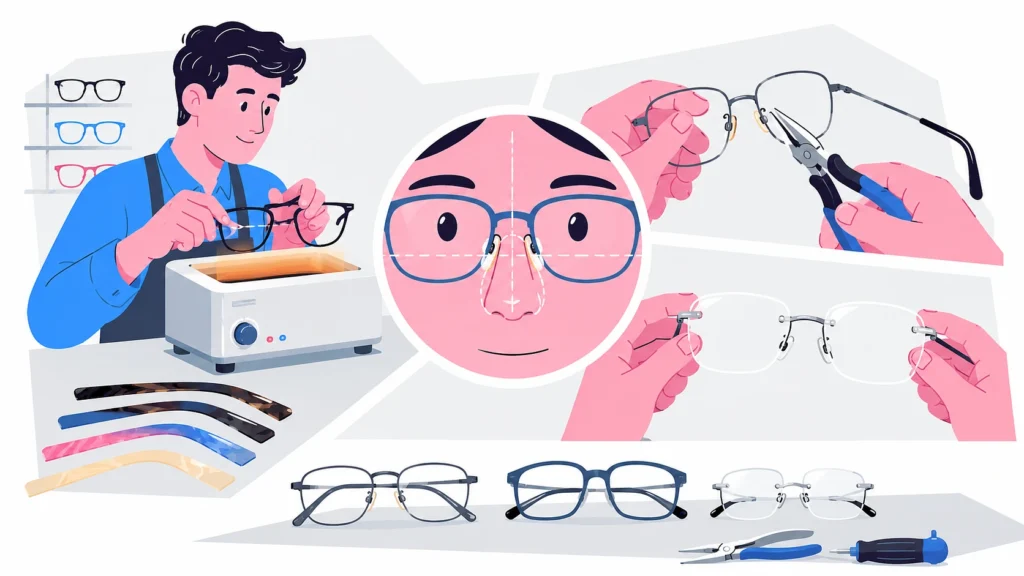
The pads sit on thin bendable arms and squeezing them slightly closer lifts the frame higher on your nose, widening them lets it drop. Both thumbs, tiny increments, keep them even, check a mirror between each nudge rather than after five. If the pads themselves have gone hard and yellow, silicone replacements cost almost nothing and most shops will fit them while you wait.
Loose screws you handle with a jeweller's screwdriver, an eighth of a turn at a time. A wobbly temple or one arm sitting looser than the other is very often just this, and it takes ten seconds.Everything past those two involves putting force into a material whose behavior you can’t predict by looking at it, which brings us to the awkward part.
The Material Decides Whether You Should Stop
Plastics
Cellulose acetate, the thick stuff most bold frames are cut from, only turns pliable when warm. An optician holds it under a hot air frame warmer for a few seconds and then it moves easily under thumb pressure. Cold acetate resists, and if you push hard enough to shift it at room temperature you aren’t bending it, you’re starting a crack that shows up three weeks later.
Acetate also usually comes with a molded one-piece bridge and no adjustable pads, so the nose fit got decided on the day you bought them. Wrong bridge, nothing to adjust. That’s a shop problem or a different frame.
Metals
Monel is the cheap workhorse, mostly nickel and copper, on a huge share of budget frames. It bends readily. That sounds like an advantage and it half is, because it forgives a careful home nose pad tweak, but it also drifts out of true on its own from ordinary daily handling, so monel wearers need adjusting more often than anyone.
Titanium is where people come unstuck, and it’s worth spending a paragraph on because it’s now on so many mid-range and premium frames.
The property that causes trouble is spring-back. Titanium resists deformation and then returns most of the way to where it started, so you push, almost nothing happens, you push harder, and the force stops distributing along the arm and starts concentrating at a weld or a hinge. Then it goes. ABO-accredited training for opticians covers the actual technique, which involves a controlled amount of heat from a hot air warmer specifically, not a bead bath, because a bead bath pits the plastic temple covers. Opticians also use pliers with nylon-coated jaws so the finish survives the job. You have your fingers and possibly a tea towel.
Memory metal, sold as nitinol or flex titanium, barely responds at all. The alloy is designed to spring back to its original shape, which is excellent if you sit on your glasses and useless if you’re trying to change them. It takes a specific approach and not every shop is set up for it.
Rimless frames deserve a mention too since they’re the most fragile category going. The lenses are drilled and bolted rather than held in a rim, so any force you apply travels straight into a hole in a piece of glass. Take those in.
Adjustment Has Been Free For a Century And Mostly Still Is
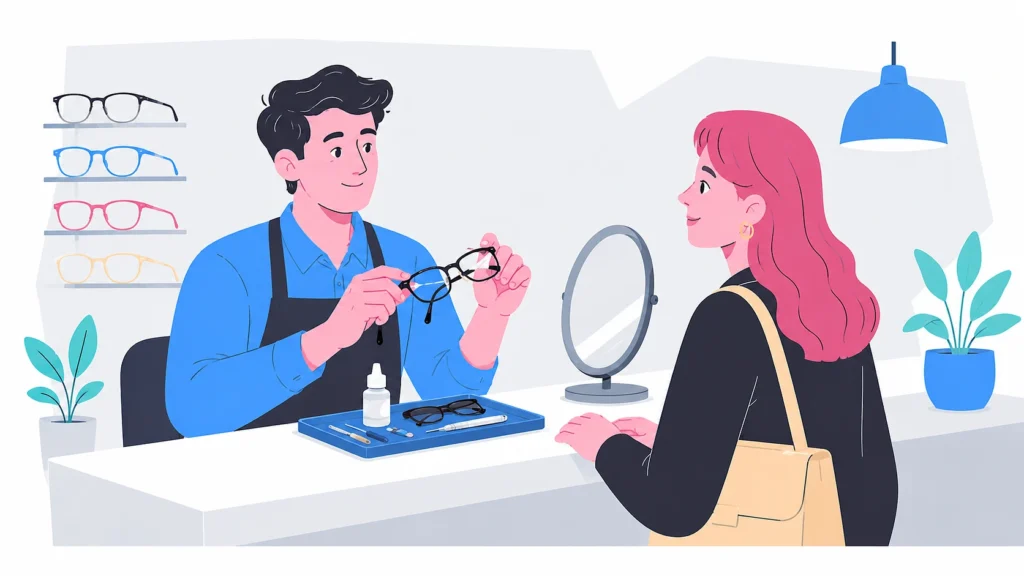
The trade logic was always that frame markup pays for aftercare, and aftercare is what brings people back. Costco Optical puts it on their own site, free in-store adjustments for Costco and non-Costco frames alike, and a great many independents work the same way without advertising it anywhere.
That norm has come under pressure. Optometry Times has covered practices writing formal policies as online eye care grew and shops found themselves fitting frames they’d earned nothing on. Some now charge a couple of dollars for glasses bought elsewhere. Plenty still don’t, on the grounds that it’s the cheapest way to get a stranger through the door.
Practically speaking:
- Chains will almost always do it free and are staffed for walk-ins.
- Independents might charge a small fee on frames bought online, which is fair.
- Whoever sold you the frames will do it free and has the tools for that specific model.
Nobody interrogates you at the counter. You say the glasses are sliding, you hand them over, you get them back straight.
The Failure Is Asymmetric, Which Is The Whole Argument
Adjusting glasses isn’t difficult and anyone telling you never to touch your own frames is being precious. Nose pads are genuinely easy.
The reason to stop at the boundary is that a good home adjustment saves you a trip, while a bad one on titanium or cold acetate costs you the frame and the lenses sitting in it. Then you’re buying a replacement pair from the same person who’d have straightened them for nothing.
Push the pads. Tighten the screw. Past that, walk in, and stop worrying about where you bought them.