

Everyone tells you to “just start.” Walk more. Drink water. Listen to your body.
You’ve heard it a hundred times. You bookmarked the articles, bought the shoes, maybe even paid for an app. And yet, three weeks later, you’re on the couch again, wondering why something so simple feels so impossible.
Here’s what nobody admits the advice isn’t wrong. It’s just incomplete. It treats your body like a machine and your motivation like an infinite resource. You’re not a machine. You’re a human being with a schedule, a history of failed attempts, and a brain that actively sabotages new habits when they feel like punishment.
I spent two years starting and stopping. I bought the resistance bands. I did the 5 AM runs. I followed the “beginner” programs that assumed I was a retired athlete, not someone who got winded walking up a flight of stairs. Then I stopped listening to the fitness industry and started paying attention to what my actual life looked like.
The First Step Has Nothing to Do with Exercise
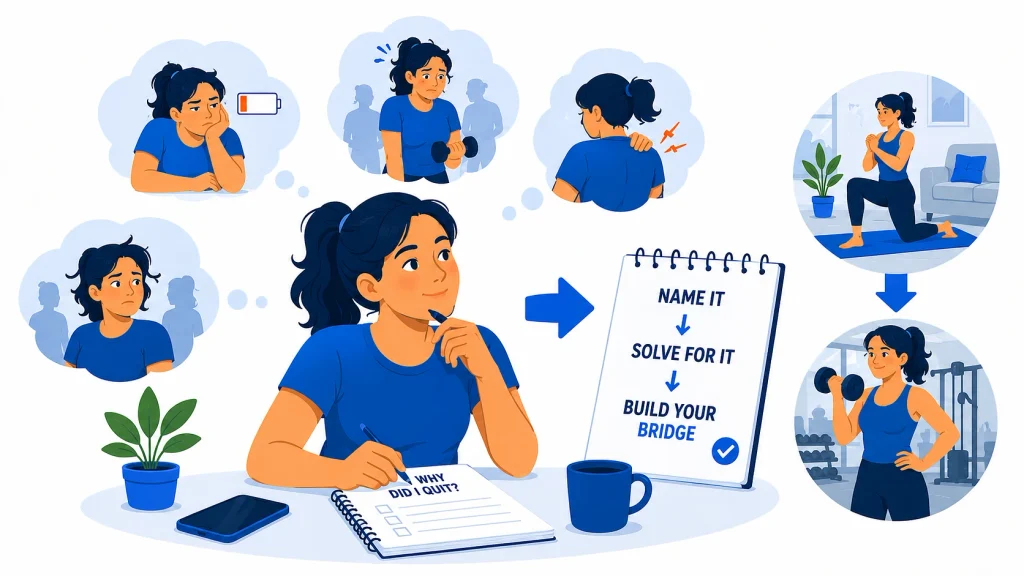
Before you touch a weight or run a mile, you need to answer one question honestly: What made you stop last time?
Not “I got busy.” That’s never the real reason. Was it boredom? Was it the shame of being the slowest person in the room? Was it the soreness that made sitting on the toilet feel like a betrayal? Was it the creeping suspicion that everyone was watching you?
Write it down. Seriously. On your phone, in a note, right now. Because that reason is coming for you again in about fourteen days, and this time you need a plan for it.
My reason was humiliating, I couldn’t handle being bad at something in public. I was competent at my job, my relationships, my hobbies. But in a gym, I was a beginner, and my ego couldn’t take it. So I stopped going.
Once I named it, I could solve for it. I worked out at home for six months before I ever stepped into a commercial gym. That wasn’t “less than” going to a gym. It was the bridge I needed to build. Your first step isn’t a workout. It’s an honest audit of why you actually quit.
The 2-Minute Rule
I stole this from a behavioral psychologist and modified it for fitness, Your only goal for the first month is two minutes.
Not twenty. Not a "quick" thirty. Two.Two minutes of stretching after you wake up. Two minutes of walking in place while your coffee brews. Two minutes of bodyweight squats while you watch Netflix.
This sounds insulting. It sounds like it can’t possibly matter. But here’s the thing: you’re not training your body yet. You’re training your identity. You’re proving to your brain that “I exercise” doesn’t mean “I suffer for an hour.” It means “I move a little, most days, and that’s enough.”
After two weeks of two-minute sessions, something shifts. You start wanting more not because a motivational quote told you to, but because your body remembers what movement feels like and starts asking for it. That’s when you add another two minutes. Then five. Then ten.
By month three, I was doing full thirty-minute sessions without a single ounce of willpower. The habit had become automatic because I never let it become overwhelming in the first place.Warm-Up Like You’re Waking Up a Sleeping Dog
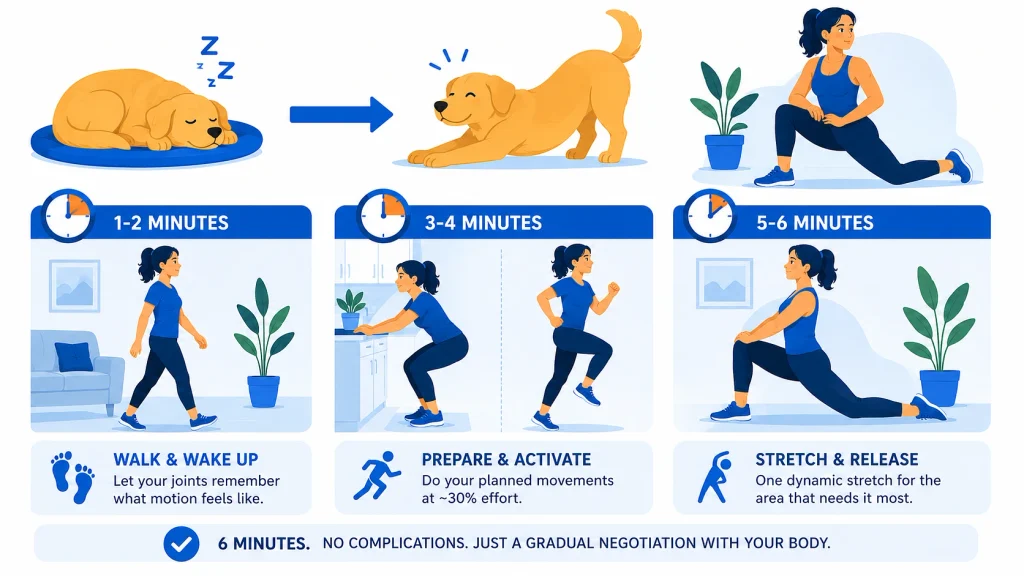
The generic advice says “warm up for five to ten minutes.” Okay, doing what? Marching in place? That bores me to tears, so I never did it. Then I pulled my hamstring reaching for a laundry basket.
Here’s what I learned your muscles aren’t rubber bands. They’re more like cold honey. You can’t just start yanking.
My actual warm-up now takes six minutes and follows a simple rule: start where you are, not where you think you should be.- Minute 1–2: I walk around my living room. Not power walking. Just walking. I let my joints remember what motion feels like.
- Minute 3–4: I do the movements I’m about to do, but at 30% effort. If I’m going to squat, I do three squats holding onto my kitchen counter. If I’m going to run, I do a slow jog in place.
- Minute 5–6: I do one dynamic stretch for the part of my body that always complains first. For me, that’s my lower back. For you, it might be your shoulders or knees.
That’s it. No complicated routine. No app required. Just a gradual negotiation with your body instead of a demand.
The Hydration Hack That Doesn’t Involve Carrying a Gallon Jug
“Drink more water” is the most useless advice ever given. Of course you should drink water. You know that. The problem is execution.
Here’s what actually works: tie hydration to something you already do.
I keep a glass next to my toothbrush. Every morning, before I brush my teeth, I drink it. That’s 16 ounces before my day even starts. I keep another bottle on my desk, and the rule is: every time I finish a work task or send an email, I take two sips. Not chug. Sips.
I don’t track ounces. I don’t carry a jug that makes me feel like a gym bro. I just anchor water to existing habits, and suddenly I’m hydrated without thinking about it.
If you hate plain water, drink herbal tea. Drink sparkling water. Add a slice of lemon. The hydration police aren’t real. The goal is liquid in your body, not a perfect Instagram aesthetic.
How to Exercise When You Have No Time, No Energy, and No Motivation
Some days, you will have none of the three resources fitness culture demands. On those days, the standard advice says “push through it.” I say: lower the bar until you can step over it.
I have a tiered system for bad days:
- Tier 1 (I feel decent): Full workout. 20–30 minutes.
- Tier 2 (I’m tired, but functional): Ten minutes of the easiest version of my workout. If I planned to run, I walk. If I planned to lift, I do bodyweight only.
- Tier 3 (Everything hurts, including my soul): Five minutes of stretching while I watch TV. Or I march in place during a phone call. Or I do ten squats after using the bathroom.
The rule is: something is infinitely better than nothing, but nothing is better than something that makes you quit forever.
There were weeks where I only hit Tier 3. I didn’t lose progress. I didn’t “fall off the wagon.” The wagon is a myth. There is only today, and what you can manage today.
The Cool-Down Is Where the Magic Happens
Everyone skips the cool-down. I skipped it for a year. Then I started waking up feeling like I’d been hit by a truck, and I realized my body was still in fight-or-flight mode when I stopped exercising. I was going from 100 to 0, and my nervous system was furious.
Now, I spend three minutes doing the most boring, unglamorous thing imaginable walking slowly in circles around my apartment while I scroll on my phone. That’s it. I let my heart rate drift down. I let my breathing settle. Then I spend two minutes stretching whatever feels tight.
I don’t use a stopwatch. I don’t follow a routine. I just give my body a transition period between “workout mode” and “real life mode.” The difference in my recovery, my sleep, and my next-day soreness is staggering.
What To Do When You Miss a Week
You will stop. Maybe for a vacation. Maybe for an injury. Maybe because life exploded and exercise was the first thing to go. This is not a moral failing. It’s a feature of being alive.
The mistake is treating a break like a reset to zero. It’s not. Your body remembers. Your cardiovascular fitness doesn’t vanish in a week. Your strength doesn’t evaporate in two. The only thing that disappears is momentum, and momentum is rebuilt the same way it was built: slowly.
When I come back from a break, I follow the Half Rule, whatever I was doing before, I do half the duration and half the intensity for the first week back. If I was running 30 minutes, I walk-jog for 15. If I was lifting a certain weight, I drop it by 50%.
My ego hates this. My ego wants to prove I haven’t lost anything. But my body thanks me, and by week two, I’m usually back to where I was without injury or burnout.
The Only Metric That Matters
Fitness culture wants you to track everything: steps, calories, heart rate zones, macros, sleep scores. It’s exhausting, and for beginners, it’s a distraction.
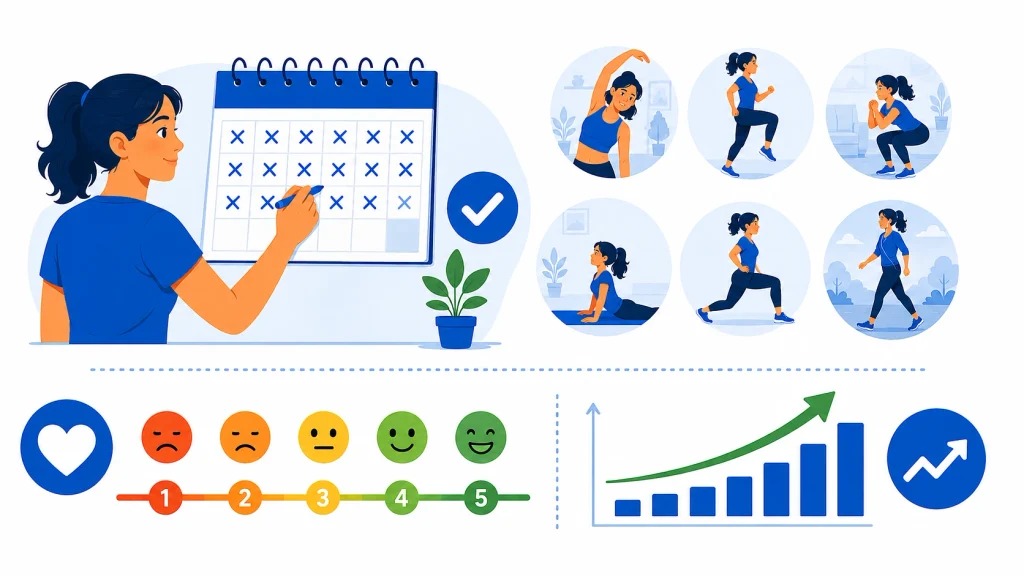
Track one thing: Did I move today? Yes or no. That’s it.
I use a wall calendar. Every day I do my two minutes, I put an X. Not a workout log. Not a calorie count. Just an X. By the end of the month, the chain of X’s becomes its own motivation. You don’t want to break the chain. Not because an app is guilting you, but because you can see your own consistency with your own eyes.
After six months of X’s, I added a second metric: How did I feel today? I rate it 1–5. Not my workout performance. My overall energy. Because here’s the secret: when you move regularly, that number trends up. Not immediately. Not linearly. But it trends up. And that upward trend is the only proof you need that this is working.
Your First Real Workout Starts Tomorrow
Not with a gym membership. Not with a new outfit. Not with a complicated program.
Tomorrow, set a timer for two minutes. Stand up. Walk around your space. Touch your toes. Reach for the ceiling. Do three squats holding onto your kitchen counter. Then stop.
That’s it. That’s the whole thing.
Do it again the next day. And the next. When it feels too easy—and it will—add another minute. Then another. Let it grow like a plant, not explode like a firework.The people who stick with exercise aren’t the ones with the most willpower. They’re the ones who made it too small to fail. Be one of those people. Start so small it feels ridiculous. Because ridiculous and done is infinitely better than ambitious and abandoned.
Your body is ready. It always was. You just needed a plan that respects where you’re actually starting from, not where the fitness industry thinks you should be.