

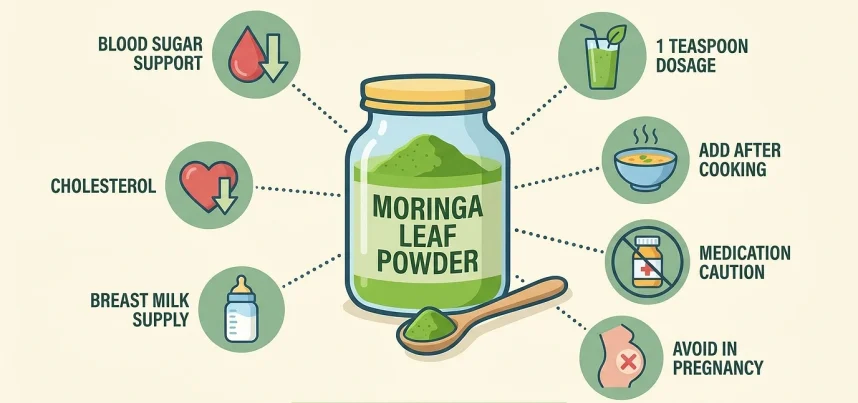
When researchers in globally ran a randomised controlled trial on prediabetic adults and found reduced fasting glucose and HbA1c after twelve weeks, the amount they were giving people was 2.4 grams a day roughly three-quarters of a teaspoon, taken as capsules. Walk into a health shop and the tubs on the shelf will suggest a tablespoon, sometimes more, which lands somewhere between four and five times the quantity that produced a measurable effect in the one trial most often cited to sell it.
One Teaspoon a Day is Enough
Published trials have used anywhere from under a gram up to 20 grams in a single serving, and the controlled study that produced the clearest result sat near the bottom of that spread rather than the top.
Safety is not what limits the dose. Researchers have administered 50 grams in one go, and 8 grams daily across forty days, without recording harm in either case, so the ceiling is a good deal higher than anything a normal person would put in a smoothie. The argument for staying low is more mundane than toxicity: nothing in the literature suggests that more delivers more, and the flavour becomes considerably harder to disguise once you get past a teaspoon.
The Vitamin C Comparison Only Works On Paper
Seven times the vitamin C of oranges, four times the calcium of milk. You will have seen some version of this on every packet and in every article, and the arithmetic behind it is doing something the claim does not disclose, which is comparing dried powder against fresh food by weight.
Take the water out of anything and what remains concentrates. That is not a property of moringa, it is a property of dehydration, and dried parsley outperforms fresh parsley on precisely the same calculation without anyone building a wellness brand around it. Worse, the comparison assumes you are eating 100 grams of the stuff, when a realistic serving sits somewhere between two and six.
Measured against what actually goes in the glass, a teaspoon of moringa contributes a genuinely useful amount of beta carotene, vitamin C, calcium, iron and protein. It does not replace vegetables and it was never going to.
Blood Sugar Is Where The Evidence Holds Up
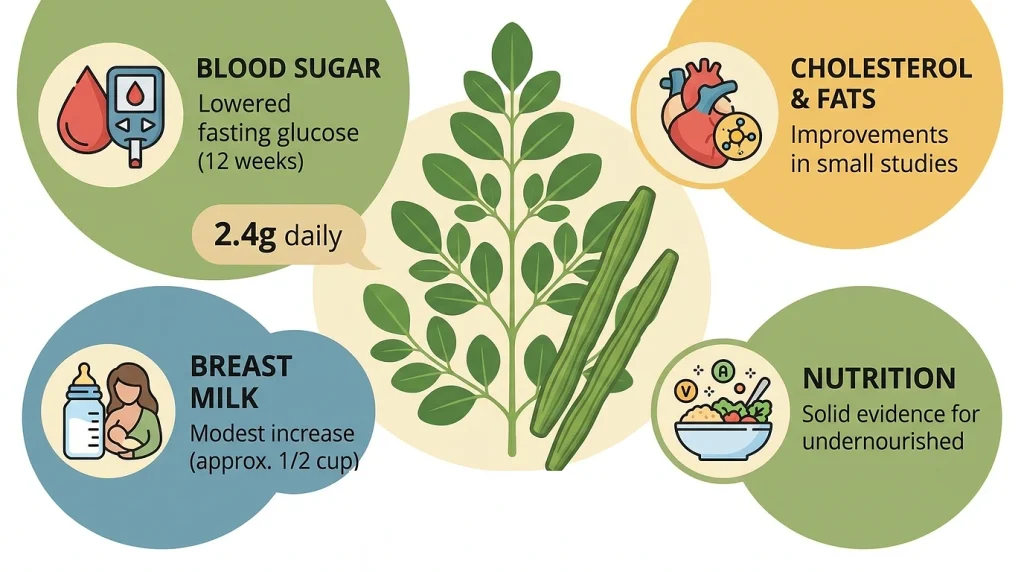
Most of what gets claimed for moringa comes out of cell cultures and rodent studies. Four things have been tested in actual people:
- Blood sugar. Twelve weeks at 2.4 grams daily lowered fasting glucose and HbA1c in prediabetic adults, and a separate study found that 20 grams flattened the post-meal glucose rise in people with type 2 diabetes.
- Cholesterol and blood fats. A handful of small studies using whole leaf powder reported improvements, collected together in a 2015 review of safety and efficacy.
- Breast milk supply. Six randomised, blinded, placebo-controlled trials found a modest increase, in the region of half a cup.
- Nutrition in undernourished populations. The most solid evidence of the lot, and the context most of the fieldwork comes from.
Cancer, liver protection, inflammation none of that has cleared the same bar. The laboratory work genuinely exists and some of it is interesting, but a compound that does something to cells in a dish has told you nothing yet about what it does inside a person who has swallowed it.
Most People Get Nothing Worse Than An Upset Stomach
Participants across the trials reported occasional digestive trouble, which the fibre content accounts for, and not a great deal else. A 2025 review of human studies and published case reports described supplementation as well tolerated.
Two findings sit outside that reassuring picture and deserve more attention than they usually receive.
The first is a published case of Stevens-Johnson syndrome following moringa consumption, with a rash appearing around fourteen hours afterwards. The condition is rare, and it can be fatal. A great many articles still repeat the claim that no adverse effect has ever been reported in the literature, and whatever was true when that line was first written, it is not true now.
The second concerns medication rather than the supplement itself. If you take tablets for diabetes or high blood pressure, something that lowers glucose or pressure is not an added benefit sitting harmlessly alongside them the effects stack, and the prescription you are on was calculated without a supplement in the picture.
Skip it Completely During Pregnancy
The root and bark of the plant have a long documented history of use for ending pregnancies, and animal research supports that the effect is real rather than folkloric.
Leaf powder is a different material and it is what any reputable brand is selling you. The difficulty is that supplement labelling receives very little scrutiny, nothing on the packaging allows you to verify which part of the plant has gone into it, and pregnancy is not the moment to find out whether a particular supplier cut corners.
Breastfeeding sits in an entirely different position. Six controlled trials support the traditional use for milk supply, so the evidence there is real, but it still belongs in a conversation with a midwife rather than a decision reached in a shop aisle.
Stir It In After Cooking, Not Before
- Heat destroys the good parts. Vitamin C breaks down and the carotenoids degrade, so it goes into a finished dish rather than a simmering one
- Food hides the taste better than water does. Grassy and distinctly bitter, somewhere between matcha and it will not disappear quietly into a glass
- Check that the label names the plant part. Leaf powder specifically, ideally from a brand that publishes third-party testing, given that the FDA does not assess supplements before they go on sale
- Judge the colour. Bright green suggests the nutrients are intact, while anything dull or brownish has been sitting around too long
Buy It For The Blood Sugar Work, Not The Label
If you want a green supplement and the taste does not defeat you, moringa is a perfectly reasonable one to land on. The glucose research is the most convincing thing about it by some margin, and it works at a dose that costs almost nothing.
If the numbers on the front of the packet are what persuaded you, those numbers are describing a serving size that eats. And if you are pregnant, taking medication for diabetes or blood pressure, or hoping it will do something a plate of greens could not, the evidence simply does not reach that far.
General information, not medical advice. Supplements are not reviewed by the FDA before sale. Speak to a doctor or pharmacist before taking moringa alongside prescribed medication, or during pregnancy or breastfeeding.