

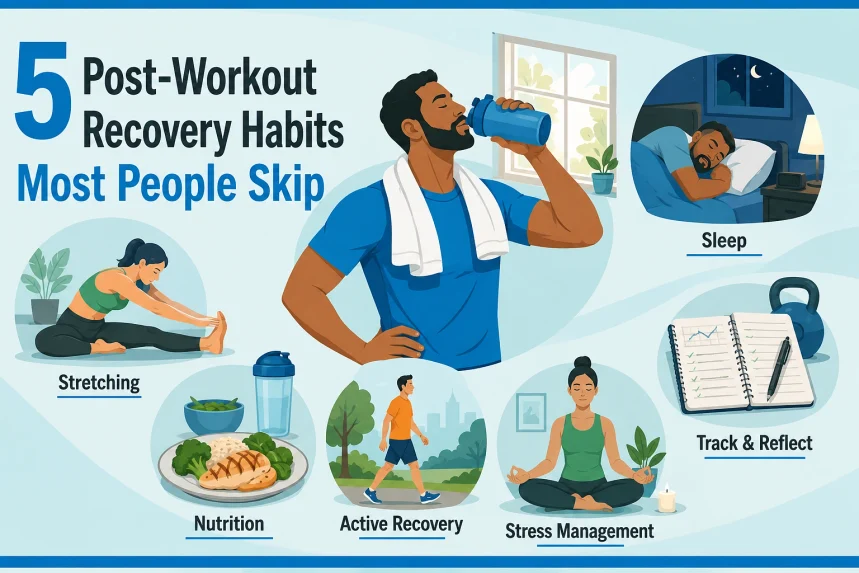
Stretching after a session does almost nothing for soreness.
That is not a contrarian opinion, it is what Cochrane reported in 2011 after Herbert, de Noronha and Kamper pooled twelve randomized trials, one of which was a field study with 2,377 people in it, and the pooled result landed at roughly four points on a hundred-point soreness scale. Four points. You could not feel that if you were sitting still trying to feel it.
So why is stretching always the first item on every recovery list? Probably because it is the one you can do in the parking lot and feel virtuous about. It is visible, sleep is not.Stretching Stays In The Routine, But Soreness Is Not What It Fixes
Keep stretching. Just be honest about the job it is doing.
Stretching maintains range of motion. It does not prevent delayed onset muscle soreness and it has never been shown to prevent injury on its own. The Cochrane team noted something worth sitting with: most of the researchers running those trials were probably hoping to find that stretching helped, and even with that thumb on the scale, the effect refused to show up.
Where it earns its place is joint position. If you cannot get into a deep squat without your heels lifting, that is an ankle problem, and ten minutes of ankle work three times a week fixes it over months. Not over one post-session cooldown.
Sleep Is The Habit Doing Almost All The Work
If you only fix one thing on this list, fix sleep, and it is not close.
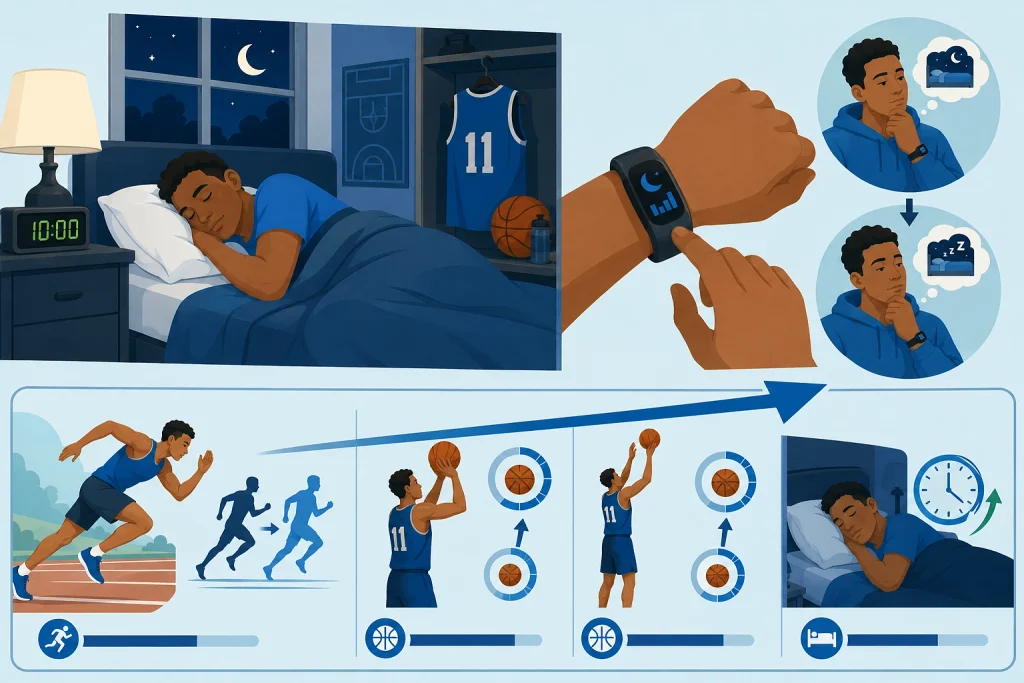
Stanford’s basketball players thought they were sleeping ten hours. They were sleeping eight and a half.
Cheri Mah and colleagues at the Stanford Sleep Disorders Clinic published this in Sleep in 2011. Eleven varsity men’s basketball players kept their normal schedule for two to four weeks, then spent five to seven weeks trying to hit a minimum of ten hours in bed. Actigraphy wrist devices tracked what they were really getting rather than what they claimed.
The results, before and after:
- 282-foot sprint: 16.2 seconds → 15.5 seconds
- Free throw accuracy: up 9%
- Three-point accuracy: up 9.2%
- Total nightly sleep: up about 111 minutes
Every one of the eleven improved. No new drills, no programming change, no supplement.The detail that sticks with me is the self-report gap. The players estimated they were getting around ten and a half hours during the extension phase. The wrist devices said about six hours forty-five minutes at baseline and eight and a half hours during the extension. They were off by two hours on their own sleep, and these are athletes whose entire job is body awareness, so if you are guessing at yours, assume you are guessing high.
Sleep restriction of the ordinary kind, the five or six hours a lot of people quietly accept during a busy stretch, is associated with reduced strength and power output, higher perceived effort for the same load, and slower recovery from injury. That last one matters more than the performance numbers. You do not notice slower repair until something tears.
Muscle Protein Synthesis Roughly Doubles At 24 Hours And Fades By 36
A rest day is not an off day. It is the day the work happens.
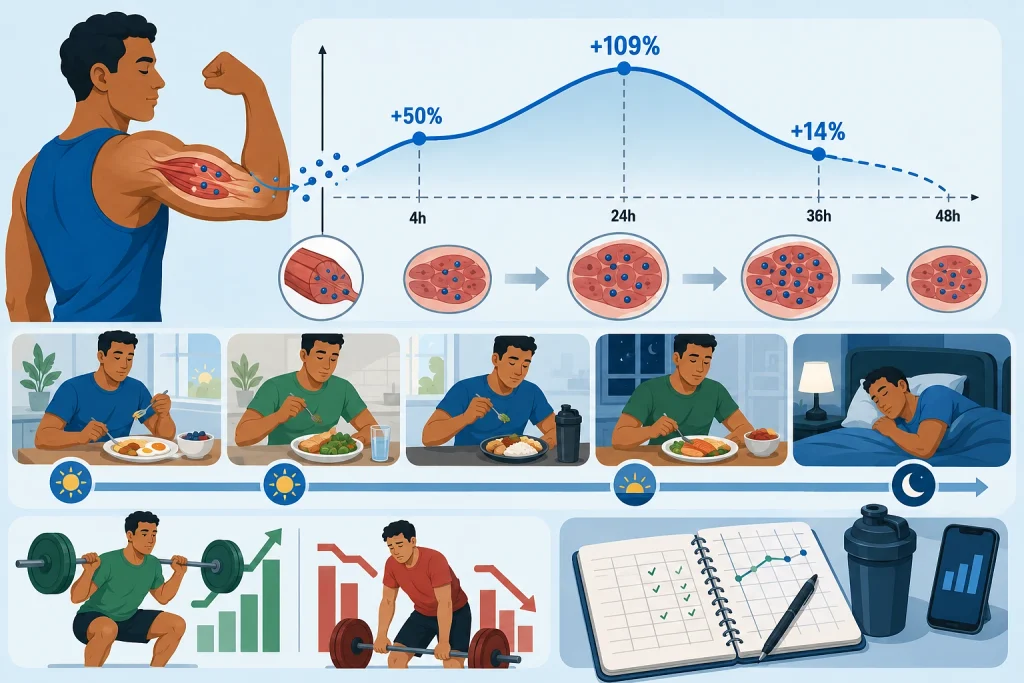
MacDougall’s group measured this directly: protein synthesis in the trained arm ran about 50% above baseline at four hours and 109% above at 24 hours, then by 36 hours it had dropped back to within 14% of the untrained control arm, which was not statistically meaningful. Phillips and others found the elevation can persist toward 48 hours, and Burd’s work showed the muscle stays sensitive to protein feeding for at least a full day after training to failure.
Two practical things fall out of that:
One, the anabolic window is not twenty minutes wide, it is closer to a day, so the sprint to the shaker bottle in the changing room is theatre. Eat well across the next twenty-four hours instead.
Two, trained lifters seem to close that window faster than untrained ones, which is part of why beginners can grow on three sessions a week while experienced lifters end up needing more frequency to keep accumulating stimulus.
Soreness is a terrible gauge for any of this. You can be sore and fully recovered, or feel fine and be three sessions into digging a hole. Bar speed and whether your top set feels heavier than it should are better signals, and both of them require you to have written something down.
Cold Plunges Cost Lifters Muscle In a 12-Week Trial
This one gets added rather than skipped, and it may be working against you.
Roberts and colleagues published in The Journal of Physiology in 2015. Twenty-one physically active men strength trained twice weekly for twelve weeks, with either ten minutes of cold water immersion or active recovery after each session. Strength and muscle mass both increased more in the active recovery group. Type II fiber area was blunted in the cold group.
Fyfe’s 2019 replication found the same split, hypertrophy attenuated but maximal strength largely spared. Piñero’s 2024 meta-analysis in the European Journal of Sport Science came down the same way, and the mechanistic explanation is that the cold suppresses the anabolic signaling and ribosome biogenesis that the training session was supposed to trigger, with effects persisting up to 48 hours.
Cold water still has a use. If you are competing again tomorrow and you need to feel functional, take the plunge and accept the trade. If you are training to get bigger, walk instead.Does Meditation Speed Up Physical Repair?
No, and the honest answer is that it is not really doing what recovery marketing says it does.
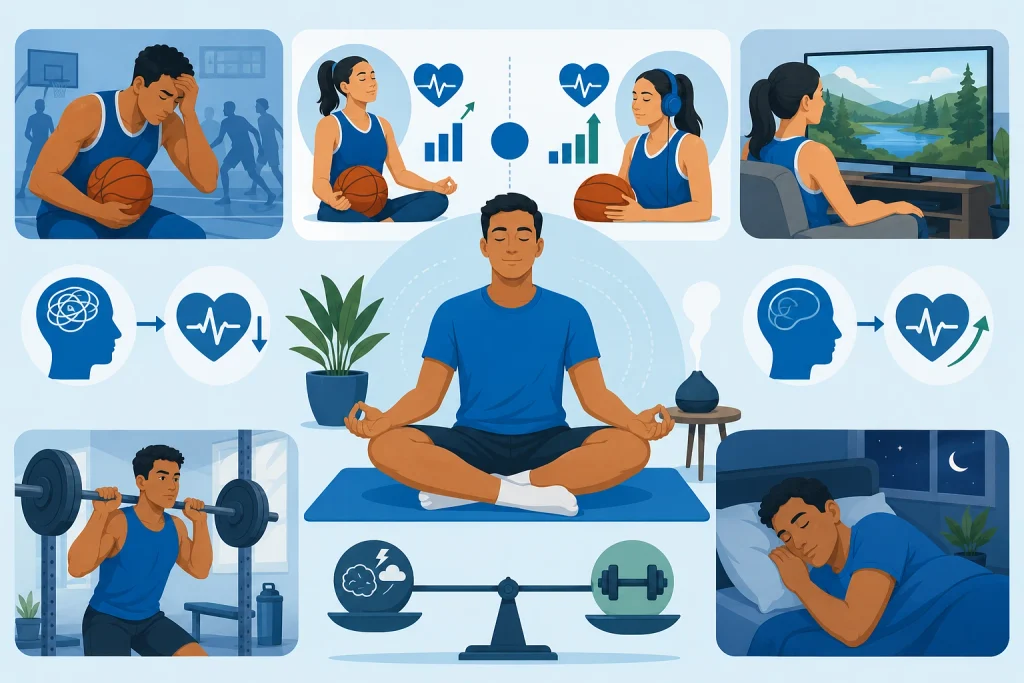
The chronic evidence for heart rate variability is reasonable. A randomized ten-day online mindfulness trial with an active music-listening control found HRV improved with regular practice. But when researchers tested the acute version, a ten-minute body scan given to nine professional female basketball players at half time of a simulated game, it did not beat watching a nature documentary on HRV recovery or cognitive task scores.
So it is not a between-sets tool. What it plausibly does is lower the background stress load you carry into training, and stress load and training load draw from the same account. I am not sure how much of the benefit here is physiological versus the fact that people who meditate ten minutes a day tend to be people who also go to bed on time.
Prayer And Reflection Sit Outside The Recovery Literature
There is no trial showing prayer accelerates muscle repair, and anyone selling you one is inventing it. What the evidence does support, broadly, is that religious and spiritual practice correlates with better stress coping, and stress is not separate from the physical picture.
Reflection is more measurable, sort of. The behavior-change literature on self-monitoring is mixed rather than glowing, and reviews of goal setting and self-tracking in physical activity show modest effects that decay as adherence drops off. Still, a training log is the only way to catch the thing that matters: the eight-week stretch where your top set stopped moving and you did not notice because each session only felt slightly worse than the last.
Write the numbers down. Read them back monthly. That is the whole practice.The frustrating part of all this is that the two habits with the strongest evidence behind them, sleeping more and taking the day off, are the two that make you feel like you are getting away with something. Stretching and cold plunges feel like discipline. Sleep feels like laziness, right up until you look at the sprint times.