

I bought a blood pressure monitor for my father. He’s seventy-three, his cardiologist wants twice-daily readings at home, and he does not get along with anything that has more than two buttons. My job was to set it up.
It arrived on a Tuesday. Before handing it over I strapped it on my own arm just to see how it worked. 148 over 94.
I’m in my thirties. I run four times a week. Nothing about that number made sense, so I took it again. 129 over 82. Third time: 141 over 88.
Nineteen points of spread inside three minutes. I spent the next month figuring out which of those numbers, if any, meant anything. The short answer is that none of them did, and the reasons why turned out to be a lot more interesting than I expected.
What “FDA Cleared” Actually Covers
This is the foundation, so it’s worth being precise.
Most home blood pressure monitors reach the American market through a regulatory route that establishes the device is substantially equivalent to a product already being sold. It’s a clearance concerned with basic safety and with equivalence to prior devices. It does not involve anyone confirming that this specific machine produces accurate blood pressure readings on real arms.
That confirmation is a separate process called clinical validation. A device goes through a defined protocol, usually ISO 81060-2, in which researchers compare its output against a reference measurement across a group of people with varied arm sizes and varied pressure ranges. It costs money. It is completely voluntary. Plenty of manufacturers skip it.
So there are two independent facts about any monitor sitting on a shelf whether it’s legal to sell, and whether anybody has verified it works. The packaging is loud about the first and usually silent about the second.
Researchers who have gone through the consumer market cataloguing what’s available keep landing on the same finding. Validated devices are a minority of what’s for sale, and the shortfall is worst at the cheap end, which is exactly where most people shop.
Three Bestsellers, Three Different Answers
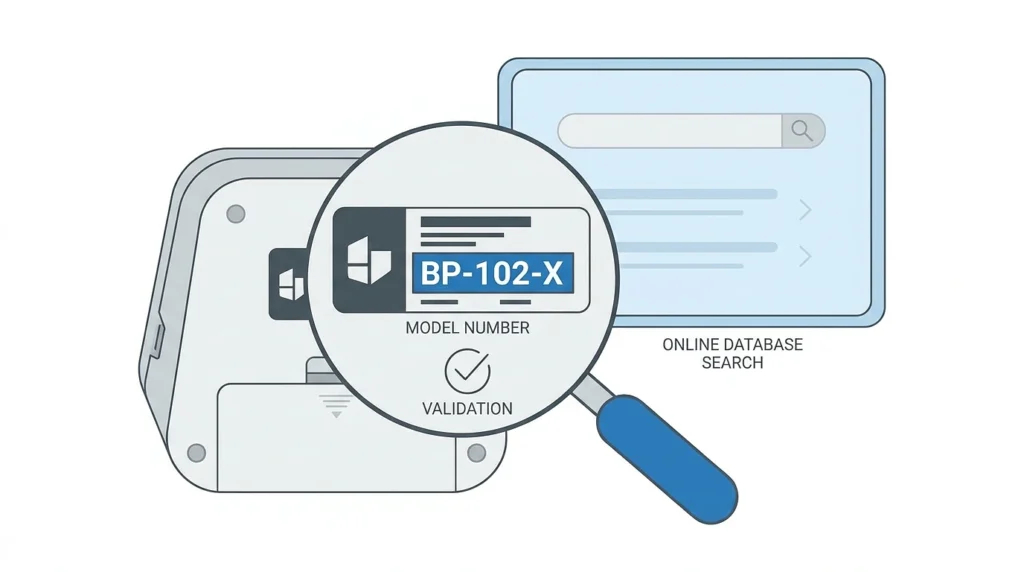
Reading that as a general claim didn’t do much for me. So I pulled three monitors sitting near the top of blood pressure category and ran their model numbers through validatebp, the registry backed by the American Medical Association, and then through STRIDE BP, the international equivalent.
I’m leaving the brands unnamed because listings change and I’d rather this page not be quietly wrong in a year. The pattern is what matters, and you can reproduce the whole exercise in about ten minutes.
The first monitor was a well-known Japanese brand at a middle price point, the kind a pharmacist would hand you without thinking. It appeared on both registries with the model number matching character for character. Clean.
The second was a brand I’d never heard of, several thousand reviews, roughly a third of the price of the first. Nothing on either registry. Not a near match, not a similar-looking entry. Simply absent.
The third is the one that stuck with me. The brand appeared on the registry, but attached to a different model number. The unit actually being sold was a newer variant with an altered suffix. Whether that variant shares validated internals with its listed sibling is something I could not establish from any public source, and the manufacturer’s own page said nothing about it.
That third case is the trap most people fall into. You search a brand name, see a hit, feel reassured, close the tab. Validation attaches to a specific model configuration, never to a company. A manufacturer that validated one device has not validated its catalogue.
Running The Check Yourself
Find the model number on the underside of the monitor or the back of the box. Not the marketing name printed on the front, which is often different. Search that exact string on validatebp and on stridebp.org, matching every character including suffixes and hyphens.
If nothing comes back, you own an unvalidated device. That is not proof it’s inaccurate. It is an absence of proof that it’s accurate, and for a number you might use to make decisions about medication, those two things are not equivalent.
The Cuff Matters More Than The Monitor
Almost everyone treats cuff size as a comfort setting, like the notch on a watch strap. It is nothing of the kind. Cuff sizing is the single biggest controllable source of error in home blood pressure measurement, bigger than brand, bigger than price, bigger than the electronics inside the housing.
The Mechanical Reason
An oscillometric monitor never measures pressure directly. It inflates the cuff until the brachial artery is occluded, then bleeds pressure off gradually while sensing the tiny pulses transmitted through the cuff as blood starts forcing its way through again. An algorithm reads the shape of those oscillations and converts them into systolic and diastolic figures.
Every step of that depends on the cuff transmitting arterial pressure honestly. The inflatable bladder inside needs to wrap a specific proportion of the limb. Standard guidance puts bladder length at roughly 75 to 100 percent of arm circumference and bladder width at about 40 percent.
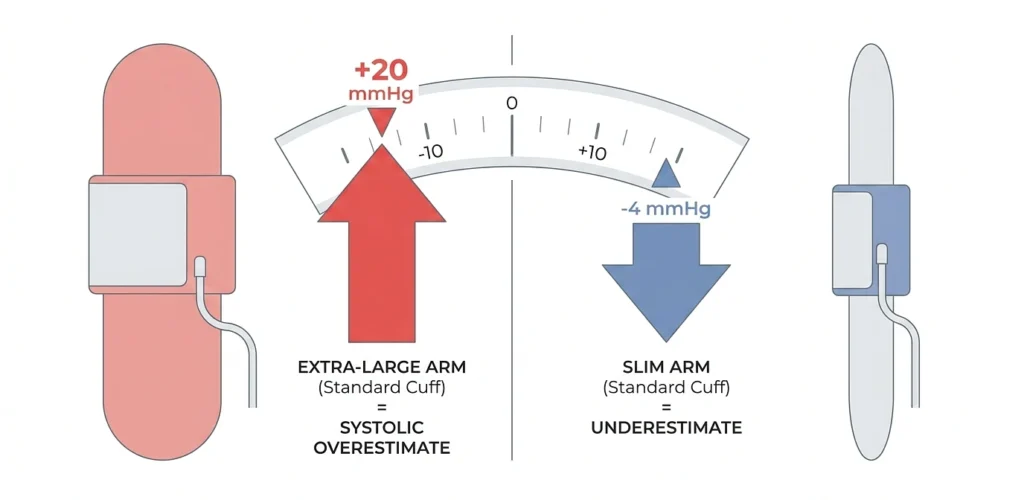
When the bladder is too short for the arm, it can’t distribute pressure evenly around the limb. The device has to inflate to a higher pressure before the artery closes, and it reports that inflated figure as your blood pressure. This is undercuffing, and it manufactures false highs.
Run it the other way, a large bladder on a slim arm, and the artery closes at a lower pressure than it should. That's overcuffing, and it manufactures false lows.How Large The Error Gets
This is where people badly underestimate the stakes.
A randomized crossover trial published in JAMA Internal Medicine in 2023 laid it out with unusual clarity. Researchers measured participants first with a properly sized cuff, then with a regular-size cuff regardless of what their arm actually needed.
- People who should have been in an extra-large cuff had systolic pressure overestimated by close to 20 mmHg when given the regular one.
- People who needed a large cuff saw an overestimate of roughly 5 mmHg.
- People who needed a small cuff had systolic pressure underestimated by about 4 mmHg.
Sit with that first figure. Twenty millimetres of mercury is not a rounding error. Twenty mmHg is the full distance between a comfortable normal reading and stage 2 hypertension. Somebody with a large arm, using the cuff that came in the box, can be told they have a serious condition they do not have. And the reverse case, a slim-armed person collecting falsely reassuring numbers, is quieter but not one bit safer.
Nearly every monitor on the market ships with one cuff sized for a middle band of arm circumferences. Manufacturers do this because it’s cheaper and because virtually nobody checks. If your arm sits outside that band, you own a precision instrument bolted to the wrong sensor.
Measure Your Arm, Properly
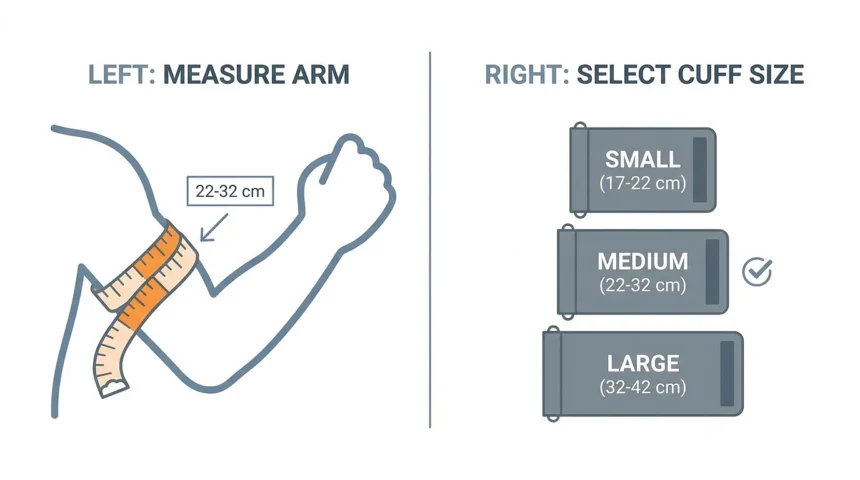
Bare the upper arm. Find the midpoint between the tip of your shoulder and the point of your elbow. Wrap a fabric tape measure around it, snug enough to stay put but not compressing the tissue. Note the number.
Now look at the cuff itself. Printed somewhere near where the tube attaches is a range in centimetres, often with inches alongside. Typical bands look roughly like this, though they shift between manufacturers:
- Small adult: about 22 to 26 cm.
- Standard adult: about 27 to 34 cm.
- Large adult: about 35 to 44 cm.
- Extra large: about 45 cm and above.
Read your own cuff rather than trusting that list. If your measurement lands right at the edge of the printed range, size up rather than down. Undercuffing errs high, and a false hypertension reading does more harm than a slightly soft one.
A replacement cuff costs a fraction of a new monitor and plugs into the same unit. If yours is the wrong size, this is the cheapest fix available to you, and it will move your numbers further than upgrading to an expensive machine ever would.
What Happened With Mine
The cuff in my box was standard size. My upper arm measures 36 cm. I had been reading myself through a cuff a full band too small, which accounts for a good portion of that 148.
I ordered a large cuff, remeasured under the same conditions, same time of day, same chair. The readings settled into the 120s and stayed there.
One person’s experience proves nothing on its own, and my technique had also improved across those weeks, so I won’t pretend this is evidence. But the direction and the rough size of the shift are exactly what the trial data predicts. I’ve since heard close to the same story from enough people that I suspect undersized cuffs are generating a quiet epidemic of unnecessary worry.
Wrist Monitors And Phone Apps
Wrist devices perform worse, and the reason is anatomical rather than electronic. The arteries at the wrist are smaller and further from the heart disease, and readings shift noticeably with the height and angle at which you hold your arm. Validated wrist monitors do exist, and for somebody who genuinely cannot use an upper-arm cuff they beat measuring nothing at all. Given the choice, take the upper arm.
Apps claiming to read blood pressure from a fingertip on a camera lens, or from the optical sensor in a wearable, with no cuff involved, have no accepted physical basis for doing so. Treat those numbers as decoration.
Technique, Kept Short
Five minutes sitting still before the first reading. Feet flat on the floor, legs uncrossed, back against the chair. Forearm resting on a table so the cuff sits near heart level. Bare arm, and don’t shove a sleeve up into a tight band above the cuff. No talking while it inflates. Empty your bladder first, and leave half an hour after coffee, nicotine, or exercise.
Two readings, one minute apart. Write both down.
None of this is secret. It’s in every clinical guideline published. People skip it because sitting motionless for five minutes feels ridiculous when the machine itself takes forty seconds.
Why Those Three Readings Disagreed
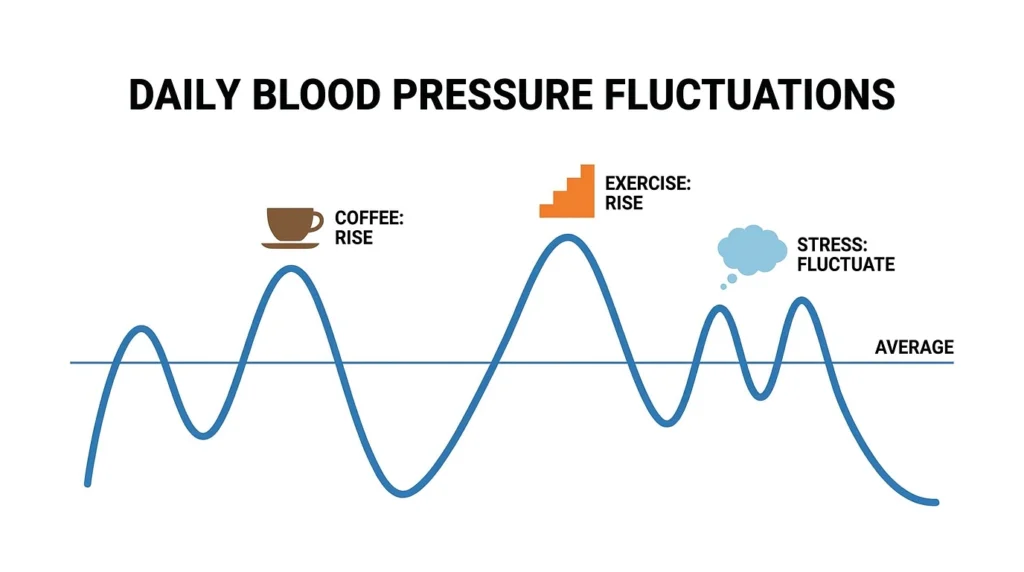
Blood pressure is not a fixed property like height or shoe size. It’s a live variable, responding continuously to posture, breathing, room temperature, and whatever crossed your mind ninety seconds ago. My nineteen-point spread was partly a wrong cuff and partly just what blood pressure looks like when you watch it closely.
Which means a single reading carries almost no information, and treating one as a verdict is the central mistake home monitoring invites.
What does carry information is a series. Two readings morning and evening, seven consecutive days, throw out everything from day one, average the rest. Day one runs high while you’re still getting used to the ritual. That average is a figure a physician can genuinely act on, and producing it is the entire reason home monitoring exists. Everything short of that is noise being mistaken for signal.
Before You Trust Another Reading
Matching the complete string including suffixes. Measure your upper arm and confirm the range printed on your cuff actually contains that number. Repair whichever of those two things is broken. Then run the seven-day series and take the whole log to your doctor rather than the single number that frightened you.
One exception overrides all of this. A very high reading alongside chest pain, severe headache, vision changes, confusion, or difficulty breathing is not a measurement problem. Stop measuring and get emergency care.