


A friend sent me a message last week that I haven’t been able to shake. Five years of psoriasis and psoriatic arthritis exercises. Feet so swollen some mornings that she crawls to the bathroom rather than walk. Tablets, injections, one biologic, then another, and nothing properly worked. And then at her last hospital appointment they discharged her back to her GP.
Her message just said “so that’s it then?”
It isn’t. I get why it felt like that, though, and I’d guess a fair few people reading this are sitting with the same letter. So here’s everything I found out while trying to help her, in roughly the order it was useful.
A Discharge Letter Doesn’t Mean Every Treatment Is Gone
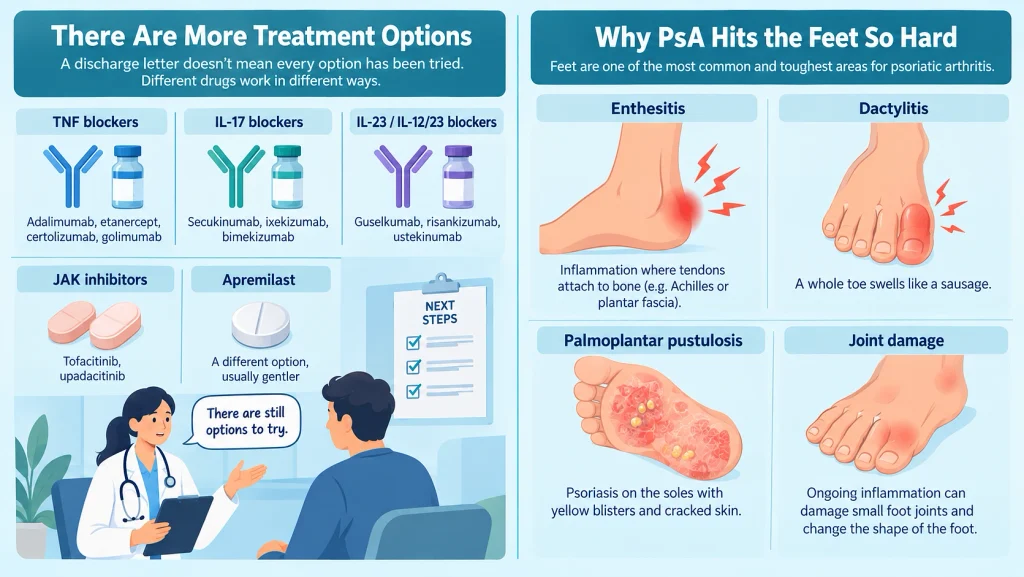
Get this straight first. A discharge usually means the clinic thinks it’s done what it can for now, or the service has rules about how long it keeps people on its books, or (honestly) someone ran out of ideas that day. It very rarely means every option has been tried. With psoriatic arthritis there are more drugs now than there have ever been.
The biologic and targeted drugs work in different ways, and failing one or two doesn’t mean you’ll fail the rest. Roughly, the groups are:
- TNF blockers: adalimumab, etanercept, certolizumab, golimumab. Usually the first biologic anyone gets.
- IL-17 blockers: secukinumab, ixekizumab, bimekizumab. Often very good for skin as well as joints.
- IL-23 and IL-12/23 blockers: guselkumab, risankizumab, ustekinumab.
- JAK inhibitors: tablets, tofacitinib and upadacitinib.
- Apremilast: a tablet that works another way again. Gentler, usually weaker.
Plenty of people who get nowhere on their first TNF blocker do much better when they switch to a drug that works differently. Moving from one TNF blocker to another sometimes helps, but changing group tends to give you a better shot. So the question to ask is simple: which ones have I had, and which groups are they in?
My friend had tried two. Both TNF blockers. That one fact changed the whole conversation.
Why PsA Hits The Feet So Hard
Feet are one of the worst spots for PsA, and knowing why tells you what to ask for.
- Enthesitis is inflammation where tendons fix onto bone. In the foot that’s the back of the heel (Achilles) or underneath it (plantar fascia). Feels like standing on a stone, worst first thing in the morning.
- Dactylitis is when a whole toe swells like a sausage. Doctors use it to tell PsA apart from other kinds of arthritis.
- Palmoplantar pustulosis is psoriasis on the soles and palms, yellow blisters and cracked skin. It’s stubborn and often needs its own plan.
- The small toe joints can get damaged and change the shape of the foot over time if the inflammation isn’t brought under control.
That last one matters most. Inflammation that runs on for years can damage joints for good. Which is exactly why “nothing more we can do” isn’t good enough while your feet are still swollen. It’s not only pain. It’s damage.
How To Get Back In Front Of A Specialist
This is where my friend got stuck, so it’s the bit I’d read twice.
- Go back to your GP and ask to be re-referred, ideally to a different rheumatology team. You can ask for a second opinion. It isn’t a legal right, but GPs say yes more often than people expect.
- Ask if there’s a combined dermatology and rheumatology clinic in your area. They exist for exactly this, skin and joints both out of control.
- If your GP won’t budge, contact the hospital’s PALS (Patient Advice and Liaison Service). They can chase things and explain what you’re entitled to.
- Ask your primary care doctor for a referral to a new rheumatologist, preferably at a university hospital, since they tend to see the harder cases.
- Get a copy of your full records first: every drug, dose, and how long you were on it.
- If insurance blocked a drug, ask about an appeal, or the maker’s patient support program.
What To Take To That Next Appointment
Doctors decide a lot on what they can see in about fifteen minutes. So make it easy for them to see.
- Every treatment you’ve had, with dates, doses and why you stopped. “Didn’t work after 4 months” and “stopped because of infections” lead to very different next steps.
- Photos of your feet on bad days. Swelling has a habit of going down by the time you’re in the chair.
- A two-week diary: minutes of morning stiffness, pain out of 10, how far you managed to walk.
- What it’s stopping you doing. Work, stairs, shoes you can’t get on, sleep. Be specific.
- Your questions written down, starting with: which drug groups haven’t I tried?
She told me she’d been saying “not too bad” at appointments because she didn’t want to seem like she was moaning. Please don’t do that. Say how it actually is.
Things That Help The Feet While You Wait

None of this replaces the right drug, but it can make the weeks less grim.
- A podiatrist, ideally one who sees rheumatology patients. Custom insoles can take pressure off inflamed heels and toes. On the NHS, ask your GP or rheumatology team to refer you.
- Wide, deep, cushioned shoes with a firm heel. Trainers or specialist footwear, not flat pumps.
- Cold packs on hot, puffy joints for 10 to 15 minutes. Some people prefer warmth for morning stiffness. Try both.
- Gentle calf and sole stretches, if they don’t make things worse.
- Thick emollient on cracked soles, because broken skin on feet can get infected.
A steroid injection into a very bad joint, or around a tendon, can sometimes settle things enough to walk while a new drug is being arranged. Worth asking.
The Exhaustion And Low Mood Are Part Of It
Five years of this would wear anyone down. PsA causes real fatigue, not just being tired, and people with psoriasis have higher rates of depression and anxiety. She said the discharge felt like being told she was making a fuss about nothing.
If that’s how you feel, tell your GP. Talking therapy, or sometimes medication, isn’t an extra here. It changes how you cope with everything else. And the patient groups can put you in touch with people who’ve been exactly where you are, which helped her more than either of us expected.
Where She’s Got To
She’s been re-referred to a different hospital with a joint skin and joint clinic. She’s taking a list of the two drugs she’s had, both from the same group, and a folder of photos on her phone. No date yet. Her feet are still bad. But she’s stopped saying “that’s it”, and I think that matters more than it sounds.
If your feet are like hers, the same applies to you. There’s more on the table than the discharge letter makes it sound.
Written from helping a friend and from reading around, not medical advice. Talk to a doctor before changing any treatment.
Reference:
- National Psoriasis Foundation (US): https://www.psoriasis.org/
- Psoriasis Association (UK): https://www.psoriasis-association.org.uk/
- Versus Arthritis, Psoriatic arthritis (UK): https://www.versusarthritis.org/about-arthritis/conditions/psoriatic-arthritis/
- NHS, Psoriatic arthritis: https://www.nhs.uk/conditions/psoriatic-arthritis/
- NICE, Psoriasis: assessment and management (CG153): https://www.nice.org.uk/guidance/cg153