

Key Takeaways
- Peritoneal dialysis is often a first modality rather than a permanent one. A Dutch cohort of 695 patients recorded a 29% technique failure rate in the first year, and 35% at two years once deaths were excluded.
- Most patients get a fair explanation of the initial choice. Very few get told what happens when PD stops working.
- Mortality peaks in the first month after a switch to hemodialysis, and a high proportion of these switches happen as emergencies rather than planned moves.
- Peritonitis and mechanical problems drive most technique failures.
- The practical protection is unglamorous prepare vascular access before you need it, ideally while PD is still working well.
The Conversation That Gets Skipped
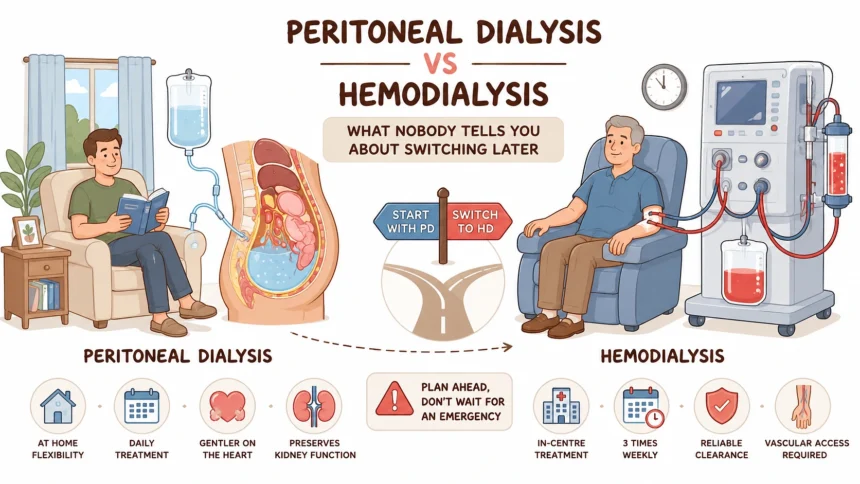
Most people starting dialysis receive a reasonable version of the standard comparison. Machine at a centre three times a week, or fluid exchanges managed at home. Needles or an abdominal catheter. Fixed schedule or flexible one. That summary is accurate as far as it goes.
Peritoneal dialysis uses the lining of your own abdomen as a filter. That lining is living tissue, and it changes with exposure to dialysis fluid and with infection. Scarring accumulates. Filtering capacity falls. At the same time, the residual kidney function that made PD adequate at the start quietly disappears. None of this represents a failure by the patient or by the treatment. It is how the therapy behaves across years rather than months.
| # | Hemodialysis (in-centre) | Peritoneal dialysis |
|---|---|---|
| How filtering works | Blood is pumped through an artificial membrane outside the body | Your own peritoneal membrane filters inside the abdomen |
| Access required | Fistula, graft, or neck catheter | Soft catheter in the abdominal wall |
| Schedule | Around 4 hours, 3 times weekly, at a fixed appointment | Daily. Manual exchanges through the day, or overnight on a machine |
| Location | Dialysis unit, with travel each session | Home, work, or while travelling |
| Who operates it | Nursing staff | You, or a trained partner or carer |
| Clearance pattern | Intermittent and intensive | Continuous and gentle |
| Effect on the heart | Rapid fluid removal can drop blood pressure | Steadier, easier on a weakened heart |
| Residual kidney function | Declines faster | Preserved longer |
| Main complications | Access problems, infection, post-session fatigue | Peritonitis, membrane failure, hernias |
| Fluid and diet limits | Tighter, particularly between sessions | Generally more relaxed |
| Home requirements | None for in-centre treatment | Storage for monthly fluid deliveries, clean space for exchanges |
| Typical time on therapy | Can continue many years | Often limited by technique failure |
Long-term survival between the two is broadly comparable in patients eligible for either. PD tends to show an advantage in the first 1.5 to 2 years, particularly among younger patients, non-diabetics, and those with residual kidney function. That advantage needs reading with caution. The early PD benefit seen in population studies may reflect selection rather than the modality itself, since healthier patients are more likely to choose home therapy.
How Often Does Peritoneal Dialysis Stop Working?
In a Dutch cohort of 695 patients who started PD between 2012 and 2016, technique failure reached 29% within the first year. With deaths excluded, failure rates were 23% at one year and 35% at two years, and median time to failure was 3.58 years.
Registry data from elsewhere shows a comparable pattern, with roughly 20% of patients transferring to hemodialysis during their first year on PD.
Both halves of the Dutch finding deserve attention. About a third of PD patients transfer within two years. The median patient still gets close to three and a half years. Which figure describes you depends largely on your peritonitis history and how quickly residual function fades.
This is not an argument against starting PD. It is an argument against starting PD under the impression that the matter is settled.Why The Switch Happens
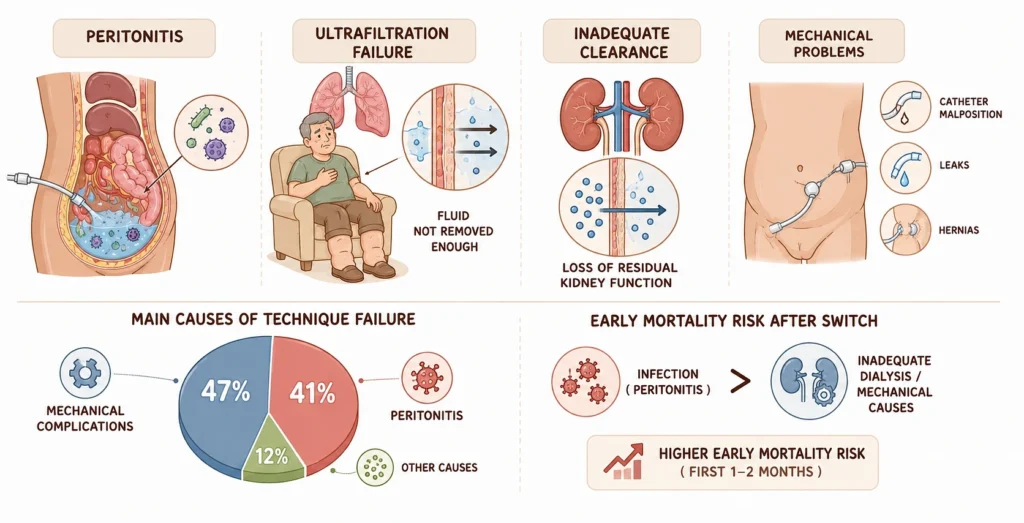
The causes fall into a few groups that behave quite differently.
- Peritonitis. Infection of the peritoneal membrane. Usually treatable, but repeated episodes leave scarring that eventually makes the membrane unusable.
- Ultrafiltration failure. The membrane no longer removes enough fluid. This develops gradually, and the first sign is often unexplained swelling or breathlessness.
- Inadequate clearance. Frequently tied to losing residual kidney function, which had been handling part of the workload without anyone noticing.
- Mechanical problems. Catheter malposition, leaks, hernias.
One published series attributed 47% of technique failures to mechanical complications and 41% to peritonitis. Proportions differ between units, though infection and mechanical issues dominate almost everywhere.The clinically important distinction patients who transferred for infectious reasons showed higher early mortality than those transferring because of inadequate dialysis or mechanical causes.
What The Transition Actually Looks Like.
A single-center study followed 60 patients moving from PD to hemodialysis. Of those, 37 had an unplanned HD start, with peritonitis the commonest cause. All 60 were hospitalized during the transition, with a median stay of 4.5 days. Nine died within two months of starting hemodialysis. At the two-month mark, only 23 of the 51 surviving patients had a mature fistula.
Sixty patients, one centre, published in 2013. Treat those percentages as illustrative rather than definitive. The authors’ broader conclusion, that unplanned hemodialysis starts are a common problem among patients transferred from PD, is consistent with wider clinical experience.
The larger registry evidence carries more weight and points the same direction. Across four national registries covering fifteen countries, crude mortality was highest during the first 30 days after transfer to hemodialysis, reaching its lowest point at four to six months. Older age and longer time on PD were both associated with increased risk, most strongly within the first 90 days. The authors framed their findings as evidence of patient vulnerability at the point of modality transfer, and of the need to improve how transitions are handled.
There is one genuinely encouraging finding in that data. Crude mortality rates were lower among patients transferring in more recent years compared with earlier cohorts. Units are improving at this. Not uniformly, and not everywhere.
Why So Many Transfers Become Emergencies
PD is working. Nobody wants to open a conversation about it failing, partly because it feels like planning for defeat and partly because there is no obvious moment to do it. Creating a fistula means an operation the patient does not currently need, followed by several months of maturation. So it waits.
Then peritonitis arrives, or the membrane gives out across a fortnight, and the time has run out. The patient goes into hospital acutely unwell, receives a neck catheter, and starts hemodialysis in close to the worst available circumstances.
What To Ask Your Kidney Team
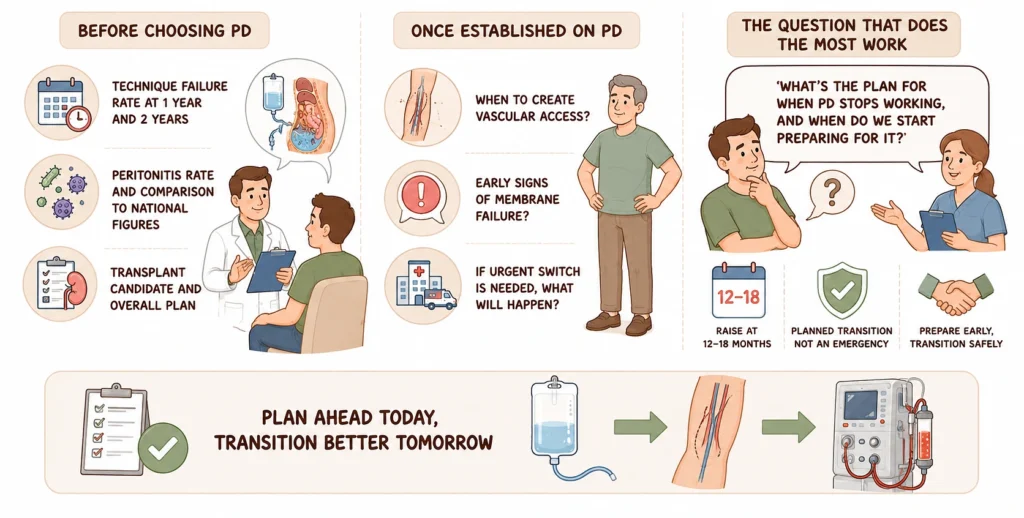
Ask these early, while things are stable.
Before choosing PD
- What is this unit’s technique failure rate at one year and at two years?
- What is the peritonitis rate here, and how does it compare with national figures?
- Am I a transplant candidate, and where does that sit in the overall plan?
Once established on PD
- At what point would you recommend creating vascular access?
- Which early signs of membrane failure should I watch for?
- If I needed to switch urgently, what would actually happen?
The question that does the most work
“What’s the plan for when PD stops working, and when do we start preparing for it?”
Note the phrasing. Not “if.” Raising this at the twelve to eighteen month mark, while PD is still going well, is what turns a probable emergency into a planned transition.
What This Does Not Mean
PD carries real advantages, including flexibility that allows people to keep working, preservation of residual kidney function, and lower cardiovascular impact. For patients with residual kidney function and no contraindications, beginning with PD makes clinical sense both to capture the early survival advantage and to protect what kidney function remains. No needles three times a week, no travel to a unit, and considerable control over your own week.
The narrower point is this. PD is a strong first modality and a weak assumption about the next decade. Patients who understand that from the start handle the eventual transition far better than those who experience it as a treatment that let them down.
References
- Bonenkamp AA, et al. Technique failure in peritoneal dialysis: Modifiable causes and patient-specific risk factors. Peritoneal Dialysis International, 2023. Largest cohort cited here, 695 patients.
- Nadeau-Fredette AC, et al. Mortality Trends After Transfer From Peritoneal Dialysis to Hemodialysis. Kidney International Reports, 2022;7:1062-1073. Multinational registry data, four registries, fifteen countries.
- Transferring From Peritoneal Dialysis to Hemodialysis: Proceed With Caution. Kidney International Reports, 2022.
- Is transition between peritoneal dialysis and hemodialysis really a gradual process? Peritoneal Dialysis International. Small single-centre study, 60 patients.
- Predictors of Transfer to Home Hemodialysis after Peritoneal Dialysis Completion. CJASN.
- Comparison of peritoneal dialysis with hemodialysis on survival of diabetic patients with end-stage kidney disease: a meta-analysis.
- Peritoneal Dialysis in Acute Kidney Injury: Trends in the Outcome across Time Periods.
- The Peritoneal Membrane: A Potential Mediator of Fibrosis and Inflammation among Heart Failure Patients on Peritoneal Dialysis.