

Key Takeaways
- The medical term for managing kidney failure without dialysis is conservative kidney management (CKM). It appears in international guidelines and it is not the same as stopping treatment.
- The people it suits most are generally over 75, frail, living with heart disease, or carrying several serious conditions at once.
- Frailty predicts more than age alone. A frail 72 year old may lose more from dialysis than a robust 82 year old.
- Younger patients with reasonable health elsewhere gain years from dialysis and especially from a transplant. CKM stays available to them, but it is not the clinical recommendation.
- The decision reverses in both directions. People move onto dialysis after starting CKM, and people withdraw from dialysis after starting it.
An Appointment That Happens Too Often
An eighty four year old woman with heart failure, moderate dementia and an eGFR of 9 is booked for fistula surgery next month. Her daughter has taken unpaid leave to manage the transport. Nobody in the room has said the words “conservative management” out loud.
This is not negligence. Nephrology is a specialty built around keeping people alive, and dialysis is the tool it has. But for a specific group of patients, dialysis buys very little extra time and costs a great deal of what remains. Conservative management stays underused largely because of an entrenched belief that dialysis is the only effective option for every patient with kidney failure, whatever it does to their survival or their quality of life.
What Is Conservative Kidney Management?
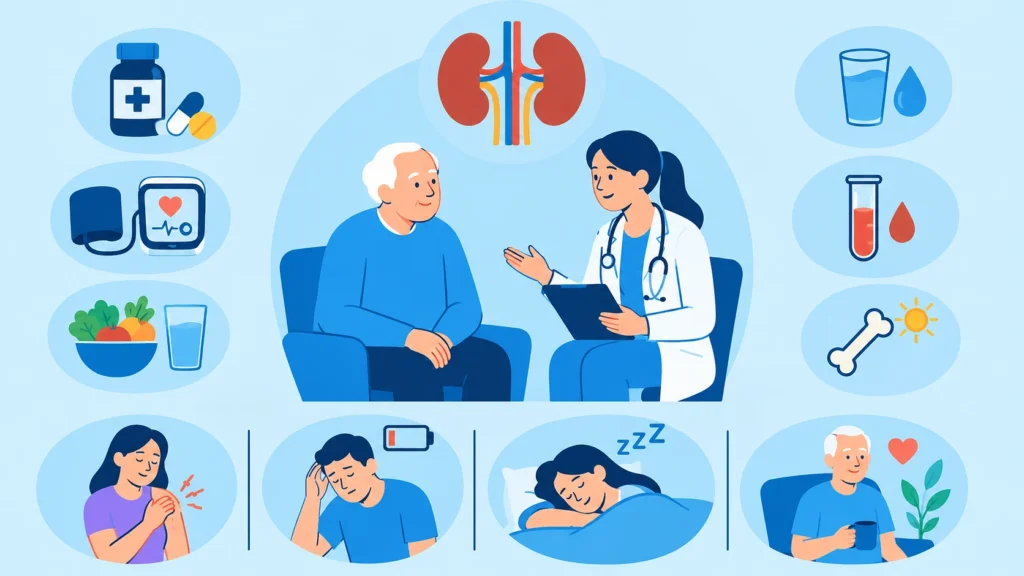
Declining dialysis is not declining treatment. Nearly everything else carries on.
The KDIGO 2024 CKD guideline treats CKM as part of the standard care pathway rather than an afterthought. The updated guideline covers the full patient journey from early diagnosis through to decisions about kidney replacement therapy, with conservative care included. Informing people with CKD about conservative care and their option to forego dialysis is described as an essential part of patient centered practice, with advance care planning sitting under the same umbrella.
Some kidney units call it maximal conservative care. The word “maximal” is doing real work. This is active treatment with the target shifted from length of life to how the days actually feel.
What Treatment Continues On A CKM Pathway?
Most of the medication stays in place. Current guidance supports SGLT2 inhibitors for proteinuric kidney disease with or without diabetes, RAAS inhibitors for blood pressure and proteinuria control, statins to reduce cardiovascular risk, and finerenone in type 2 diabetes with CKD. None of these reverse established kidney failure. They can flatten the slope.
Alongside that:
- Fluid overload gets managed aggressively, using higher dose loop diuretics, fluid restriction and daily weights taken at home.
- High potassium is controlled with potassium binders and dietary adjustment.
- Metabolic acidosis is corrected with sodium bicarbonate, which is inexpensive and does more for appetite and energy than most patients expect.
- Anaemia is treated with erythropoiesis stimulating agents and iron, aimed at how someone feels rather than at a normal haemoglobin figure.
- Bone and mineral disease is managed with phosphate binders and vitamin D analogues.
Then there are the symptoms themselves. Itching, nausea, restless legs, and that particular exhausted but sleepless quality of uremic fatigue. This is where CKM parts company most sharply with dialysis track care. The stated goal is preservation of quality of life through proper symptom control, rather than prolonging life as such. Palliative care specialists get involved early, sometimes years before anyone would describe the situation as end of life.
Who Is Conservative Kidney Management Right For?

Frailty Is The Strongest Single Signal
The landmark evidence comes from a 2009 New England Journal of Medicine study of 3,702 American nursing home residents who started dialysis. The findings are sobering. Among nursing home residents with end stage renal disease, starting dialysis was associated with a substantial and sustained decline in functional status. Cumulative mortality reached 24% at three months and 58% at twelve months after starting treatment. At the twelve month point, only 13% had held onto the level of function they had before dialysis began.
The lead author’s own summary is worth sitting with. In patients with multiple chronic illnesses, Kidney disease failure may itself be part of the dying process, which is why function keeps declining despite dialysis, and why in some of these patients dialysis prolongs suffering rather than life.
One caution. That study looked at nursing home residents specifically, so it does not transfer cleanly to a frail person still living independently at home. What it does explain is why frailty measures (grip strength, gait speed, unintentional weight loss, exhaustion, low activity) often tell a nephrologist more than the eGFR number does.
Age Over 75, And Particularly Over 80
The survival advantage of dialysis narrows steeply as patients get older.
One single centre cohort study found no statistically significant survival advantage for renal replacement therapy over conservative management in patients aged 80 and above, with higher comorbidity eroding whatever advantage was left. A Dutch value based cohort study found the same pattern. The overall survival benefit of the dialysis pathway either diminished or lost statistical significance in patients aged 80 or older, and in those with severe comorbidity.
Most patients have never been told this, because the framing they receive is that dialysis is simply what keeps you alive.Heart Disease And Multiple Conditions
Haemodialysis is haemodynamically demanding. Each session removes fluid quickly enough to drop blood pressure, and patients with limited cardiac reserve tolerate that poorly. Across the published literature, dialysis prolonged survival mainly in younger and less comorbid patients, and that advantage diminished as frailty and multimorbidity increased.
Dementia And Cognitive Impairment
A patient who cannot retain why they are taken somewhere three times a week to sit connected to a machine experiences that as distress, repeatedly, without the understanding that would make it bearable. In a Madrid cohort, choosing conservative kidney management over haemodialysis was more common among patients who were older, frail, dependent on assistance and cognitively impaired.
A Considered Personal Choice
Older patients with advanced CKD often place staying independent in daily activities above survival, and factors beyond life expectancy (quality of life, treatment burden, the impact on family, and cost) drive the decision toward conservative management.
A fully informed patient who decides that four hours in a chair three times a week is not how they want to spend the time they have left has made a legitimate choice. That is not giving up.Who Should Not Choose Conservative Management?
Younger patients with limited other illness. The same studies showing no survival benefit in the frail elderly show a genuine benefit in less comorbid patients. For someone in their fifties with reasonable health elsewhere, the difference is measured in years.
Anyone who might be a transplant candidate. This deserves separating out, because reluctance about dialysis often gets misread as reluctance about all treatment. They are different things. Pre-emptive transplantation, carried out before dialysis ever starts, produces the best outcomes of any pathway, and recipients return to work and travel in a way dialysis patients mostly do not. If there is a possible living donor anywhere in the family, the whole conversation changes.
Patients with a reversible cause. Obstruction, certain glomerular diseases and drug induced injury all need excluding first.
Anyone deciding on poor information. Some patients decline dialysis because it was described to them in frightening terms, or because nobody mentioned home haemodialysis or peritoneal dialysis. Neither of those involves the three times weekly journey to a centre. A decision made without that information is not really a decision.
How Long Can You Live With Kidney Failure Without Dialysis?
Without dialysis or a transplant, established kidney failure progresses to death. Conservative management does not change that.
Anyone offering a confident survival figure is overstating what the evidence supports. Median survival estimates for conservative management patients range enormously across published studies, from 1 to 45 months, with one year survival rates falling anywhere between 29% and 82%, which makes consistent advice genuinely hard to give. A nephrologist looking at your own rate of decline and your other conditions can narrow that range far better than any published figure.
In the Dutch cohort, conservatively managed patients recorded 352.7 hospital free days per year against 282.7 days for patients on the dialysis pathway, and there were no significant differences between the two groups on physical or mental health quality of life scores. That is roughly seventy extra days at home each year, with no measured quality of life penalty. Wider reviews report the same thing, with conservative management delivering comparable or better health related quality of life.
Can You Change Your Mind Later?
Yes, and in both directions. This is worth saying plainly, because the choice feels far more permanent than it actually is.
In one published cohort, twelve patients who initially chose renal replacement therapy switched across to conservative management, while two who initially chose conservative management moved onto dialysis. Withdrawal from dialysis is a recognised decision with established supportive pathways built around it.
Some units offer a defined trial of dialysis, perhaps three months, with an honest review agreed in advance. It turns something that feels irreversible into an experiment, which suits patients who genuinely cannot predict how they will cope.
Most units do not offer this. The reasons are administrative rather than clinical. Somebody has to own the review, schedule it, and be prepared to say the trial has failed, and that role does not sit in anyone’s job description. It is a sound idea that mostly does not happen, and there is no satisfying explanation for why.
How To Raise This With Your Nephrologist

The sentence to bring into the appointment:
“I’d like to understand conservative kidney management as an option for me specifically.”
The clinical term signals that you have read something. The phrase “for me specifically” asks for a personalised assessment rather than a general explanation of what CKM is.
Useful follow up questions:
- Given my age and my other conditions, how much extra time would dialysis realistically give me?
- How many hospital days would you expect on each pathway?
- Does this unit have a conservative care or renal supportive care clinic?
- Am I a transplant candidate, and has that been formally assessed?
- If I chose conservative management and later changed my mind, how quickly could dialysis start?
One thing to be aware of before you go in. Comorbidities, daily functioning and cognitive status all feed into these assessments, but no standardised criteria currently exist for deciding dialysis suitability. Two nephrologists can weigh the same patient differently. That is an argument for asking directly, and for seeking a second opinion if the answers feel thin.
The Decision Belongs To You
The right answer for a fit sixty year old and for a frail eighty five year old with heart failure is not the same answer. Stated plainly that sounds obvious, and it still gets lost, because dialysis is presented as the default and everything else reads as refusal.
Conservative kidney management is a real clinical pathway with evidence behind it, appropriate for a specific group of patients and inappropriate for others. Working out which group you belong to is the whole question, and you are entitled to have it answered directly.