

Key Takeaways
- His LDL fell 18 points on seven months of low-fat eating. His non-HDL cholesterol fell six, and non-HDL counts every artery-clogging particle instead of one subset.
- Triglycerides went from 148 to 211 mg/dL, which is the number that quietly corrupted the LDL figure printed on his report.
- Most labs never measure LDL. They estimate it, and the standard estimate runs about 9 mg/dL low once triglycerides pass 150.
- The biggest low-fat trial ever run put 48,835 women on a 20% fat target for eight years. LDL moved 3.55 mg/dL. Heart disease rates did not move at all.
- Cutting fat is half an instruction. The half that decides the result is what replaces it, and refined carbohydrate is the replacement that erases the benefit.
- Non-HDL, triglyceride-to-HDL ratio, and apoB tell you more than LDL alone. Two of those three are already on the panel you have.
The lab pushes results to a portal now, so I read his second panel on my phone in a parking lot, which is a stupid place to read anything medical. LDL was down. That had been the whole point of the previous seven months, so, good, fine.
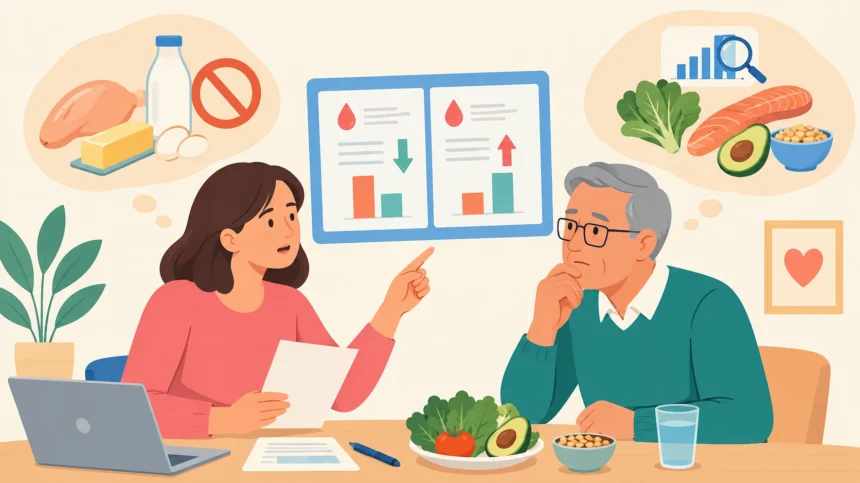
He is 68 and hypertensive. The first panel came back at 232 total cholesterol, LDL 154, and his doctor gave him the instruction American doctors have handed out since before I was born. Cut the fat. I backed her up, because I am the one in the family who reads studies, and when he asked whether she was right I said yes and then went further and helped him execute it. Butter gone. Whole milk gone. Eggs rationed to two a week. Chicken thighs traded for breast, cooked dry, which he hated and mentioned on roughly every phone call.
What Two Lipid Panels Showed Seven Months Apart
| Marker | Panel 1 | Panel 2 | Change |
|---|---|---|---|
| Total cholesterol | 232 mg/dL | 219 mg/dL | −13 |
| LDL (calculated) | 154 mg/dL | 136 mg/dL | −18 |
| HDL | 48 mg/dL | 41 mg/dL | −7 |
| Triglycerides | 148 mg/dL | 211 mg/dL | +63 |
| Non-HDL | 184 mg/dL | 178 mg/dL | −6 |
| Triglyceride : HDL | 3.1 | 5.1 | worse |
Why Non-HDL Cholesterol Told A Different Story Than LDL
Non-HDL is total cholesterol minus HDL. Four seconds of subtraction, and the components are already sitting on the report unlabeled.That single figure sweeps in LDL, VLDL, IDL, and remnant particles, meaning everything carrying apolipoprotein B, which is the protein that lets a particle burrow into an artery wall and stay there. LDL is one member of that family. Non-HDL is the family.
His went from 184 to 178.
Seven months of dry chicken breast for six points.
The Triglyceride To HDL Ratio Nobody Circled On His Report
Divide triglycerides by HDL. His went from 3.1 to 5.1.
That ratio is a rough proxy for insulin resistance and for the presence of small dense LDL particles, and it moved in the wrong direction while the headline number moved in the right one. A lab prints it nowhere. You have to want it.Your Lab Probably Calculated Your LDL Instead Of Measuring It
I did not know this properly, and I have been reading nutrition research for years, so it goes near the top rather than buried in a footnote.
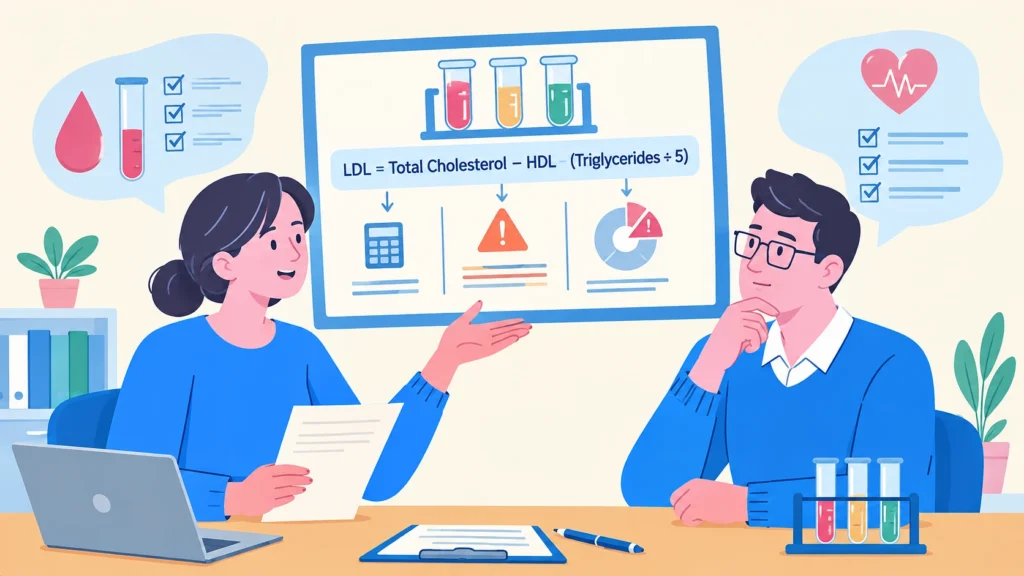
Your panel measured three things: total cholesterol, HDL, and triglycerides. LDL was arrived at by arithmetic.
How The Friedewald Equation Breaks Down At High Triglycerides
The Friedewald equation is LDL = total cholesterol − HDL − (triglycerides ÷ 5). That divide by five assumes a fixed ratio between triglycerides and VLDL cholesterol. The ratio is not fixed. It shifts between people, and it shifts inside the same person depending on what they have been eating and whether they fasted.
What happens to the estimate when triglycerides climb? It starts undercounting. Measured against direct testing, Friedewald runs roughly 9.0 mg/dL low in people with triglycerides between 150 and 199, and the gap widens from there. His were at 211.
So the 18-point drop I was pleased about in that parking lot was partly manufactured by the thing that got worse. Triglycerides rose, the formula subtracted more, the LDL number came down on paper.Better Equations Exist And Your Lab May Not Use Them
The Martin-Hopkins method swaps the flat divide-by-five for an adjustable factor set by triglyceride and non-HDL levels, and it tracks measured LDL and apoB more closely. The Sampson equation was built for people with genuinely high triglycerides.
One Spanish hospital ran 108,000 lipid profiles through all three and found Friedewald disagreed with Martin-Hopkins on 15% of samples. Fifteen percent is not a rounding error when the number decides whether somebody starts a statin.
What To Ask For At The Next Draw
- Direct LDL rather than calculated, especially if triglycerides sit above 150.
- ApoB, which counts particles instead of the cholesterol inside them.
- Lp(a) once in your life, because it is largely genetic and diet will not touch it.
- Whether the lab uses Martin-Hopkins, which costs nothing extra to apply.
- A fasting draw if triglycerides have been erratic, since non-fasting samples read differently.
Where The Low-Fat Instruction Came From In The First Place
Low-fat did not arrive from a trial. It came out of a chain of reasoning that sounded airtight: saturated fat raises LDL, LDL turns up in plaque, therefore less fat means less plaque.
Every link in that chain is defensible on its own. The chain skipped one question, which was what people would eat instead. For about twenty years the answer was bread, cereal, and fat-free yogurt with sugar stirred in so it tasted like food.
My mother still keeps a tub of margarine in the fridge door out of a habit she formed in 1987. I stopped arguing about it. Separate fight, smaller one.
The Women’s Health Initiative Tested Low-Fat On 48,835 Women

The Women’s Health Initiative Dietary Modification Trial is the largest test low-fat eating has ever received, and it is not a close contest. Just under 49,000 postmenopausal women. Forty clinical centers. A target of 20% of calories from fat, propped up with group sessions and one-on-one counseling. Eight years of intervention, then mortality follow-up running to 2013.
The intervention arm did the work:
- Fat intake dropped 8.2% of total energy.
- Vegetables and fruit rose by about a serving a day.
- Grains rose half a serving.
- Saturated fat came down 2.9%, monounsaturated 3.3%, polyunsaturated 1.5%.
The payoff was LDL down 3.55 mg/dL and diastolic blood pressure down 0.31 mm Hg. HDL, triglycerides, glucose, and insulin showed no meaningful separation from the comparison group. Coronary heart health, stroke, and total cardiovascular disease came out statistically indistinguishable.
The Subgroup Finding That Complicates It
Women who entered without cardiovascular disease and with normal blood pressure did see a coronary benefit, hazard ratio 0.70. Some of that benefit was offset by a rise in ischemic stroke risk in the same group. Among women who were already hypertensive, it disappeared.
My father is hypertensive. He was sitting in precisely the slice of the population the trial had the least to offer.Substitution Is The Entire Argument
This is where I was sloppy, and I would rather be specific about the sloppiness than vague about it.Saturated Fat Swapped For Polyunsaturated Fat
Pull saturated fat out, put polyunsaturated fat in, meaning walnuts, sunflower and soybean oil, fatty fish. LDL comes down and the total-to-HDL ratio improves. That effect is old, replicated, and not in serious dispute. HDL dips slightly, LDL dips more, the ratio ends up better.
Saturated Fat Swapped For Refined Carbohydrate
Pull the same saturated fat out, put white bread in, and the picture inverts. Triglycerides rise. Small dense LDL particles increase. HDL falls. That trio is the signature of insulin resistance and metabolic syndrome, and the clinical reference literature puts low-fat high-carbohydrate patterns at a 3% to 9% HDL reduction across both short and long interventions.
What My Father Actually Put On The Plate
- Bagels, because they are fat-free and he likes them.
- Pretzels instead of the almonds he used to keep in the car.
- Fat-free flavored yogurt, which is sugar with a dairy delivery system.
- Orange juice, on the theory that fruit is fruit.
- More pasta, since the sauce held the fat.
Every one of those follows the instruction correctly. He did not cheat. He complied, and compliance took him somewhere worse.
The Foods That Do Lower LDL Without This Trade
Fiber is the part that got lost when fat became the villain. Soluble fiber binds bile acids in the gut and forces the liver to pull cholesterol out of circulation to make more.
- Oats and barley, for the beta-glucan.
- Beans, lentils, chickpeas.
- Psyllium husk, which is the concentrated version.
- Apples, pears, citrus, for the pectin.
- Nuts, which land on both the fiber list and the unsaturated fat list
The Mediterranean Trials Used Low-Fat As The Control Arm
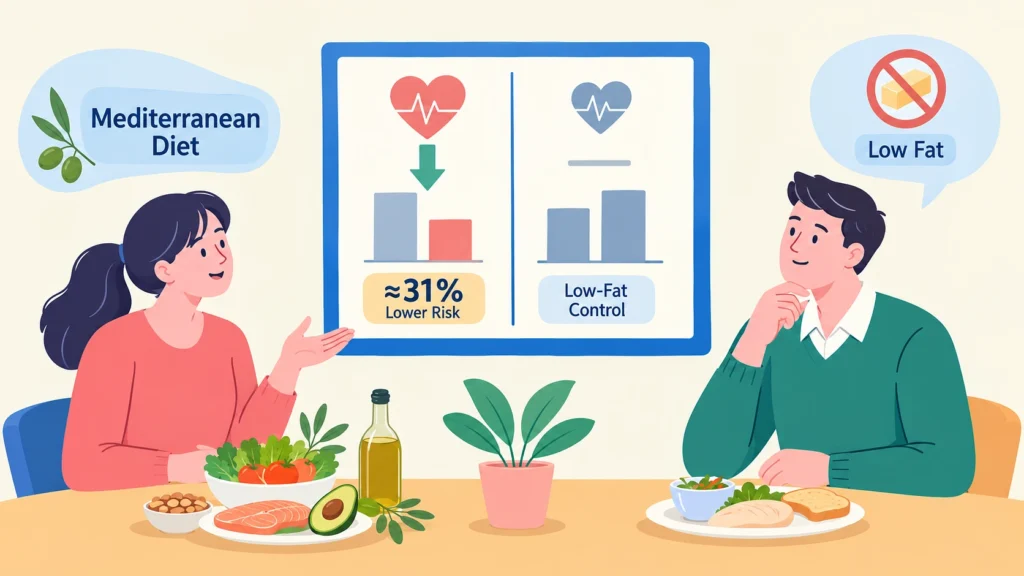
PREDIMED randomized 7,447 high-risk Spanish adults into three arms: Mediterranean diet with about a liter of extra virgin olive oil weekly, the same diet with 30 grams of mixed nuts daily, or a control arm counseled to eat low fat. The trial stopped early. The olive oil group came in around 31% lower on the combined outcome of heart attack, stroke, and cardiovascular death.
Read the control arm again. Low fat was the thing the olive oil beat.
The Retraction I Still Think About
The 2013 version of that paper was pulled. Some participants had been assigned by household or by clinic rather than randomized individually, which is a genuine methodological failure and not a technicality.
The authors reanalyzed, republished in 2018, and the effect held at close to the same magnitude. I find that reassuring. I do not find it as reassuring as a trial that never had the problem, and anyone who cites PREDIMED without mentioning this is selling you something.
CORDIOPREV Ran The Comparison Again
A later Spanish trial put Mediterranean against a properly supervised low-fat arm in people who already had coronary disease, with both groups tracked and counseled equally, and landed near the same 30% figure. The low-fat arm in that one was a real intervention rather than a leaflet, which was the standing criticism of PREDIMED’s control group.
Where DASH Fits, Since Blood Pressure Is Half The Problem
His hypertension is the reason the low-fat subgroup data mattered, so it deserves more than a mention.DASH works on a different mechanism than the fat question entirely. It pushes potassium, calcium, and magnesium up through vegetables, fruit, legumes, and low-fat dairy, and pushes sodium and added sugar down. Blood pressure responds to that mineral shift within weeks.
The two patterns overlap heavily. Vegetables, whole grains, legumes, nuts, fish. The American Heart Association’s 2021 dietary guidance abandoned nutrient-percentage targets almost completely in favor of food-based advice, and both DASH and Mediterranean score well against it.
What He Eats Now
Olive oil is back, generously. Almonds replaced the pretzels in the car. Fish twice a week, which took negotiating. Eggs are no longer rationed.
Bread went whole grain and went down in volume. Juice went entirely. Oats most mornings.
He kept the chicken breast, which surprised me. Says he got used to it.
Third panel is in October. I have asked for a direct LDL and an apoB if the doctor will order them, and I genuinely do not know whether she will.Saturated fat still matters, and I want that stated plainly, because a corner of the internet took “low-fat was oversold” and drove it straight into eating butter by the spoonful. Replacing it with polyunsaturated fat lowers LDL. Nothing I have read overturns that.