

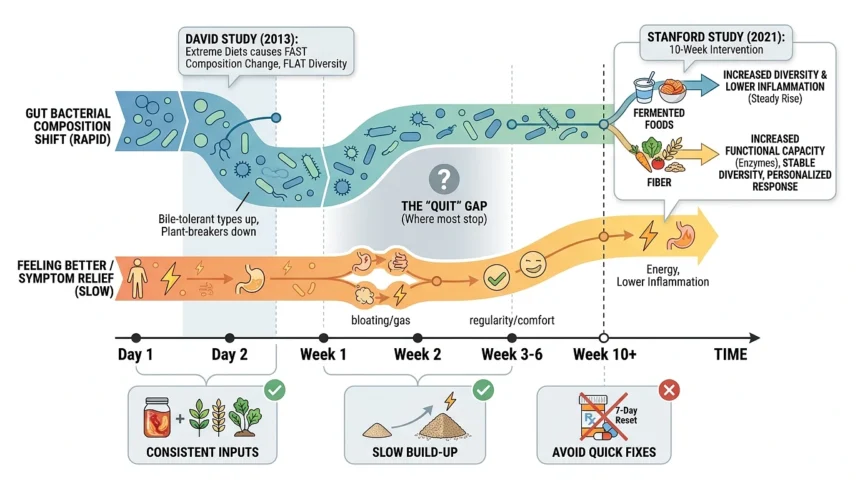
Change what you eat today and the bacteria in your gut start shifting within a single day. That part is genuinely fast. What isn’t fast is the bit you care about, which is feeling different. Symptoms, energy, bloating, the sense that your digestion has finally sorted itself out, all of that runs weeks behind the bacteria.
Most people quit somewhere inside that gap. It's the whole story of why gut health advice fails, and almost nobody explains it.The 24-Hour Part Is Real, And Weirder Than You’d Guess
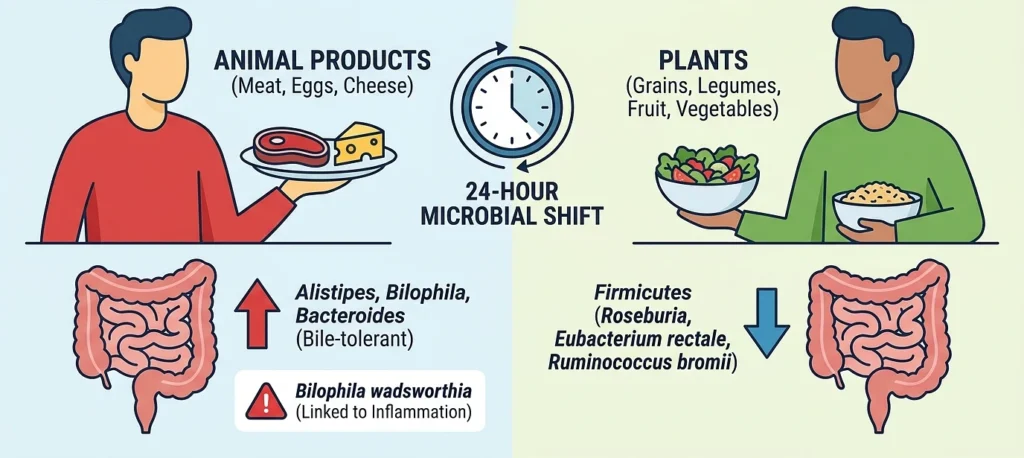
In 2013 a team led by Lawrence David at Harvard put ten volunteers on two extreme diets. One group ate nothing but animal products meat, eggs, cheese. The other ate nothing but plants grains, legumes, fruit, vegetables. Then they sequenced what happened inside them.
The results, published in nature, came back faster than anyone predicted. The study found the microbial community changed within a single day, and the shift was big enough to overwhelm the differences that existed between individuals beforehand.
That second part deserves a pause. Everyone’s gut microbiome is distinctive, closer to a fingerprint than a blood type. Four days of eating only animal products pushed ten different people’s guts in the same direction anyway.
What Actually Moved
The animal-based diet raised bile-tolerant organisms Alistipes, Bilophila, Bacteroides. It dropped the Firmicutes that break down plant polysaccharides, including Roseburia, Eubacterium rectale and Ruminococcus bromii. The resulting pattern mirrored the gap between carnivorous and herbivorous mammals.
One finding gets less attention than it should. Bilophila wadsworthia grew on the animal diet, and it has been linked to inflammatory bowel disease in mice. The researchers read this as support for a chain running from dietary fat, through bile acids, to the outgrowth of microbes capable of triggering intestinal inflammation.
Four days of eating produced a measurable shift toward a bacterium associated with gut disease. That’s how responsive this system is.
So Why Does Nothing Feel Different?
Here’s where the honest version of this splits from the ones selling you a seven-day gut reset.
Bacterial composition changing is not the same event as you feeling better. Composition is who lives there. What you experience depends on what those organisms produce, how your gut lining responds, how your immune system reads the situation, and how much of any of it has piled up.
Short-chain fatty acids, the compounds gut bacteria make from fiber and the main reason anyone bothers feeding them, depend on population sizes that take time to build. Inflammatory markers move slowly. The gut lining replaces itself on its own schedule. A bacterial population can double overnight while the downstream effects take a month to reach your mornings.
The detail that reframes everything
There’s a wrinkle in the David study worth sitting with. Within-sample species diversity, the measure people mean when they say “gut diversity,” did not significantly change during either diet arm.
Composition shifted dramatically. Diversity held flat.
Four days is enough to change who's in the room. It isn't enough to change how many different kinds are in the room.What Happened When Researchers Ran It Properly
If four days is too short, what does an adequate timeline look like?
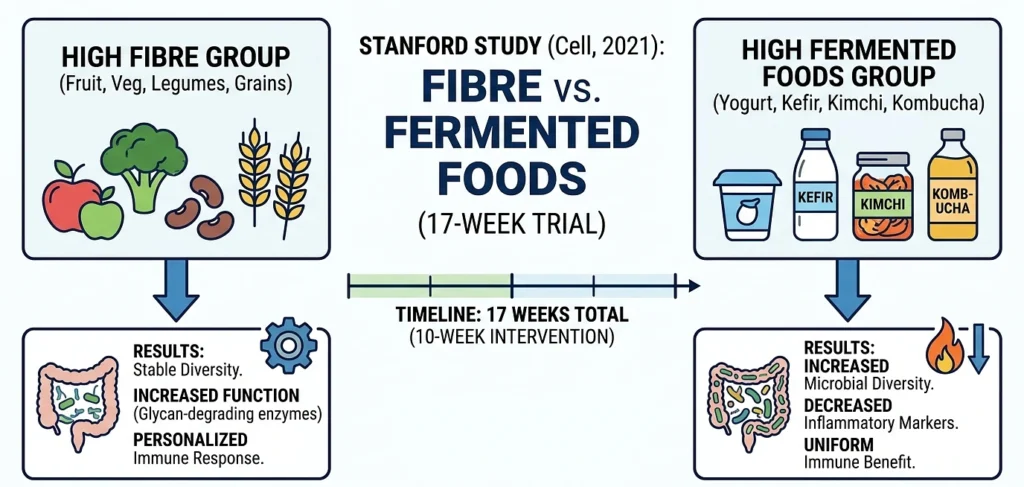
Stanford answered that. Published in Cell in 2021, the trial put 36 healthy adults into two arms across a 17-week randomised study with a 10-week intervention at its core.
One group increased fibre: fruit, vegetables, legumes, nuts, seeds, whole grains. The other increased fermented foods: yogurt, kefir, kimchi, fermented cottage cheese, vegetable brine drinks, kombucha.
The researchers expected fibre to win.
It didn’t
The fermented food group showed a steady rise in microbial diversity and a broad drop in inflammatory markers, with larger servings producing stronger effects. Justin Sonnenburg called it a stunning finding, and one of the first examples of a simple dietary change reproducibly remodelling the microbiota across a whole group of healthy adults.
The fibre group did something else entirely. Community diversity stayed stable. What changed was function: the microbiome’s capacity to encode glycan-degrading enzymes went up, meaning the bacteria already present got better at their jobs rather than being joined by newcomers. Immune responses in this arm were personalised rather than uniform, splitting participants into distinct subgroups.
Erica Sonnenburg’s summary of the finding: increased fibre intake alone over a short period appears insufficient to increase microbiota diversity.
Ten weeks of serious fibre didn’t move diversity. Sit with that before buying a weekend cleanse.
Don’t Misread The Fibre Result
Fibre did not fail. High-fibre diets are associated with lower mortality rates, an endpoint considerably more important than a diversity score. What the trial showed is that fibre works through a different mechanism on a different timeline. It upgraded the microbiome’s functional capacity instead of its species count.
The trial surfaced a second complication too. Fibre responses were individual rather than uniform. People arriving with different baseline microbiomes responded differently, and for some, piling on fibre quickly is uncomfortable or worse.
The mechanism there is simple enough. If your microbial community lacks the organisms that ferment a particular fibre, what you get is gas and bloating instead of short-chain fatty acids.
That’s the argument for ramping up over weeks rather than overhauling your diet on a Monday.
The Timeline, Week By Week
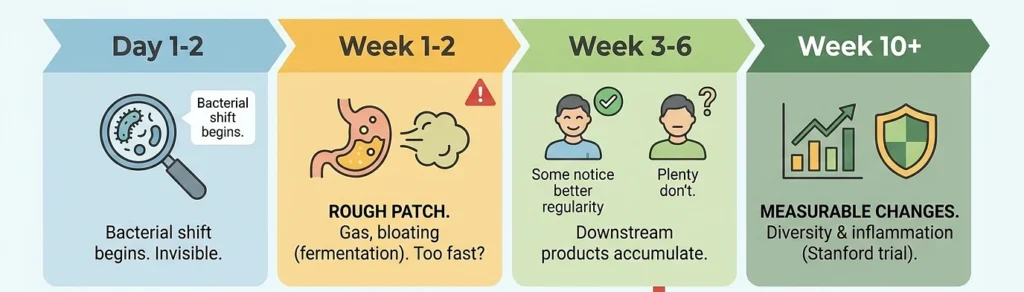
- Day 1 to 2. Bacterial composition begins shifting. You won’t feel it. Nothing in your day signals that anything is happening.
- Week 1 to 2. If you’ve pushed fibre hard, this is the rough patch. Gas, bloating, changed stool frequency. That’s fermentation activity, not evidence the change is wrong, though it does suggest you moved too fast.
- Week 3 to 6. Downstream products accumulate. Some people notice better regularity and comfort here. Plenty don’t.
- Week 10 and beyond. Where the Stanford trial found measurable diversity and inflammation changes. Also well past the point where most people have already given up.
The failure pattern falls out of that timeline on its own. Someone makes a change, feels worse in week one from fermentation, feels nothing in week three, and concludes it isn't working. They stop roughly seven weeks before the evidence says anything would have appeared.What Belongs On The Plate
Fermented foods, three to six servings daily. The intervention with the strongest recent evidence for both diversity and inflammation, and dose mattered in the trial. Yogurt with live cultures, kefir, kimchi, sauerkraut, fermented cottage cheese, kombucha, vegetable brine.
One catch worth knowing: live cultures are the point. Pasteurised sauerkraut off a supermarket shelf has been heat-treated and the organisms in it are dead.
Fibre, built up slowly. Vegetables, legumes, whole grains, nuts, seeds, fruit. The long-term health evidence is strong even where the diversity evidence isn’t. Add over weeks, especially if your current intake is low.
Variety ahead of quantity. Different fibres feed different organisms. Thirty plant foods across a week does more than the same three vegetables every day.
Consistency ahead of intensity. Your bacteria respond to what you eat regularly, not to what you ate impressively once.
What Nobody Selling A Gut Product Will Tell You
The 24-hour headline is true, and it gets used to sell things that don’t work.
If gut bacteria respond to diet within a day, any product claiming rapid gut change is making a technically defensible claim while being useless. The speed comes from food. It came from food in every study here. David’s trial used meat and vegetables. Stanford’s used yogurt and kimchi. No supplement produced either result.
What the research actually supports is cheap and unglamorous: eat fermented foods most days, eat more plants than you currently do, keep going for longer than feels reasonable, and stop checking for results in week two.
The bacteria are already responding. You just can't feel them yet.