

Key Takeaways
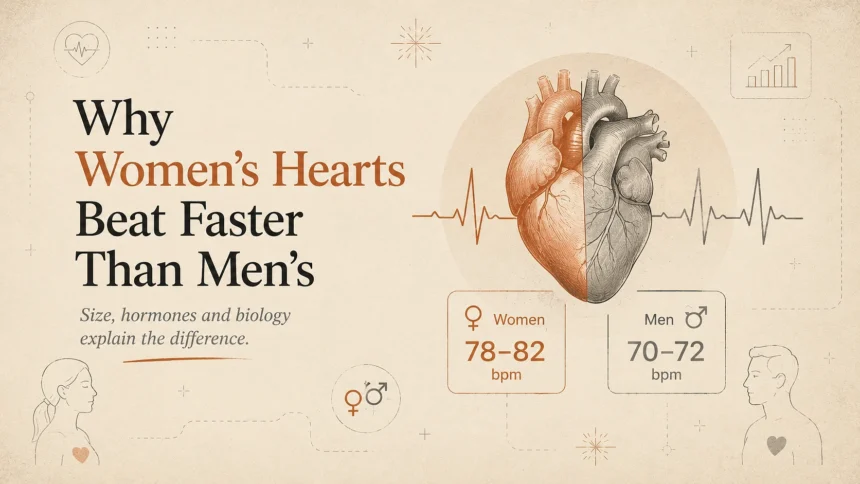
- Women’s resting heart rates run about 8 to 10 bpm higher than men’s, averaging 78 to 82 bpm against 70 to 72.
- The female heart is roughly one-fourth smaller with stroke volume about 23% lower, so it beats more often to move comparable blood volume.
- Size isn’t the whole mechanism. Different autonomic regulation of the sinoatrial node contributes separately, with sex hormones shaping both the structure and the autonomic input.
- Men and women raise cardiac output by different routes during exercise. Men increase ejection fraction. Women increase end-diastolic volume by around 30%. This affects how stress tests should be read.
- 220 minus age overestimates maximum heart rate in women. The Gulati formula, 206 − (0.88 × age), came from 5,437 women aged 35 and older and gives a lower, more accurate number, though independent validation has found it can underestimate measured max in some groups.
- At age 50 the difference is 8 bpm, which moves every training zone calculated from it.
- The smaller female heart is more efficient per unit of tissue but handles volume loading worse, part of why heart failure with preserved ejection fraction skews female.
- A resting rate over 100, a change in your own baseline, or a fast pulse with symptoms needs medical attention whatever the population average says.
A woman’s heart is roughly a quarter smaller than a man’s, and a smaller left ventricle pushes out less blood with each squeeze. Moving the same amount of blood around the body means beating more often. That shows up as a resting pulse of about 78 to 82 beats per minute in adult women, against 70 to 72 in adult men.
Most people never think about it. The ones who do usually arrive at it sideways. A fitness tracker flags a number their partner would find alarming. A gym chart says they’re at 90% capacity while they’re chatting through a jog. A nurse mentions their pulse is “a little quick” at a checkup and they spend the drive home turning that over.
Start With the Plumbing
The Frontiers in Cardiovascular Medicine review puts the female heart at about one-fourth smaller than the male heart on average. That holds after adjusting for body size. Women have smaller ventricular chambers and narrower, shorter arteries than men of the same age and race.
The American Heart Association’s Circulation review says the same from the clinical side: healthy women and men have distinctly different left ventricular dimensions and function even after indexing for body size, with women having smaller chambers and correspondingly lower stroke volumes.
The arithmetic follows on its own. Cardiac output equals stroke volume multiplied by heart rate. Drop the volume per beat by a quarter and the beats have to rise to make up the difference. The faster resting rate closes most of the gap without quite closing all of it. Total output in women lands near 5.6 litres per minute against roughly 6.7 in men.
A faster resting pulse in a woman is not a fitness problem. It’s what a smaller pump has to do.
Size Is Only Part of the Answer
A 2024 review in the Journal of Clinical Investigation attributes women’s higher resting heart rates to distinct autonomic nervous system regulation of the sinoatrial node. The sinoatrial node is the heart’s pacemaker, the patch of tissue that sets the tempo. It gets different autonomic input in women than in men. That’s a mechanism running alongside chamber size, not downstream of it.
Hormones shape both. Testosterone drives faster growth and greater muscle mass in the male heart during adolescence, producing the larger size and thicker ventricular walls seen in adult men. Estrogen has modulating and cardioprotective effects, with estrogen receptors influencing cardiac cells and vascular function.
So there are three layers stacked here: structural, autonomic, and hormonal. Anyone who tells you it comes down to heart size alone is giving you the simplified version.
The Bit That Happens When You Start Moving
Exercise demands more blood flow. A heart has two ways to supply it. Squeeze harder, ejecting a bigger share of what’s in the chamber. Or fill more, taking in extra volume to push out. Men and women pick different options.
A study in Circulation measured it directly. In men, ejection fraction rose from 0.62 at rest to 0.77 during exercise. In women it barely shifted, sitting around 0.63. What moved instead was end-diastolic volume, climbing 30% in women while staying flat in men.
Worth sitting with, because it’s the crux of the whole thing. Men raise output by contracting harder. Women raise output by filling fuller. The endpoint is comparable, since relative increases in stroke volume came out the same for both groups. The route is not.
The Formula on Your Treadmill Was Built From Male Data
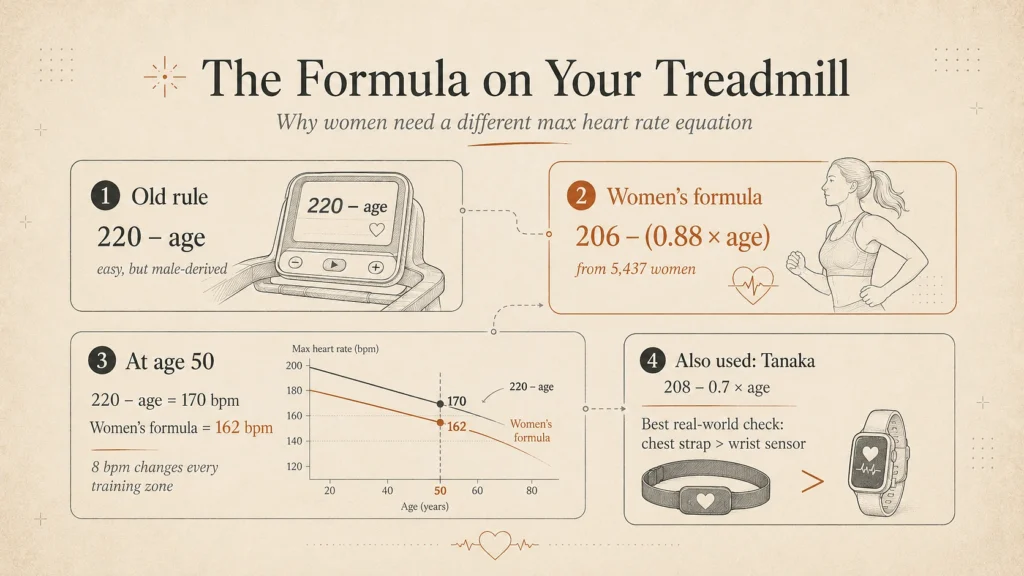
220 minus your age. Printed on gym equipment, coded into apps, quoted by trainers who never asked where it came from.
Where it came from is the problem. It was never derived from a real study. Researchers cited eleven small unpublished studies and produced a rule of thumb. It stuck because it was easy to remember, not because it was accurate.
The data behind it also came almost entirely from men. Cardiologist Martha Gulati went after this with the St. James Women Take Heart Project, studying 5,437 healthy women aged 35 and older. She found the old formula overestimates peak heart rate in women, and that women’s maximum heart rate follows a different age curve than the male-derived research assumes, with a lower starting point and a gentler decline.
The corrected version:
Women's estimated maximum heart rate = 206 − (0.88 × age)The gap isn’t small. At 50, the traditional formula gives 170 bpm to everybody. The women’s formula gives 162.
Eight beats changes every zone built on top of it. Gulati described the practical fallout directly: before this, many women couldn’t reach their target heart rate, and with the corrected formula they actually meet their age-defined rate. Women were being given targets they physiologically could not hit, then treated as though the effort was the issue.
Her summary of the problem is the line worth keeping. Women health are not small men. Exercise capacity differs, and different physiologic responses occur.
The clinical stakes run past gym zones. Gulati noted that with the right formula, physicians can more accurately judge whether a woman’s exercise response is normal or abnormal, and an abnormal response marks a higher risk of death.
Caveats, Because This Isn’t Settled Either
The Gulati equation has its own problems. Independent validation work has found it can underestimate measured maximum heart rate in some female populations, and every age-based formula carries individual variation of roughly 7 to 12 bpm. The Tanaka formula (208 − 0.7 × age) holds up well across mixed populations and is often the better general-purpose pick.
Anyone training seriously should get a measured max from a chest-strap field test instead. Wrist sensors fall apart at high intensity, and a reading of 230 bpm is almost always your stride frequency fooling the optical sensor.
The Trade Nobody Talks About
Women show a higher left ventricular ejection fraction, with some studies putting the baseline 2 to 3% above men’s. End-systolic elastance, a marker of contractile force, also runs higher. Per unit of tissue, the smaller heart is mechanically more efficient.
That efficiency comes with a cost, and it’s specific. Smaller, stiffer ventricles cope badly with volume loading. During rapid saline loading, older women show a greater rise in pulmonary capillary wedge pressure than men, alongside a larger increase in right atrial pressure, pointing to impaired diastolic filling and increased pericardial restraint. Part of why heart failure with preserved ejection fraction skews so heavily female sits right here.
The same architecture producing the quicker pulse and better ejection fraction also produces a chamber with less room to absorb extra volume. A trade, not a defect.
When the Number Is Worth a Doctor’s Attention
None of this makes every elevated pulse in a woman normal physiology. The baseline difference runs 8 to 10 bpm. It explains nothing outside that range.
Take these to a doctor:
- A resting rate consistently over 100 bpm. That’s tachycardia by definition, sex regardless.
- A shift in your own baseline. Your resting rate climbing 15 bpm over a few weeks carries more information than sitting at 80 permanently.
- A fast pulse with symptoms attached. Breathlessness at low effort, chest discomfort, dizziness, fainting, or palpitations that feel irregular rather than merely quick.
- Sluggish recovery after exercise. How fast the rate drops in the first minute after stopping is a stronger signal than the resting figure.
- Any change during pregnancy, thyroid problems, anaemia, or after a new medication.
The thing most often skipped: thyroid dysfunction and iron deficiency both push resting heart rate up, and both hit women far more often than men. A pulse that's newly fast deserves bloodwork before anyone writes it off as normal female physiology.What to Do With Any of This
If you’re a woman looking at a resting rate in the high 70s and measuring it against a man’s low 70s, you’re comparing two different machines and expecting one reading.
Three things that actually change:
- Recalculate your zones. Use 206 − (0.88 × age), or Tanaka, rather than 220 minus age. If your app only supports the standard formula, its zones sit too high for you.
- Track yourself against yourself. Population averages tell you close to nothing about your own cardiovascular health. The trend in your resting rate across months is where the signal lives.
- Ask how your stress test was read. Given that women raise output by filling rather than squeezing, and that the old targets were unreachable for many women, that’s a reasonable question for a cardiologist.