

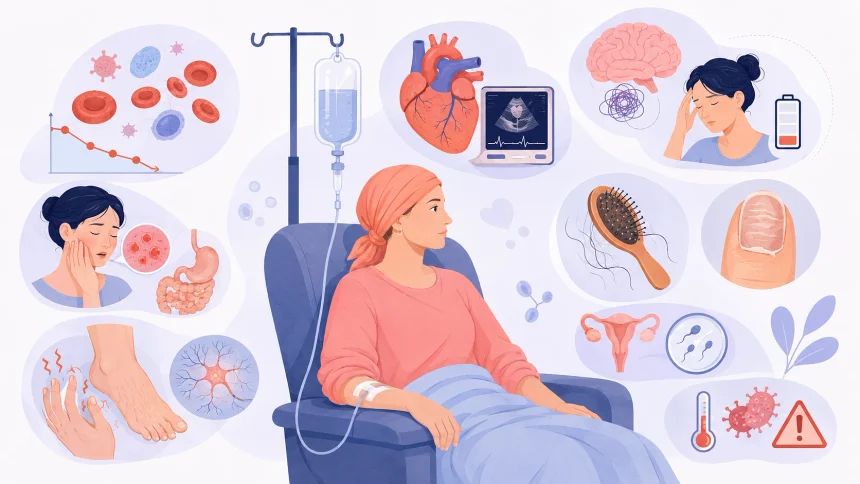
Ask ten people what chemotherapy does to you and nine will describe the infusion day. The chair, the drip, the nurse checking the line. Almost none will mention day ten, which is the one that sends people to hospital.
Cytotoxic chemotherapy attacks cells that divide quickly. Tumor cells divide quickly. So does the lining of your mouth, the lining of your gut, your hair follicles, and the marrow inside your bones that manufactures blood around the clock. The drug cannot tell them apart. Every effect below follows from that one problem.
Immunotherapy and targeted therapies get called chemo in casual conversation and behave nothing like it. If your treatment is a checkpoint inhibitor or a monoclonal antibody, much of what follows will not apply to you, and comparing side effects with someone on a different drug class tends to produce more confusion than comfort.
Your Blood Count Bottoms Out Around Day Ten
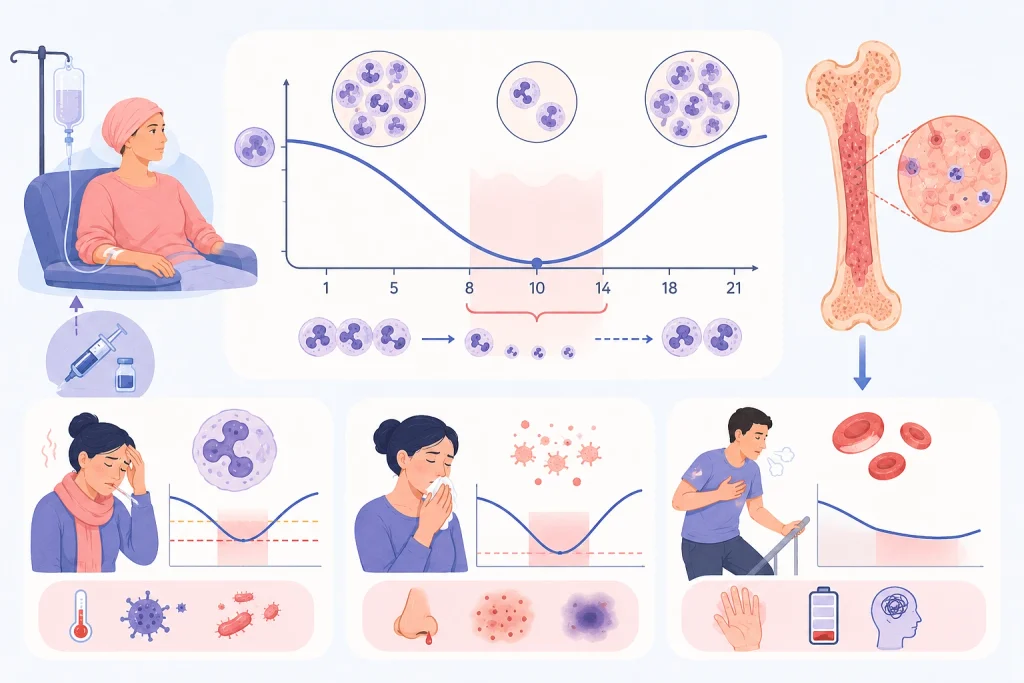
Neutrophils are the white cells that handle bacterial infection. They survive roughly six to eight hours in circulation, so the moment marrow production slows, the supply runs down fast.
After an infusion the absolute neutrophil count follows a predictable curve. It falls to a low point called the nadir, sits there, then climbs as the marrow recovers. Across common regimens the nadir arrives somewhere between day 8 and day 14, most often near day ten, with recovery over the following week to ten days. Then the next cycle starts and the whole curve repeats.
- Below 1,000 neutrophils per μL is grade 3.
- Below 500 per μL is grade 4, where infection risk climbs steeply.
Now the part that changes behavior. Neutropenia removes your body’s ability to mount an inflammatory response, so infection stops producing the signs you would normally look for. No redness. No swelling. No pus at the site.
Fever is often the only symptom you get. A temperature of 38°C or 100.4°F during the nadir window is febrile neutropenia, and it is treated as an oncologic emergency, not as something to sleep off and mention at the next appointment.
Growth factor injections such as filgrastim and pegfilgrastim push the marrow to produce neutrophils faster, and guidelines generally recommend them when a regimen carries a predicted febrile neutropenia risk above 20%.
Platelets Follow A Few Days Behind
Platelet counts reach their low point around day 10 to 14. Below roughly 50 × 10⁹/L, bleeding and bruising risk rises. Nosebleeds that will not stop, blood in urine or stool, bruises appearing without a cause.
Anemia Builds Slowly Instead
Red cells live around 120 days, so this one creeps. The breathlessness on the stairs that shows up in cycle four and was absent in cycle one is usually falling hemoglobin rather than being out of shape.
Key Points To Hold Onto
- Infection risk peaks 8 to 14 days after infusion, not on treatment day.
- Fever during that window is an emergency, because it may be the only sign of infection you get.
- Nerve damage is the most common lasting effect, at roughly 68% after one month and 30% at six months or more.
- Heart damage tracks cumulative dose and shows up early, usually within the first year.
- Reaction time slows measurably right after an infusion, which matters if you drive yourself home.
- Most effects reverse. Nerve damage, heart muscle injury and fertility are the ones that may not.
The Mouth And Gut Take It Early
Mucositis means inflammation and ulceration of that lining. In the mouth it turns eating into a chore and creates an infection route at exactly the point in the cycle when white counts are lowest. Lower down the same damage produces cramping, diarrhea and poor absorption of whatever the patient managed to swallow.
Nausea is handled far better than it was two decades ago, largely because anti-emetics are now given before treatment rather than in response to symptoms.Taste changes are the underrated one. Metallic taste, food registering as cardboard, water becoming unpleasant enough that patients stop drinking enough of it. Clinicians tend to treat this as minor and patients almost never do. It usually settles within weeks to months of the last cycle.
Nerve Damage Is The Effect Most Likely To Stay
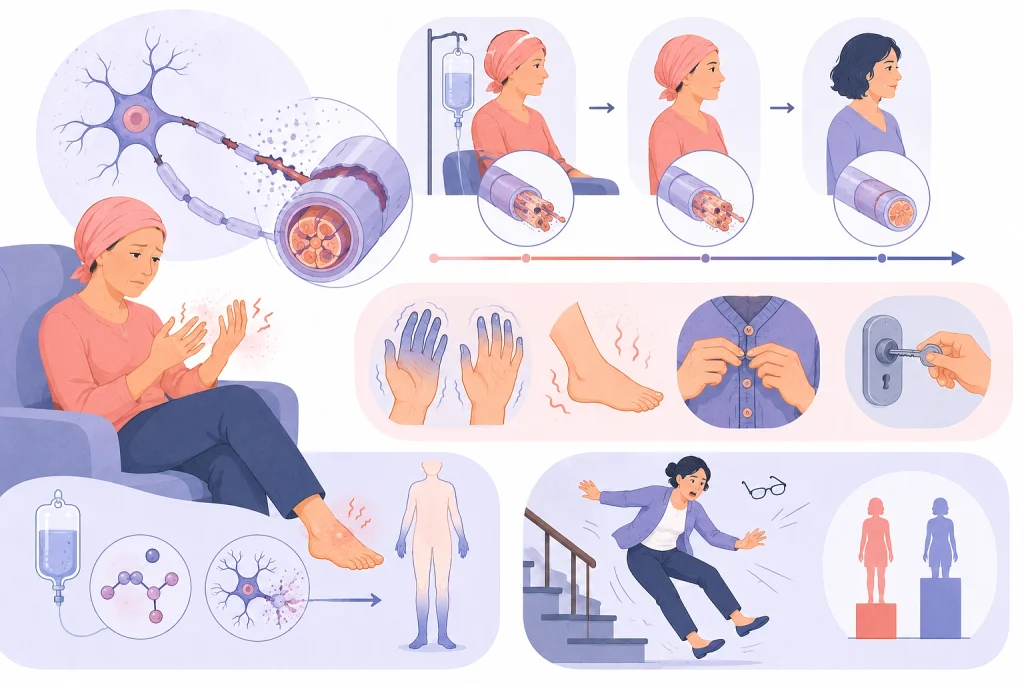
Chemotherapy-induced peripheral neuropathy, or CIPN, damages the sensory nerves in the hands and feet. A meta-analysis pooling 31 studies and 4,179 patients put prevalence at 68.1% in the first month, 60.0% at three months, and 30.0% at six months or beyond.
Symptoms arrive symmetrically and start at the extremities, in what clinicians call a glove-and-stocking pattern. Numbness, pins and needles, burning, and loss of fine sensitivity. Buttons become difficult. Keys become difficult. Platinum drugs and taxanes carry the highest risk, and severity tracks cumulative dose rather than any one infusion.
It Can Get Worse After You Finish
Chemotherapy drug can remain in the nerve axon and continue causing damage after the last cycle. Oncologists call this coasting, and it means neuropathy sometimes appears or worsens months into recovery.
Patients who have not been warned about coasting reasonably assume something new has gone wrong, which is a preventable form of fear.
The functional cost is real too. Breast cancer survivors reporting CIPN symptoms were found to be 1.8 times more likely to have had a recent fall than women without them.Heart Damage Depends On Total Dose, Not Any One Cycle
Anthracyclines, meaning doxorubicin and its relatives, carry the clearest cardiac risk in the whole drug class.
A prospective study following 2,625 patients on anthracycline therapy recorded cardiotoxicity in 9% of them. Median time from the end of chemotherapy to the problem appearing was 3.5 months, and 98% of cases turned up within the first year.
Cardiac event rates rise with cumulative exposure, running around 7% at 150 mg/m² of doxorubicin and roughly 18% at 350 mg/m², with the threshold between low and high risk generally drawn at 250 to 300 mg/m². Your oncologist tracks this number across your entire treatment history, including anything you had years ago.
Two things soften the picture. Dexrazoxane is approved specifically to reduce this risk and is usually considered as cumulative dose nears 300 mg/m². And left ventricular function recovers in up to 82% of cases when heart failure treatment begins within two months of detection, which is the whole reason surveillance echocardiograms keep getting scheduled after you feel fine.
Brain, Attention And Energy
Do Not Drive Yourself Home
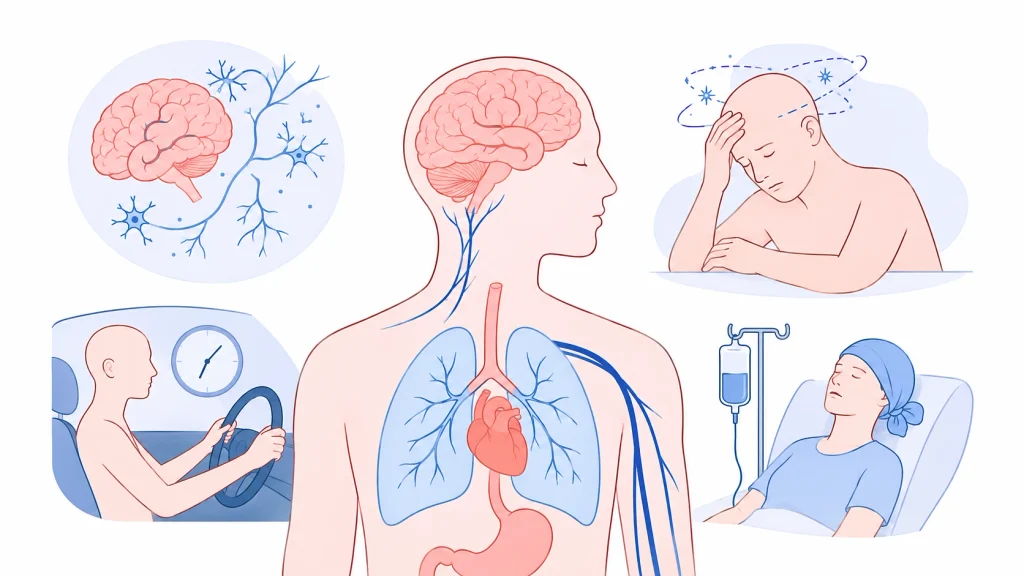
A prospective study measured reaction time before and after infusion and found that psychomotor vigilance slowed by more than 20 milliseconds in 40% of patients. The authors compared that degree of impairment to alcohol effects reported in other research.
Chemo Brain Is Real, And The Cause Is Messier Than The Name
Cancer-related cognitive impairment, known everywhere as chemo brain, affects attention, working memory and processing speed. Estimates run to 75% of patients during treatment, with about 35% still reporting problems months or years later.
The complication is that roughly 20% of cancer patients show measurable cognitive dysfunction before chemotherapy begins. The disease itself contributes. So do surgery, anesthesia, poor sleep and the sustained anxiety of a cancer diagnosis. Pinning all of it on the drugs makes a cleaner story than the evidence supports, and I would not pretend the research has fully untangled which factor does what.
Fatigue Is Not Tiredness
Cancer-related fatigue does not respond to sleep the way ordinary exhaustion does. Up to 60% of patients report it during treatment, and somewhere between 19 and 38% of survivors still have it after treatment ends.
Hair, Skin And Nails
Hair usually starts coming out two to three weeks after the first cycle. Regrowth generally begins within a few months of finishing, often with a different texture or color at first. Scalp cooling reduces loss with some regimens and not others.
Skin gets dry and burns more easily in sun. Nails develop ridges and discoloration, and can lift from the bed months later, which reflects damage done to the nail matrix weeks earlier rather than anything new happening.Fertility Has A Deadline Attached
Effects on fertility depend on drug class, dose and age at treatment, with alkylating agents carrying the highest risk of permanent damage to ovarian reserve and sperm production.
Preservation options narrow sharply once the first cycle is given. Anyone of reproductive age should raise this at the treatment planning appointment rather than waiting to be asked, because plenty of people are never asked.
Symptoms That Mean Call Today
- Temperature of 38°C or 100.4°F or above, at any point in the cycle.
- Shaking chills, with or without a measured fever.
- Bleeding that will not stop, or widespread bruising with no cause.
- Vomiting or diarrhea severe enough that fluids will not stay down.
- Sudden breathlessness, chest pain or swollen ankles.
- New numbness or weakness affecting your grip or your walking.