

Sometime in late 2020, a supplement aisle near me sold out of vitamin D3 twice in one month. The pharmacist said people were walking in with printouts, articles promising that a sunshine vitamin could keep them out of the hospital. That hope wasn’t stupid. It had a real basis in the science of the day. It also turned out to be mostly wrong, and the space between what people believed and what the research actually showed is one of the more useful stories to come out of the pandemic.
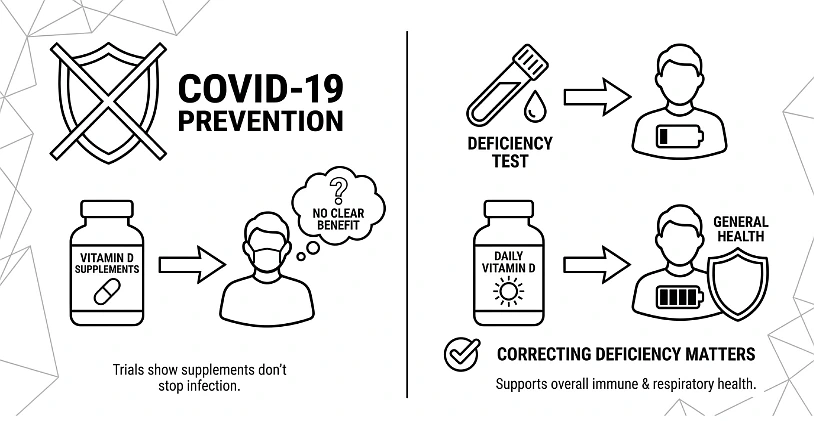
So here’s the plain version before I explain why it’s more interesting than it sounds. Taking vitamin D supplements does not seem to stop you catching COVID-19, and it doesn’t reliably change how sick you get once you have it. Being genuinely deficient, though, the kind that shows up on a blood test, still lines up with worse outcomes. Those two facts feel like they cancel each other out. They don’t, and the reason they don’t is the whole point of reading further.
The Evidence That Got Everyone Excited
The early case for vitamin D leaned heavily on observational studies, and there were plenty of them. Researchers measured 25-hydroxyvitamin D, the standard blood marker, then looked at who caught the virus, who ended up in intensive care, and who died. The same pattern kept surfacing. People with lower vitamin D tended to do worse, showing up more often in the severe and fatal columns.
There was also a believable biological story behind it. Vitamin D does far more than look after your bones. It sends signals to both the innate and adaptive immune systems, helps the body make antimicrobial proteins, and calms inflammation. It even touches the ACE2 receptor, the same doorway SARS-CoV-2 uses to slip into cells. Give people a plausible mechanism and a consistent statistical link, and the pull to call it cause and effect becomes almost irresistible.
Why The Association Was A Trap
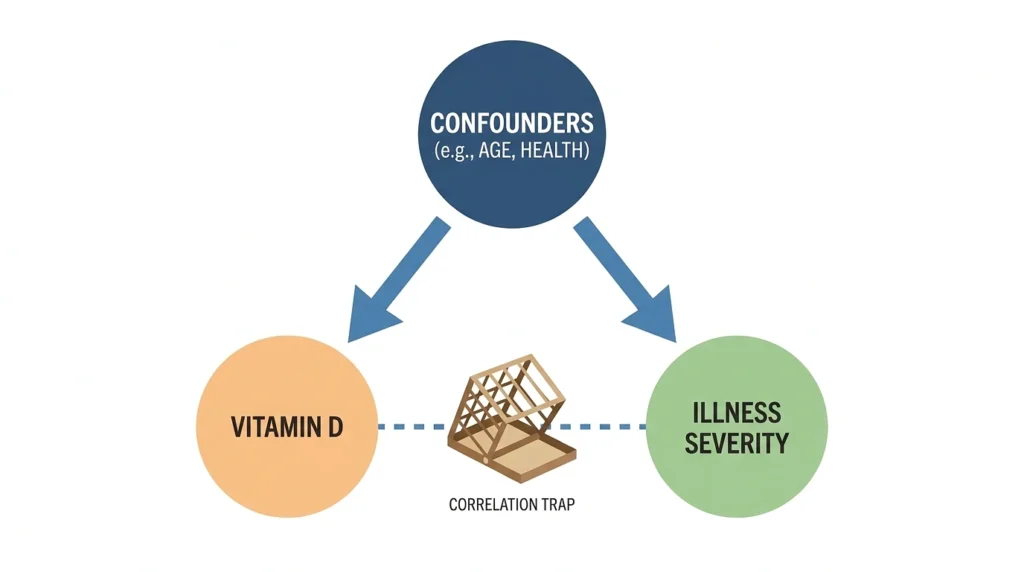
Observational studies carry a stubborn weakness called confounding, and vitamin D might be the textbook example. Think for a second about who usually has low vitamin D:
- Older adults.
- People carrying extra weight.
- Those with diabetes or kidney disease.
- People with darker skin, who make less of it from limited sun.
- Anyone already unwell and stuck indoors most of the day.
Read that list again with COVID in mind. Every one of those groups already faced worse outcomes for reasons that have nothing to do with a vitamin. So when a study reported that low-vitamin-D patients did badly, it couldn’t cleanly separate the vitamin from everything else. Low vitamin D may have been nothing more than a flag for being older, heavier, sicker, or frailer to start with.
There’s a sneakier possibility too, and it runs in the opposite direction. Acute illness and the inflammation that comes with it can actually push measured vitamin D down. In some patients, the severe infection may have caused the low reading rather than the low reading causing the severe infection. The arrow could easily point the other way.
None of this is hand-waving. When researchers turned to Mendelian randomization, which uses genetic variants to estimate a person’s lifelong vitamin D level and mostly dodges those confounders, the findings came back empty. Genetically predicted vitamin D showed no clear effect on catching COVID-19, on how severe it got, or on hospitalization. The genetics quietly knocked the legs out from under the observational story.
What Happened When They Actually Tested It
The honest test of any treatment is the randomized controlled trial. Take a group of people, randomly hand some of them vitamin D and the rest a placebo, then watch what happens. Randomizing shuffles all those confounders, the age and the weight and the pre-existing conditions, so that on average the only real difference between the two groups is the supplement itself.
One Trial After Another Came Back Flat:
- A single 100,000 IU bolus of cholecalciferol given at hospital admission did nothing for outcomes.
- High-dose versus standard-dose comparisons in older adults produced no meaningful edge.
- A trial in severely ill ICU patients found no real difference in days on respiratory support, or in any secondary outcome, between the vitamin D group and the control group.
When the trials were pooled into meta-analyses, the picture stayed the same. Vitamin D supplementation didn’t significantly cut ICU admission on its own, and reviewers kept landing on the same conclusion: the current evidence isn’t enough to recommend vitamin D for preventing or treating COVID-19. A few analyses picked up faint hints of benefit, the kind that keep scientists curious, but nothing solid enough to call reliable or clinically meaningful.
Prevention told the same story from another angle. In the D-Health trial, more than 20,000 Australian adults took monthly high doses of vitamin D, and it didn’t lower the risk or severity of acute respiratory infections overall. There was a measurable dip in how long symptoms lasted, but it worked out to roughly half a day, which is nobody’s idea of protection worth clearing a pharmacy shelf for.
So Why Does Deficiency Still Matter?
Here’s the part that usually gets flattened in the coverage. “Supplements don’t help” and “deficiency is harmless” are two different claims, and only the first one holds up.
Baseline Is Where The Real Signal Lives
The most telling detail sits at the starting line. In a large meta-analysis of respiratory infection trials, the protective effect of vitamin D was strongest in people who began genuinely deficient, with blood levels below roughly 25 nmol/L. The ones who benefited weren’t the already-adequate crowd topping up a full tank. They were the people running on empty.
How You Take It Changes What You Get
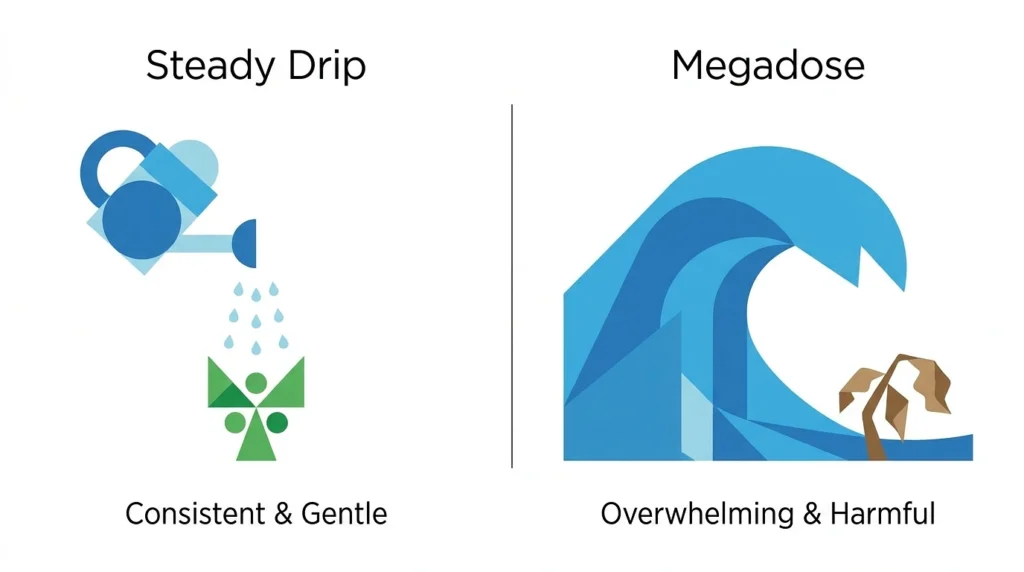
Dosing pattern turns out to matter as much as deficiency. Daily or weekly modest doses helped against respiratory infections in that same analysis. Large one-off bolus doses didn’t. There’s a biochemical reason for the split: a single massive dose can switch on an enzyme called 24-hydroxylase that shunts vitamin D toward breakdown products, so a steady drip may deliver more usable vitamin than an occasional flood.
Stitch those two threads together and the picture stops looking contradictory. Fixing a real deficiency with sensible daily dosing is a reasonable thing to do for your general respiratory health and overall wellbeing. Megadosing someone who’s already sufficient in the hope of a COVID-specific shield is not something the trials back up. Supplements failing to prevent COVID-19 doesn’t make your vitamin D status irrelevant. It means the vitamin was never a magic lever, and being deficient is still worth correcting on its own terms.
What To Actually Do With This
If your vitamin D is on your mind, the honest advice is unglamorous. Ask your doctor for a 25-hydroxyvitamin D test instead of guessing. Come back deficient, and a modest daily supplement is cheap, safe within normal ranges, and worthwhile for reasons that reach well past any single virus. Come back fine, and piling on high doses probably buys you nothing extra, while very high doses carry risks of their own.
What the evidence won’t support is treating vitamin D as a stand-in for the things that genuinely move the needle against COVID-19, or skipping a doctor’s visit because a supplement felt like insurance. The sunshine vitamin turned out to be a decent thing to keep topped up and a poor thing to build a defense around. Dull as that distinction sounds, it’s the one the trials paid for in full.