

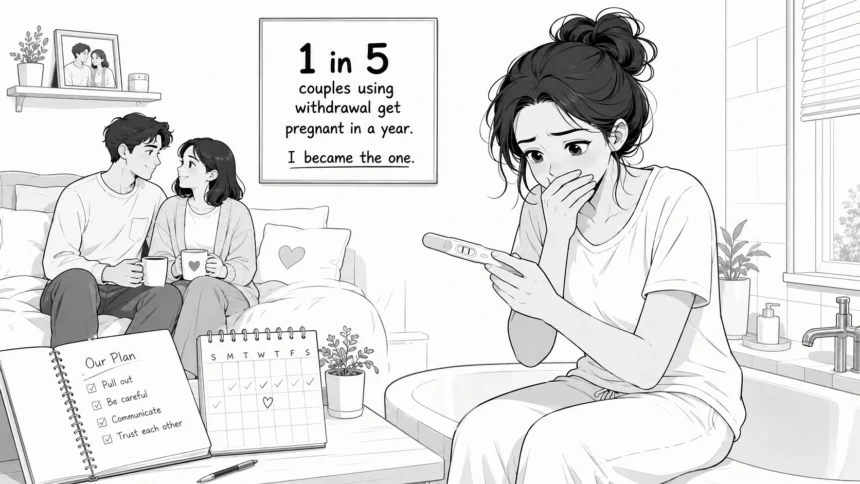
I want to start with the number, because the number is the whole reason I’m writing this. Roughly one in five couples who rely on the pull-out method for a year will end up pregnant, a figure the US Office on Women’s Health puts at around 22%. For four years I read that statistic as something that happened to other people. Careless people. People who weren’t as careful as my partner and I were. Then I sat on the edge of my bathtub at 6am holding a test with two lines on it, and I understood that the statistic was never describing careless people. It was describing me.
Key Takeaways
- The typical-use failure rate for withdrawal sits around 20 to 22%. That’s the one-in-five figure, and it reflects real couples over a real year, not people being reckless.
- Perfect use and typical use are wildly different numbers. Under flawless conditions the failure rate drops to about 4%, but almost nobody keeps conditions flawless every single time for years.
- Timing is not something you can feel your way through. The riskiest days are the five leading up to ovulation, and you often can’t tell when those are without tracking.
- Pre-ejaculate can carry sperm, which means pregnancy stays possible even when withdrawal happens exactly as planned.
- Being careful is not the same as being protected. My partner and I were meticulous. The method still failed, because the method itself has a ceiling.
What Careful Actually Looked Like For Us
I need you to understand that we were not sloppy. We had a system. My partner would pull out well before he thought he was close, every single time, without fail. We talked about it openly, which the internet will tell you is exactly what separates the couples who make withdrawal work from the ones who don’t. We were the communicating, trusting, coordinated couple that the how-to articles describe.
For a while, that felt like enough. One empty month followed another, and each one quietly hardened the belief that we had cracked it. We hadn’t cracked anything. We had simply been landing on the lucky side of a coin that was always going to turn over eventually, given enough flips.
That is the real trap with this method. Every month it works, it teaches you that it works. The absence of a pregnancy feels like proof of skill, when it’s only proof that this particular month, the odds happened to break your way.
The Month It Stopped Working
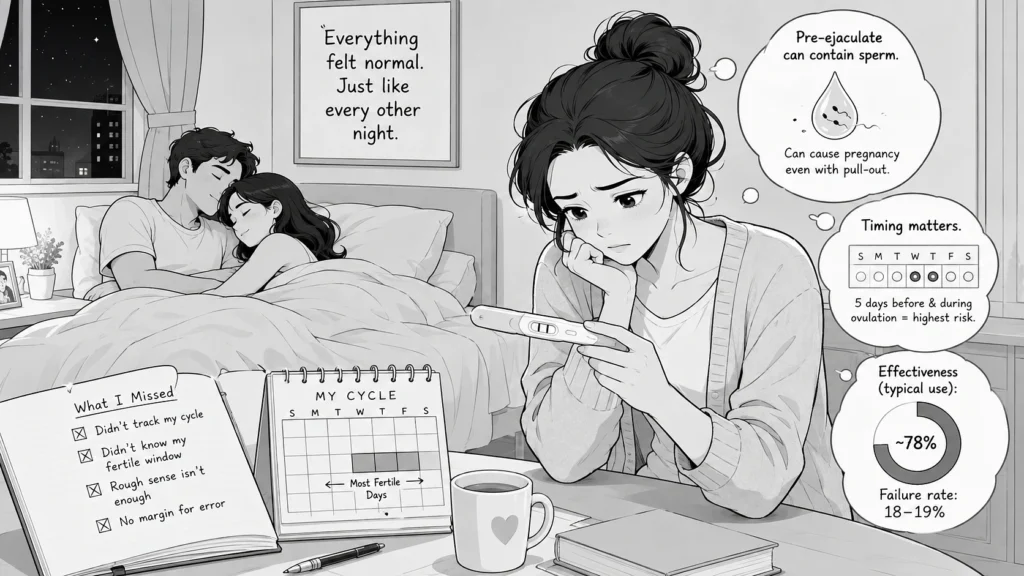
I can’t point to the exact moment it failed. That’s part of what rattled me afterward. There was no obvious slip, no panicked pause in the middle of things. As far as either of us could tell, it was a completely normal night that went the way every other night had gone.
What I didn’t grasp back then was how little margin the method actually leaves you. The American Pregnancy Association puts the failure rate at 18 to 19%, and one reason is something most people never factor in pre-ejaculate can contain sperm. As Scientific American reports, experts generally assume pre-ejaculate usually carries at least some sperm, which is enough for contraception to fail. So even a textbook pull-out isn’t a guarantee, because something can already be in motion before the moment you’re counting on.
Timing was the other thing I got wrong. I wasn’t tracking my cycle. I figured I had a rough sense of my own body, and I did, but a rough sense is useless here. Planned Parenthood puts the overall effectiveness at about 78%, with the odds of pregnancy climbing during the five days before and during ovulation. To this day I have no idea where in my cycle that night fell, because I never gave myself the information to know.
Why The Perfect-Use Number Fooled Me

Here’s the statistic that genuinely misled me for years. Look up the pull-out method and you’ll often see it described as around 96% effective. That sounds excellent. It sounds nearly as good as a condom.
What that number doesn’t say out loud, and what I wish it had, is that 96% effective describes perfect use only. Planned Parenthood estimates about 4 out of 100 people will get pregnant using withdrawal flawlessly. And there’s the word that undoes everything: flawlessly. Flawless means correct timing and correct execution, every single time, with no lapse in judgment and no biological surprise, across every encounter for a year.
Nobody lives flawlessly. Real life includes tiredness, a drink or two, getting swept up in the moment, misjudging by a second. Fold all of that back in and the 4% swells into the roughly 20% that actually happens to actual couples. I had been quoting myself the perfect-use number while living a typical-use life.
The Gap Nobody Explained To Me
The distance between 4% and 20% is the single most important thing I failed to understand. It’s the difference between the method as a physics problem and the method as a thing done by tired, distracted, ordinary humans. I planned my contraception around the physics and lived my life as a human. That gap is where my pregnancy came from.
What I Would Tell My Past Self

I’m not writing this to tell anyone that withdrawal is worthless. It really is better than using nothing, and for some couples in some seasons of life it’s a reasonable choice made with clear eyes. What I resent, looking back, is that I made the choice without clear eyes. I made it believing I was one of the safe ones.
So if you’re relying on this method right now, here are the things I wish someone had said to me plainly:
- Know your real number. You’re working with roughly one-in-five odds over a year of typical use, not the reassuring 96%.
- Track your cycle if this is your method, because the fertile window is where the risk concentrates and you cannot feel it arriving.
- Keep emergency contraception on hand. Planned Parenthood recommends it as a backup precisely because withdrawal leaves room for error, and it can prevent pregnancy for up to five days after.
- Consider pairing withdrawal with a condom. Used together, they cover for each other’s weak spots far better than either does alone.
My daughter is fourteen months old now, and I wouldn’t trade her for anything, which is a complicated sentence to write at the close of an article about an unplanned pregnancy. Both things are true at once. I love the outcome and I still wish I’d made the decision that led to her with the real facts in front of me, instead of the comforting version I fed myself for four years.
The number was never talking about someone else. If you’re using this method, it’s talking about you too.