

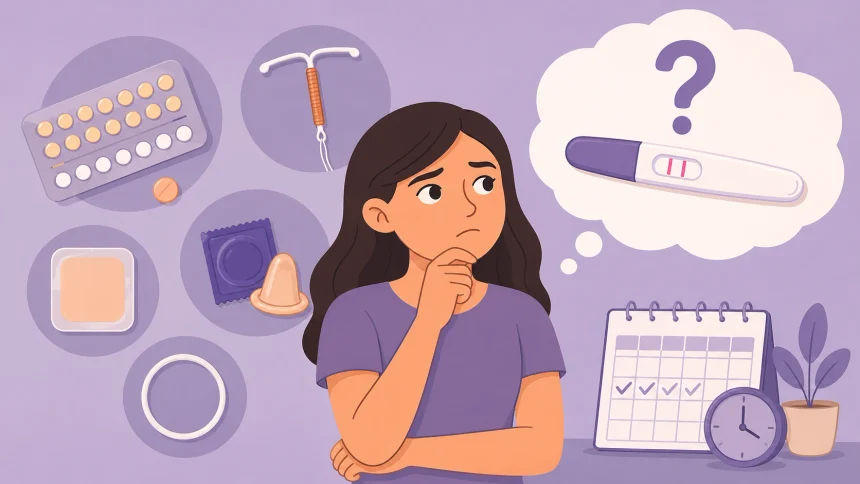
Yes, you can. Every reversible contraceptive method carries a failure rate above zero, and around half of all unintended pregnancies in the United States happen to people who were using something in the month they conceived.
That sounds alarming until you look at who those pregnancies belong to. A Guttmacher Institute analysis of contraceptive use and unintended pregnancy found that the two-thirds of U.S. women at risk who use their method consistently and correctly account for only 5% of unintended pregnancies. The 19% who use a method inconsistently account for 43%. The 16% using nothing for a month or more account for 52%.
The pill is not failing at scale. Missed doses, late restarts and gaps in coverage are doing nearly all of the work.Key Points Before You Read Further
- Typical use and perfect use are two separate statistics. For the pill they sit about ten times apart.
- Implants and IUDs score under 1% in both columns, because there is no daily step to get wrong.
- Most antibiotics do not affect hormonal birth control. Rifampin and rifabutin are the documented exceptions.
- Levonorgestrel emergency contraception weakens as body weight rises, with a sharp drop above roughly 70 kg.
- A copper IUD is the only emergency option whose effectiveness does not change with weight.
- A positive pregnancy test while an IUD is in place needs a same-week clinical assessment, not a wait-and-see.
Typical Use And Perfect Use Are Two Different Statistics
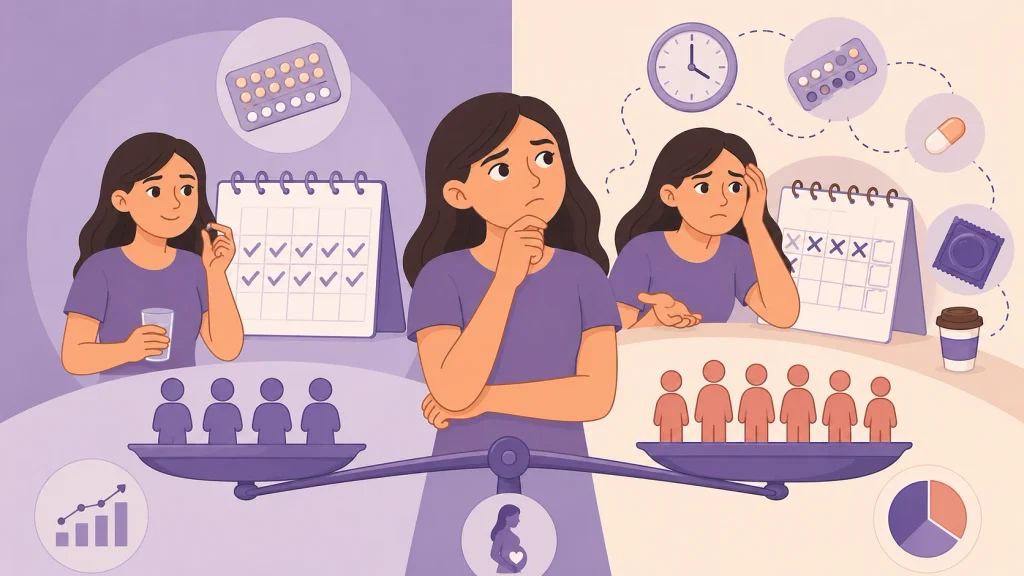
Perfect use measures failure among people who use the method consistently and correctly every single time. Typical use measures failure among everyone who says they use it, including the person who forgot Tuesday and the couple who skipped the condom once. The gap between the two columns is the size of the human factor.
How Failure Rates Are Calculated
A failure rate is the proportion of women health who become pregnant within the first twelve months of starting a method. The older measure behind these figures is the Pearl Index, developed by Raymond Pearl in 1934, which counts contraceptive failures per 100 woman-years of use. Methods that demand daily action tend to carry the higher Pearl numbers.
Where Each Method Lands
Figures below come from Guttmacher’s contraceptive effectiveness fact sheet.
| Method | Typical Use Failure | Perfect Use Failure |
|---|---|---|
| Contraceptive implant | Under 1% | Under 1% |
| IUD, hormonal or copper | Under 1% | Under 1% |
| Injectable, the shot | 4% | Under 1% |
| Pill, patch, vaginal ring | 7% | Under 1% |
| External condom | 13% | 2% |
| Internal condom | 21% | 5% |
| Fertility awareness methods | 2% to 34% | Under 1% to 5% |
| No method at all | 85% | 85% |
The older CDC effectiveness table puts the pill at 9% typical and 0.3% perfect. Both sets of figures still circulate in clinical writing, and the difference between them matters far less than the shape they share.
What Goes Wrong Inside That 7%
Missed Pills And The Placebo Week
The most vulnerable point in a pill cycle is not mid-pack. It is the restart after the hormone-free days. Pushing that restart back by a day or two extends the window in which ovulation can slip through, so a late new pack carries more risk than a forgotten Wednesday.
Common patterns behind an unplanned pregnancy on the pill:
- A dose missed and doubled up the following day.
- A new pack started late after the placebo or break week.
- A prescription that lapsed over a holiday or a move.
- Pills taken at wildly different times each day.
- Switching brands without backup during the changeover.
Does one late pill mean pregnancy? On its own, almost never. Risk is cumulative and clusters around the start of a pack, which is why patient leaflets always ask where in the cycle the miss happened before telling you what to do.
Vomiting, Diarrhea And Absorption
Throwing up within a couple of hours of swallowing a pill can mean the dose never fully absorbed. Significant diarrhea does the same thing further down. A stomach bug during week one of a pack is worth treating as a missed pill rather than bad luck.
Progestin Only Pills Have A Tighter Window
Combined pills generally allow around twelve hours of flexibility. Some progestin-only pills lose reliability after roughly three hours off schedule, which makes them far less forgiving for anyone with an irregular routine. People often switch to the mini-pill for medical reasons without being told the window shrank.
Rifampin Is The One Antibiotic That Changes Anything
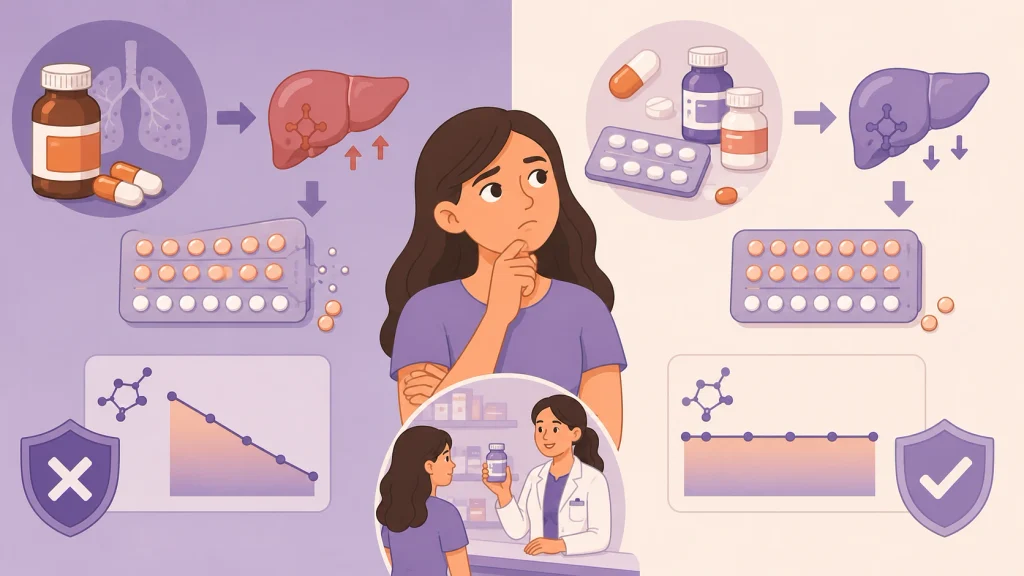
Most antibiotics do not reduce the effectiveness of hormonal contraception. The exception is the rifamycin class, mainly rifampin and to a lesser extent rifabutin, which induce the liver enzymes that break down contraceptive hormones. Rifampin treats tuberculosis and is not a common U.S. prescription.
A 2018 review in the American Journal of Obstetrics and Gynecology examined non-rifamycin antibiotics and concluded that most women can expect no reduction in effectiveness. Pharmacokinetic studies have repeatedly shown that taking amoxicillin, doxycycline, metronidazole, erythromycin or ciprofloxacin alongside oral contraceptives leaves hormone levels unchanged.
Where The Antibiotic Myth Started
A 1971 German report described breakthrough bleeding in women taking antibiotics with the pill. Spotting was read as a possible sign of weakened protection, which was fair caution for the era. Warning labels went on. The labels stayed on long after the evidence moved, and most pharmacists still advise backup out of caution.
- Large trials of this interaction have never run, because deliberately exposing participants to unintended pregnancy is not an ethical study design. The evidence is pharmacokinetic rather than definitive.
- The illness often matters more than the drug. Vomiting and diarrhea from a bad infection interfere with absorption no matter which antibiotic caused it.
Other Drugs Worth Asking A Pharmacist About
Enzyme-inducing medications are a genuine category, and they extend well past antibiotics. Some anticonvulsants and St John’s wort appear on these lists, as do certain HIV medications. Any new prescription is worth a thirty-second question at the counter about whether it touches your contraception.
Implants And IUDs Sit Under 1% In Both Columns
There is nothing to remember. No daily window, no restart date, no pack to collect from a pharmacy. Typical use and perfect use are the same behavior once the device is in place, which is why the two columns collapse into one number.
- Progestogen implants: around 0.05% failure.
- Hormonal IUDs: around 0.2% failure.
- Copper IUDs: under 1%, hormone free.
These are the lowest reversible failure rates available. The tradeoff is procedural rather than statistical, and it is real: an insertion appointment, side effects some people find intolerable, and an adjustment period that can run months. Continuation at one year runs near 84% for implants against 43% for condoms, and a method you abandon protects you from nothing.
Emergency Contraception Loses Power Above 70 Kilograms
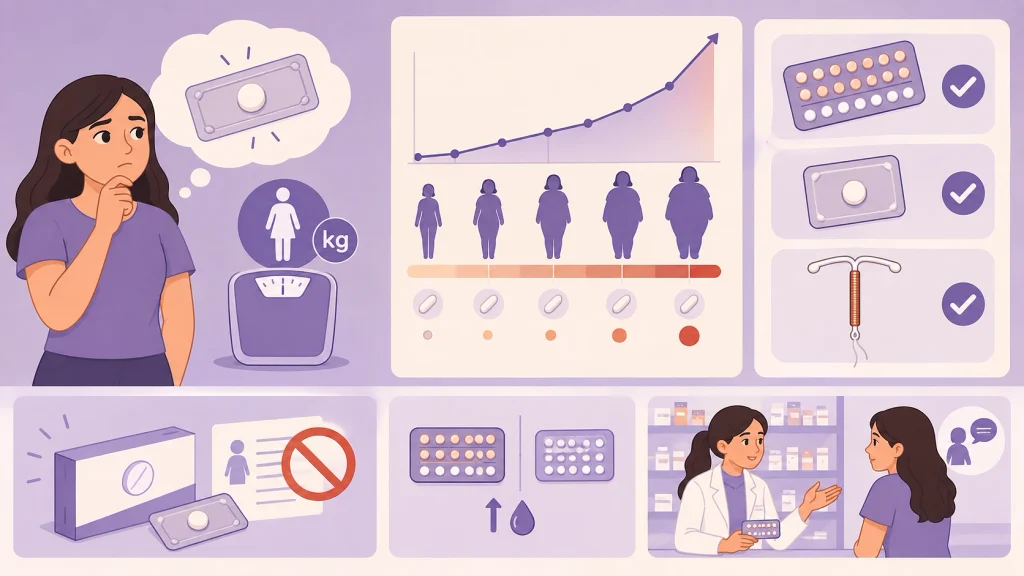
Levonorgestrel emergency contraception, sold over the counter under several brand names, becomes less effective as body weight rises. In a pooled analysis of 1,731 women published in Contraception, the estimated pregnancy rate ran 1.4% among women weighing 65 to 75 kg and 6.4% in the 75 to 85 kg group. Statistical modeling showed a steep climb beginning near 70 to 75 kg. Above roughly 80 kg, researchers have described the pregnancy risk as approaching what you would expect with no contraception at all.
Women with a BMI of 30 or higher had more than four times the pregnancy risk of women in the normal range, and a randomized trial testing whether doubling the dose fixes this found peak drug concentrations coming in around 50% lower to begin with.
What Works Better At Higher Body Weight
- Ulipristal acetate holds up better than levonorgestrel at higher weight and BMI.
- UK clinical guidance suggests considering a 3 mg levonorgestrel dose rather than 1.5 mg, though doubling the dose did not fix pregnancy outcomes in trial conditions even when it corrected blood levels.
- A copper IUD is the most effective emergency option and its performance does not change with weight.
Levonorgestrel packets sold in the U.S. and Europe carry no weight warning on the box. Someone follows the instructions perfectly and has no way of knowing the method may not work for their body. That is a labeling failure, not a user failure.
Signs Of Pregnancy While Using Contraception
Symptoms look the same whether or not you were using a method. Worth a test:
- A missed period, or one noticeably lighter and shorter than usual.
- Breast tenderness or swelling.
- Nausea, often but not only in the morning.
- Unexplained fatigue.
- More frequent urination.
Can you bleed and still be pregnant? Yes. Implantation spotting and breakthrough bleeding both get mistaken for a light period, and on hormonal methods a scant bleed is common anyway. Home tests are most reliable from the first day of a missed period onward.